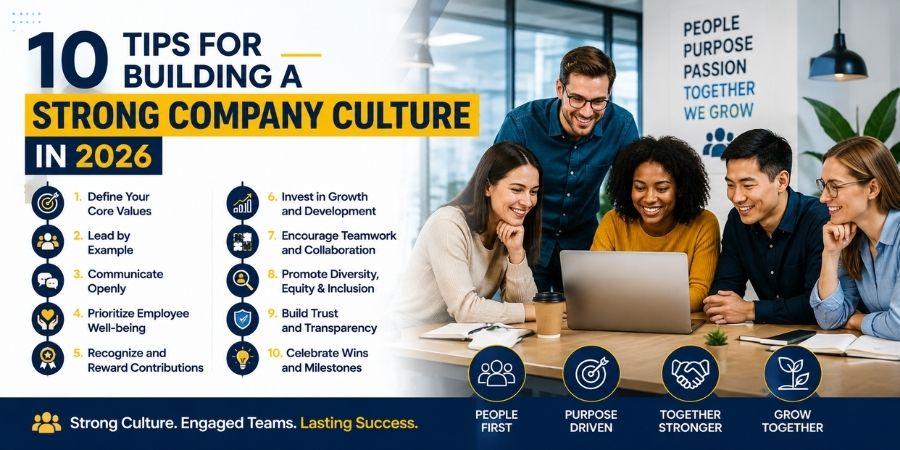
Company culture is often discussed as if it were an HR project. In practice, employees experience it through much simpler things: how their manager speaks to them, whether good work is recognised, whether they understand what is expected and whether they see a future with the company.
That is why building a strong company culture in 2026 requires more than new values, office perks or an annual employee survey.
Gallup’s research shows that employees who know and use their strengths are nearly six times more likely to be engaged at work. Gallup also found that organisations that continue developing employee strengths can see a 23% increase in engagement. Its broader analysis of 1.2 million employees and 49,495 work units across 45 countries found that teams receiving strengths-based development recorded higher sales and profits and lower turnover and safety incidents.
The lesson for employers is simple: culture improves when employees have a good reason to contribute, managers know how to support them and company values are reflected in everyday decisions.
Here are 10 practical ways to build that kind of workplace in 2026.
1. Start With the Way Managers Treat People
Employees experience a company largely through their immediate manager.
A manager who gives useful feedback, listens carefully, recognises good work and sets clear expectations can create a very different workplace experience from a manager who communicates only when something goes wrong.
Gallup identifies managers as an important driver of employee engagement and recommends moving away from a traditional boss-centred approach toward ongoing coaching and development.
Managers can start with a few basic habits:
- Hold regular one-on-one conversations.
- Ask employees what support they need.
- Recognise specific work rather than giving generic praise.
- Discuss development throughout the year.
- Address performance problems directly.
- Give employees room to suggest better ways of working.
These practices do not require a large budget. They require managers to make time for people.
2. Help Employees Understand What They Do Best
Employees bring different abilities to the same workplace.
Some are good at organising complicated projects. Others are comfortable speaking with customers, solving difficult problems, developing ideas or keeping teams connected.
Gallup’s CliftonStrengths framework identifies 34 talent themes that help people understand these recurring patterns. The assessment is intended as a development tool, rather than a label that determines what someone can or cannot do.
Companies can use strengths information during:
- Career conversations
- Project planning
- Team meetings
- Coaching
- Employee development
- Recognition
- Performance discussions
The point is simple: managers should know more about an employee than their job title.
3. Stop Saving Feedback for the Annual Review
An annual performance review gives employees information after much of the relevant work has already happened.
Regular conversations are more useful.
Gallup reports that only 14% of employees strongly agree that their performance reviews inspire them to improve. It also found that only two in 10 employees strongly agree that their performance is managed in a way that motivates them to do outstanding work.
A better performance conversation can happen once a month or once a quarter and cover five simple areas:
Area | What to discuss |
Results | What went well? |
Problems | What made the work difficult? |
Strengths | Which abilities helped? |
Development | What should improve? |
Next steps | What happens next? |
This gives employees a chance to adjust while there is still time to improve the outcome.
4. Give People Opportunities to Grow
Salary matters, but career development also influences whether people stay.
An employee who has been doing the same work for several years without learning anything new can become disengaged even when the job itself is stable.
Development does not always mean a promotion.
Companies can offer:
- Mentoring
- Coaching
- Cross-functional projects
- Training
- Stretch assignments
- Leadership opportunities
- Job rotations
- New responsibilities
Gallup describes development as a central part of a strengths-based culture and recommends helping employees build their talents regardless of their current title or position.
A useful question for managers is: What could this employee learn next?
5. Make Company Values Visible
Most companies have values. The real test is whether employees can see those values in everyday decisions.
Suppose a company says it values collaboration but rewards employees almost entirely for individual results. Employees will notice the difference.
The same problem occurs when a company talks about development but gives managers no time to coach their teams.
Gallup recommends auditing internal programmes and practices to identify areas that send conflicting messages about the culture an organisation wants to create.
Companies can check this by asking:
- Do our reward systems support our stated values?
- Does our management style reflect those values?
- Does onboarding communicate the same expectations as performance management?
- Do senior leaders follow the behaviours they expect from employees?
- Are employees recognised for the behaviours we say matter?
Culture becomes believable when employees see consistency.
6. Give Employees a Voice and Do Something with It
Employee surveys can provide useful information. A survey without follow-up can create frustration.
If employees repeatedly report the same problem and nothing changes, they eventually stop expecting anything from the process.
A stronger approach is to communicate what the organisation heard and what it plans to do.
For example:
- You told us: Teams need clearer priorities.
- We are doing: Managers will publish weekly priorities and review them during team meetings.
- We will measure: Employee feedback on role clarity after three months.
The specific solution will differ from company to company. The important part is closing the feedback loop.
7. Build Teams Around Complementary Strengths
A good team does not require everyone to work in the same way.
One employee may be strong at execution. Another may be better at generating ideas. Someone else may naturally build relationships across departments.
CliftonStrengths groups its 34 themes into four broad domains:
Domain | General focus |
Executing | Getting work completed |
Influencing | Gaining support and communicating ideas |
Relationship Building | Creating connections |
Strategic Thinking | Analysing information and developing ideas |
Understanding these differences can make team discussions more productive. It also gives managers another way to decide who might contribute to a particular project.
That does not mean putting employees into permanent boxes. People can develop skills outside their strongest areas.
8. Train Managers to Coach, Not Just Manage
A manager’s job involves more than assigning work and checking deadlines.
Good managers help employees understand where they are performing well, where they need to improve and what they can do next.
Gallup reports that 67% of employees who agree their manager focuses on their CliftonStrengths are engaged, compared with 2% among employees who disagree.
A manager can bring strengths into a normal conversation by asking:
- What part of this project suited you?
- Where did you feel most effective?
- What was difficult?
- What would you like to take on next?
- What support would help you perform better?
These questions can produce a more useful conversation than simply asking whether an employee is happy.
9. Make Culture Part of Onboarding
New employees learn about company culture quickly.
They notice how their manager communicates, how colleagues treat one another, how decisions are made and whether the values discussed during recruitment actually exist in the workplace.
Onboarding should therefore explain more than policies and software.
Companies can use the first few weeks to introduce:
- Company purpose
- Team expectations
- Working practices
- Communication norms
- Development opportunities
- Recognition practices
- Employee strengths
Gallup recommends creating an ongoing plan for incorporating strengths as new employees join the organisation.
That matters because culture should not depend on when someone joined the company.
10. Measure Culture with More Than One Number
There is no single metric that can tell a company whether its culture is healthy.
Leadership teams should look at several indicators together.
Metric | What it can show |
Employee engagement | How connected employees feel to their work |
Turnover | Whether people are staying |
Internal mobility | Whether employees see opportunities to grow |
Absenteeism | Possible workload or workplace issues |
Manager effectiveness | Quality of day-to-day leadership |
Employee feedback | Specific workplace concerns |
Development participation | Access to growth opportunities |
Performance | Business impact |
For example, high turnover may indicate management problems, compensation issues, limited career opportunities or changes in the local labour market. Employee feedback can help explain what the headline number means.
Company Culture Statistics to Know
Several Gallup findings provide useful context for organisations reviewing their culture in 2026.
Finding | Figure |
Increase in engagement after taking CliftonStrengths | 7% |
Increase in engagement when strengths development continues | 23% |
Increase in sales reported from strengths-based development | 19% |
Increase in profits | 29% |
Fewer safety incidents | 59% |
Lower turnover in high-turnover organisations | 72% |
People included in Gallup’s meta-analysis | 1.2 million |
Work units included | 49,495 |
Countries represented | 45 |
These figures come from Gallup’s research into strengths-based development. They describe outcomes associated with the approach and should not be treated as guaranteed results for every organisation.
Company culture is also influenced by compensation, workload, leadership quality, career opportunities, job security and working conditions.
What Should Companies Avoid When Building Culture?
Some culture initiatives fail because companies focus on visible activities instead of everyday management.
Common problems include:
- Launching values without changing management behaviour.
- Conducting surveys without acting on the results.
- Giving employees an assessment and never discussing it again.
- Treating employee recognition as an occasional event.
- Making development available only to high-potential employees.
- Expecting managers to coach employees without giving them time or training.
- Measuring engagement without examining why scores change.
Gallup makes a similar point about strengths-based culture: taking the CliftonStrengths assessment is only the beginning. The approach needs to become part of conversations, management practices and organisational processes.
A Simple Company Culture Plan for 2026
Companies do not need to introduce ten new programmes at once.
A practical starting plan could look like this:
First 30 days
- Ask employees what is working and what is causing problems.
- Review engagement and turnover data.
- Identify the biggest management gaps.
- Clarify company and team priorities.
Next 60 days
- Train managers in regular coaching conversations.
- Introduce more frequent feedback.
- Review employee development plans.
- Identify opportunities to use employee strengths.
By 90 days
- Measure employee feedback again.
- Review whether managers are following the new practices.
- Share progress with employees.
- Adjust the programme based on what the data shows.
This approach gives employees something concrete to experience rather than another company-wide announcement.
Frequently Asked Questions
What makes a strong company culture?
A strong company culture gives employees clear expectations, supportive managers, opportunities to grow, meaningful work and a workplace where company values are reflected in everyday behaviour.
How can a company improve its culture in 2026?
Companies can improve culture by training managers, strengthening employee development, creating regular feedback conversations, recognising good work, listening to employees and connecting daily work with organisational purpose.
What is a strengths-based company culture?
It is a culture where employees are encouraged to understand and develop their natural talents and apply them to their work. Gallup recommends integrating strengths into management, performance conversations, teamwork and organisational processes.
Does a strengths-based culture mean ignoring weaknesses?
No. Employees still need to meet performance expectations. Gallup’s approach focuses on developing strengths while helping employees manage areas where they have less natural talent.
How important are managers to company culture?
Managers have a direct influence on the day-to-day employee experience. Their approach to communication, feedback, recognition, development and accountability can affect how employees experience the broader company culture.
Key Takeaways
- Strong company culture develops through everyday behaviour, not slogans.
- Managers have an important role in shaping the employee experience.
- Employees need regular feedback rather than relying only on annual reviews.
- Career development should be available beyond promotion opportunities.
- Company values should influence actual decisions and management practices.
- Employee feedback needs visible follow-up.
- Teams can benefit from understanding the different strengths people bring to their work.
- CliftonStrengths can provide a useful framework for understanding and developing employee talents.
- Culture should be measured through several indicators rather than one engagement score.
- The best culture initiatives become part of normal management rather than remaining separate HR programmes.
Final Thoughts
A strong company culture is built through ordinary interactions.
An employee receives useful feedback. A manager notices a strength and gives someone a chance to use it. A team listens to an idea. A company acts on employee feedback. A leader follows the same values expected from everyone else.
Those moments may seem small individually, but they determine what working at a company actually feels like.
For 2026, companies have plenty of technology and data to measure the employee experience. The harder part is turning what they learn into better management.
That starts with people.
Give employees clear expectations. Give them opportunities to grow. Help them understand what they do well. Train managers to have better conversations. Then make sure the company’s systems support the culture leadership says it wants.
That is a more practical starting point for building a company culture that employees can actually experience every day.