A life guided by imagination, research, and a clear vision for technology!
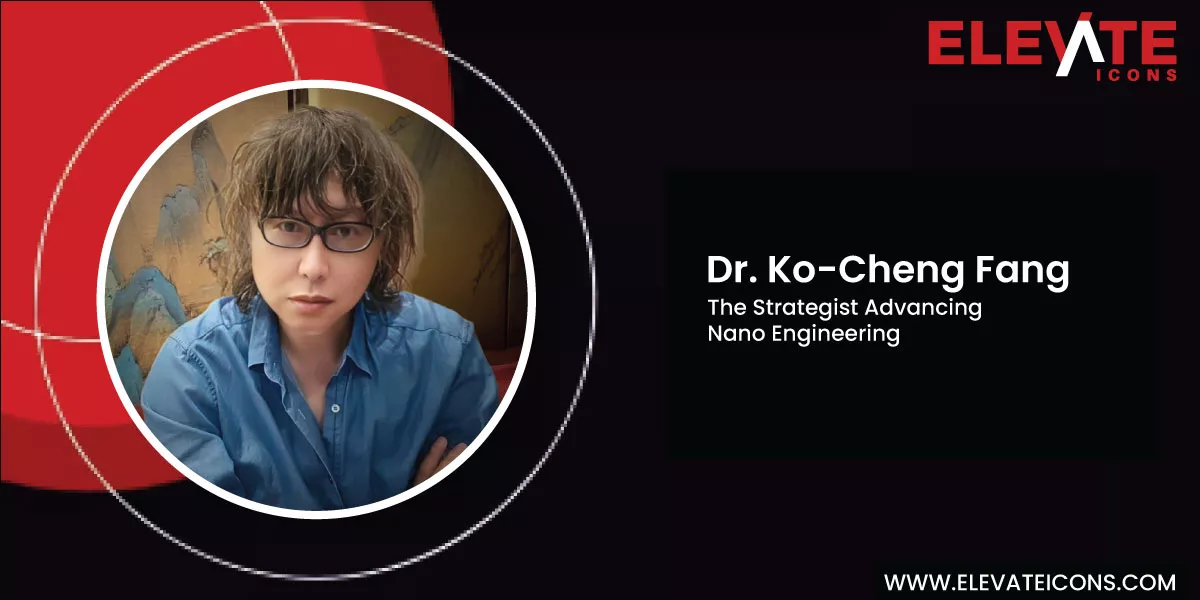
Technology grows through small sparks of curiosity. A single question can open a path that leads to deep discovery. Many leaders enter this field through study or training, but Dr. Ko-Cheng Fang’s journey began with something far simpler. A young boy, a quiet room, and a book filled with Western Art History. He read that book again and again. The colors and stories stirred something inside him, and he drew for hours with steady joy, certain that painting would guide his future.
As he grew older, a new world opened through the internet. Strange scientific terms filled the space where art once stood alone. One word in particular captured him. Nanotechnology. The sound of it carried mystery and possibility. He searched for explanations, explored every kind of nano-material he could find, and filled his home with samples. The small rooms slowly turned into a personal laboratory. He kept testing, learning, and pushing forward, driven by an instinct to understand how things worked at the smallest scale.
What this really means is that art trained his eye to see beauty and detail, while science trained his mind to explore structure and change. These two sides formed him together. He grew through invention, creation, and focused study. Every step was pulled from both worlds, and they guided his decisions with equal strength.
Dr. Fang serves today as the Founder, CEO, and Chairman of LongServing Technology Co. Ltd. His leadership carries the soul of his early years. The imagination of a young artist lives in his visions for the future. The discipline of a self-made researcher drives his work. His story shows how early wonder can stay with a person through every chapter, and how curiosity can build a life with purpose, depth, and courage.
Let us learn more about his journey:
Curiosity That Grew Into a Company
The path to LongServing Technology began with Dr. Fang’s habit of exploring any field that sparked his interest.
Dr. Fang describes how the surge of online information pushed him to study technology in a wide and deeply interconnected way. His interest in modern cancer treatments led him into advanced herbal science. The rise of cyberattacks pushed him into building anti-hacking systems that evolved into cloud security and password lock technologies later adopted by the United States Department of Homeland Security.
His inventions won major awards around the world, including a Lifetime Achievement Award presented by the President of the Ukrainian Academy of Sciences and an honorary doctorate from the President of the International American University (IAU). Even so, he believed awards did not create real wealth on their own.
This belief guided him to found LongServing Technology. His goal was to turn inventions into practical wealth. This choice eventually led him to solve the central technical barriers behind creating the world’s first commercialized lab-grown Imperial Green jadeite.
The Push Beyond Silicon
The tech industry is hitting physical and economic limits in semiconductor development, which sets the stage for Dr. Fang’s next breakthrough. He points out that modern chips are approaching the boundary of Moore’s Law. Extreme miniaturization now causes leakage, heat, and unstable signals. AI workloads only worsen the problem, pushing power consumption to levels that rival entire towns. He notes that countries like Taiwan have filled landscapes with solar farms, even though solar infrastructure poses recycling and environmental challenges.
Photon-based chips, he says, represent the true future of humanity. Einstein stated that photons are quanta; when photonic chips reach the nanometer scale, they become quantum chips. Their signals are quantum signals. A photonic quantum smartphone could interface with today’s electronic systems by outputting binary while simultaneously generating quantum bits through redesigned architecture. Such power would easily satisfy all present and future AI needs.
He notes that since NVIDIA’s GPU-based recognition systems became the foundation of AI, the sector has experienced a Wall Street boom. But concerns about power consumption and capital cost expose the instability of electronic AI. A photomask for a 7 nm chip costs about 15 million USD, and the mask itself has a feature size of roughly 40 nm; the capital investment required for developing a 2 nm chip process is estimated to be around USD 28 billion; EUV machines cost hundreds of millions. Japan’s photoresists, Germany’s optics, and other supply chain components require national investment, making it nearly impossible for individuals or new companies to enter the field.
To illustrate the severity, Dr. Fang points out that NVIDIA’s H100 consumes 700 watts per card, and clusters running hundreds of cards reach 10–15 megawatts. Many U.S. clusters sit idle because the infrastructure cannot supply enough electricity. Electronic AI, he says, has fallen into a power-hungry black hole.
This led him to design the photonic quantum chip. From the outset, he avoided EUV lithography entirely, bypassing complex multi-step fabrication. No metal deposition, no buried copper wiring, only light pathways. He developed a material capable of compressing silicon photon wavelengths from over 1,300 nm down to an average of 2 nm, entering the X photon regime.
LongServing Technology has also released a 7 nm photomask for the optical chip, with electron microscope imaging of its patterns. This surpasses the photomask capabilities of all advanced semiconductor processes, including those of TSMC, which remain at 28 nm.
According to Dr. Fang, photonic chips deliver roughly one thousand times the computational power of semiconductor transistors. Once photonic quantum chips enter the market, today’s transistors will follow vacuum tubes into museums.
He adds that the cryptocurrency industry will be affected first because its value relies on computational difficulty.
A world formed by photonic quantum computing, he notes, will change everyday life. At a 2 nm photonic coating thickness, the wavelength becomes invisible. In experiments, the material appears transparent and only becomes visible through electron microscope methods. He sees tremendous potential for autonomous vehicles and aerospace.
Artistry Forged in a Laboratory
The creation of lab-grown Imperial Green jadeite blends geology, chemistry, and an artist’s devotion to beauty. Dr. Fang says he was born with an artistic nature, and this sense of beauty drives his work with laboratory-grown jadeite. Imperial Green refers to rich, saturated green jadeite with high transparency, a natural material that is nearly extinct. His objective from the start was to recreate natural imperial-grade jadeite in its purest form.
Unlike diamonds, jadeite is a complex metamorphic rock composed of sodium, chromium, aluminum, iron, and silicon. Its transparency forms over hundreds of millions of years. To recreate this structure, Dr. Fang spent more than two decades researching how to produce lab-grown jadeite with rich green color and high transparency. By simulating the natural growth environment of jadeite and refining the materials at 1,400°C, he enabled the crystals to grow gradually, layer by layer. As a result, every piece of lab-grown jadeite develops its own unique crystalline structure—distinct and individual, just like a fingerprint.
He sees this work as a way to preserve a vanishing treasure. Without a lab-grown counterpart, natural Imperial Green jadeite would become uncollectible and confined to museums. Its rarity is so extreme that its value already surpasses diamonds and emeralds.
The Weight Behind the Title
Being called the Modern Da Vinci carries expectations tied to creativity and vision. Dr. Fang reflects on Leonardo da Vinci as a figure who blended art with ideas that predicted future technology. He sees the Mona Lisa as an example of timeless artistic mastery.
He believes his own paintings evoke a similar experience. Whether capturing the playfulness of a young dog or the calm of an old one, each painting tells its own story. Many people revisit his social media pages for emotional comfort, including professional athletes seeking calm before major competitions.
He also mentions that his artwork was recently selected for the Light of the Chinese Culture global stamp collection, with limited edition stamps soon to be issued in South Korea, Japan, Malaysia, and Ukraine.
Thriving in the Face of Doubt
Every new idea meets skepticism, and Dr. Fang’s work has faced more than most. Dr. Fang recalls that early on, people often accused him of fraud. When he began creating lab grown jadeite, many assumed it was a cheap imitation similar to dyed agate. Major US tech companies and national labs in China had already attempted and abandoned the same goal. Achieving something widely labeled impossible required a level of obsession he embraced.
The same skepticism arose when he developed the photonic chip. From concept to patent, every step was doubted. Today, his photonic chip technology holds patents in more than twenty industrial nations, and he has already begun production. He demonstrated a clear progression from a 7 nm photomask to 5 nm and ultimately the essential 2 nm photonic pathways.
He often describes his thinking as extraterrestrial, believing his past life was not of this world. Those memories feel vivid to him and perhaps explain why he produces technologies that seem beyond human imagination.
Leading Through Vision and Precision
Running LongServing Technology requires a specific kind of leadership rooted in discipline and foresight. Dr. Fang states that as CEO, he has one obsession: creating technology. He leads with that passion and instructs his team never to hesitate when difficulties arise because he already sees the future path. The present, he says, is simply picking up what already exists.
Materials are the true obstacles. When materials cannot be sourced, he creates them. This includes the 2 nm photonic material that cannot be reverse engineered and does not exist in nature.
Capital is the second challenge. Research burns money endlessly, but he continues regardless, welcoming investment but not depending on it. He redesigned fabrication to eliminate deep UV and EUV lithography, using X-rays instead. Because LongServing manufactures its own photosensitive materials and resists, the team can build what the world lacks.
Building Innovators, Not Followers
Innovation inside a company depends on people who are willing to grow. Dr. Fang sees creativity as a natural talent, similar to an artist mixing colors. Not everyone has the same creative instinct, and that is acceptable. What he values most is execution. This includes the courage to face difficult tasks, the ability to learn, and the drive to grow.
He believes that talented R and D professionals can take knowledge from research papers and existing technologies and use it to achieve any challenge he assigns. That is what makes someone truly qualified.
Creativity as a Response to Challenge
Scientific progress often begins with someone refusing to accept the obvious. Dr. Fang states that creativity appears when people respond to challenges. Rivers bend and flood; humans straighten waterways and build dams. Accepting things without question, he says, destroys creativity. He dislikes the word impossible.
Whatever nature can create, he believes he can create. This belief drove him to develop lab-grown jadeite. Humanity thrives because of dreams, and without dreams, survival loses meaning.
A Future Reshaped by Light
Quantum and photonic technologies are set to transform global industries from computing to energy. He argues that the development of electronic chips has hit a bottleneck. Massive AI data centers consume enormous resources, and their investment costs often outweigh their benefits. For example, using countless AI chips for robot learning remains more expensive than hiring human labor.
Electronic computation is too slow. The human brain operates at light speed, not through continuous binary. To reach that speed, photonic and quantum computation are needed.
LongServing’s photonic chips drastically reduce power use and compute more than one thousand times faster, while quantum modes increase that advantage tenfold. He warns that the investment gap between photonic chips and electronic AI chips is a ticking crisis. Once photonic chips emerge, a wave of bankruptcies and collapsing tech stocks may follow. He believes LongServing stands like David against giants and expects dramatic shifts in the near future.
Innovation With a Long Horizon
Sustainable and ethical technology requires a foundation strong enough to last decades. Dr. Fang says that if a technology cannot guarantee revenue for 20 years, LongServing does not invest. Outproducing competitors is meaningless if someone else can outproduce you tomorrow. The real advantage lies in innovation secured by strong patents.
Many researchers, he notes, chase patents only for rewards, making trivial changes. True pioneering technology should lead the field. While “photonic transmission” chips exist everywhere, none use photons for computation. LongServing is the only one, and even TSMC does not have this.
Defining Contributions to the Modern World
Some inventions reshape daily life in ways people barely notice.
Dr. Fang considers his greatest contributions to be the cloud and the password lock. He holds patents for both and has deployed them worldwide. Before the cloud, software was tied to individual computers. People had no concept of virtualized databases. Boot passwords were insufficient, so he designed the software password lock.
Without these inventions, he says, modern smartphones and e-commerce would not exist as they do today.
A Mind That Refuses Comfort
Personal habits and philosophies often reveal how an innovator sustains momentum. Dr. Fang says that while many people seek comfort, he is always thinking about the next goal. His notebooks are filled with dense sketches, ready to be executed when the moment is right. Preparation lets him advance rapidly when he chooses a direction.
Meditation is his only leisure. It inspires him and gives him a sense of the future that guides his inventions.
Humans and Machines Growing Together
In an age dominated by AI and automation, the relationship between people and technology is changing.
Dr. Fang believes technology will never replace humans. Tools amplify ability but remain under human control. It’s just like that a car may exceed 200 kilometers an hour but a human drives it.
Even advanced robots and AI systems depend on software, input intelligence, and the accumulated experience of human experts. With photonic AI, humans will focus more on innovation while machines perform labor-intensive tasks.
Innovations on the Horizon
LongServing Technology continues to explore breakthroughs that could transform fields from medicine to consumer electronics.
Dr. Fang shares that LongServing’s anticancer drug has shown promising laboratory results, eliminating liver cancer and even lung cancer cells. But clinical trials will take many years.
Another technology is progressing far faster: 3D holographic projection on mobile phones. Because the photonic chip material is transparent, future devices may embed countless photonic pathways within a single piece of glass. He sees photonic gateways as a coming shift in how the world thinks about mobile devices.
Building a Foundation for Global Impact
Young innovators often struggle to balance creativity with survival. Dr. Fang advises young innovators to master both technology and wealth. Without financial strength, even the most talented technologist may be acquired or go bankrupt. He recommends creating one profitable technology first.
When LongServing developed the photonic quantum chip, he set a clear target: to avoid expensive physical equipment and instead rely on chemistry and materials science to gain an advantage.
A Legacy Aimed at the Next Century
Every innovator hopes to leave behind work that elevates humanity. Dr. Fang wants to be remembered for creating the photonic quantum chip, a technology he believes challenges the boundaries of Nobel Prize level innovation.
He explains that Taiwan’s national silicon photonics teams work with photons at 1,310 to 1,550 nm to accelerate electronic signals. His material shortens the photonic wavelength to an average of 2 nm, a limit previously thought unreachable. Even EUV lithography operates at 13.5 nm.
He believes this breakthrough pushes human civilization forward by more than a century and represents the true essence of his legacy.