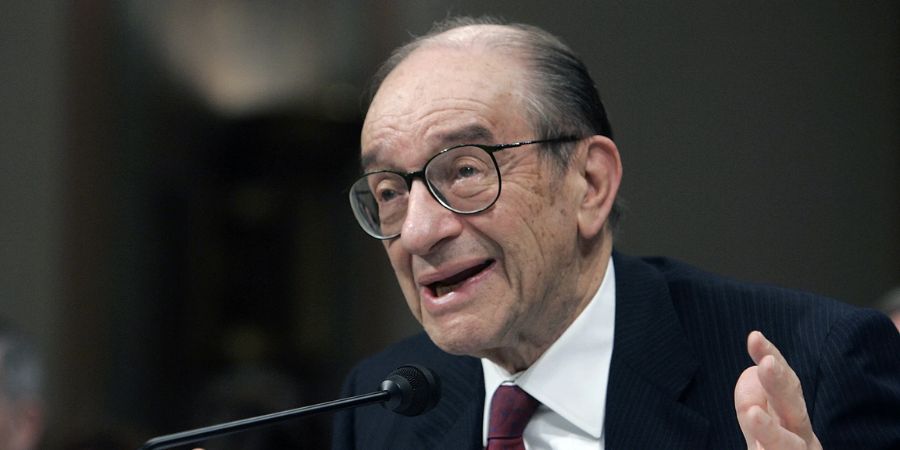
For nearly 2 decades, Wall Street ran on the words of Alan Greenspan. As Chairman of the Federal Reserve from 1987 to 2006, his voice carried enough weight to shift global markets with a single adjective. Because the stakes were so high, Greenspan elevated ambiguity to an art form, developing a dense, protective dialect that observers dubbed “Fedspeak.”
To understand Greenspan’s tenure, its triumphs, its blind spots, and its ultimate reckoning, you have to look at what he said, what he meant, and what he was forced to take back.
“Since I’ve become a central banker, I’ve learned to mumble with great incoherence. If I seem unduly clear to you, you must have misunderstood what I said.”
Greenspan understood that a central banker’s greatest enemy is market certainty. If investors knew exactly when interest rates would rise or fall, they would trade on that certainty, causing the very instability the Fed was trying to prevent. His solution was a calculated, constructive fog.
He later remarked, “I know you think you understand what you thought I said, but I’m not sure you realize that what you heard is not what I meant.” This wasn’t just evasion; it was a deliberate strategy to force the markets to move cautiously.
“How do we know when irrational exuberance has unduly escalated asset values?”
Tucked into a dense, televised speech in December 1996, this rhetorical question became the defining phrase of the dot-com era. Greenspan spotted the tech bubble years before it burst, identifying the psychological shift where market momentum completely detached from economic reality.
Yet, the quote also highlights the limits of central banking: despite recognizing the “irrational exuberance,” Greenspan kept interest rates relatively low, letting the bubble inflate for another three years before the crash of 2000.
“I found a flaw in the model that I perceived is the critical functioning structure that defines how the world works.”
This was Greenspan’s moment of ultimate reckoning. In October 2008, appearing before a congressional committee in the wake of the subprime mortgage collapse, the man who had championed financial deregulation for decades admitted he had been wrong.
Heavily influenced in his youth by the libertarian philosopher Ayn Rand, Greenspan had operated on the firm belief that banks would naturally regulate themselves to protect their own shareholders. The financial crisis shattered that worldview, leaving him, by his own admission, in a state of “shocked disbelief.”
“It hardly makes any difference who will be the next president. The world is governed by market forces.”
When asked by a Swiss newspaper about an upcoming U.S. presidential election, Greenspan offered this blunt assessment of political power.
It reflects the core philosophy of his era: the belief that global capital flows, central bank policies, and supply chains matter far more to everyday economics than whoever happens to be sitting in the White House.
“Excessive optimism sows the seeds of its own reversal.”
This simple observation captures the cyclical nature of economic history. Greenspan recognized that the greatest threat to financial stability is often a long period of uninterrupted peace. When times are good, companies and consumers forget what risk feels like.
They take on cheap debt, overextend themselves, and build the exact conditions required for the next recession.
Conclusion
Ultimately, Greenspan’s words leave behind this complicated paradox, almost like something that doesn’t sit still. The man who mastered “Fedspeak” to keep the markets, well guessing, ended up being fooled by his own economic script, kind of ironic. His rhetoric reminds us that central banking is never just a sterile math question, it is a not-quite-predictable game of human psychology, where the illusion of perfect control hangs around only until the next cycle breaks it, flat.