
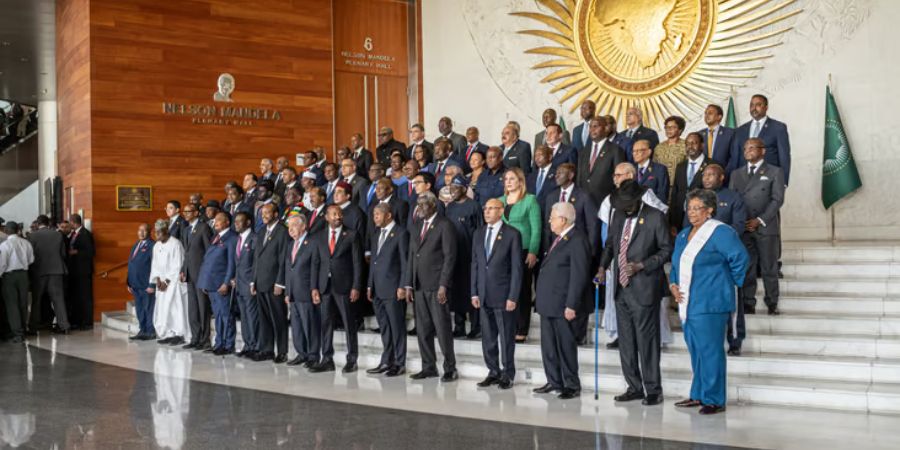
The 39th African Union (AU) Summit is being hosted in Addis Ababa, Ethiopia and the debate could not be more immediate. Political crises that are challenging democracy in Africa are forcing leaders in different parts of the continent to congregate to face them. These comprise military coup, contested elections, an increasing wave of protests, and a growing legitimacy deficit between the AU and the young fast-growing population in the continent.
This article examines the causes behind these issues, their impact on political stability, the reasons why the role of the AU has been called into question and how this is symbolic of democracy in Africa.
A Continent at a Crossroads
Africa contains approximately 1.4 billion people, of which the youngest population of any continent can be found. Over 400 million Africans fall between 15 and 35 years old. The same young people are becoming more and more angry with the political systems they perceive as being unresponsive and leaders who are viewed as being in touch.
The main cause of this frustration is recurrent military coups and efforts to circumvent constitutional leadership in various states. Military takeovers have occurred in countries across Mali and Burkina Faso to Sudan, Gabon, and other countries in the past few years. These occurrences have overturned constitutional rule and rendered the democratic developments weak.
There is no one-time coup. Various successful and attempted coups have been witnessed in Africa between 2020 and 2025 undoing progress achieved over previous decades toward democratic governance.
The transformed political order in Africa by coups.
Africa has a rich history of coups and recent coups are markedly different in nature and frequency compared to past waves.
There are at least three historical waves, which scholars identify:
- The first wave of post-independence was characterized by military coups that were often violent and in the newly independent states.
- The subsequent wave of the 1990s and early 2000s witnessed less coups and more emphasis on democratization.
- The present wave is commonly known as the third wave. Internal political manipulation, weak institutions, security failure and disputed election results are more likely to motivate these coups. They tend to include the intervention of military leadership in response to (or in the case of) perceived political corruption.
This development alters the character of democratic risk. Coups are not merely military plays, but indicators of even greater problems in governance that entail institutional weaknesses in the state, the lack of accountability of leadership, and electoral cheating.
The reason why the African Union is experiencing a Legitimacy Crisis.
The African Union was established with the aim of fostering unity, peace and democratic principles among the member countries. Its Charter, as well as such instruments as the African Charter on Democracy, Elections and Governance, provides a clear legal framework against any unconstitutional modifications of government.
However, critics say that the AU has not been able to apply these principles consistently.
Military coups may also make countries lose their membership in the AU. It is a significant figurative punishment. However, frustration on politics is still there because suspension is not always effective to restore constitutional authority and prevent future coups.
The way the AU has responded to other democratic erosions has elicited a lot of criticism.
During certain controversial elections last year, the AU was tardy in quibbling results which many viewers felt were not up to be. During the recent presidential election in Uganda, the initial analysis by the AU praised the elections despite the rampant coverage of internet shutdowns and opposition-based crackdowns. The reaction angered a large number of young Africans.
It contributes to a broader view that the AU is no longer a concern of ordinary citizens, but is too comfortable with the existing leaders who are not really accountable.
The Out-of-touch With the Youth and Citizens
The most striking political fact in modern Africa is that it is actually largely youthful. But a good number of young Africans are politically marginalized.
Social media youth activists define the AU as an association of elderly leaders whose interests do not resonate with the aspirations and demands of the young majority in Africa. It is not a marginal sentiment but rather it is beginning to be a mainstream political critique.
According to studies on the public opinion, it is clear that citizens are finding more and more connection between the failures of democracy and the daily struggles that they face economically. Suffering can encourage citizens to be less tolerant of prolonged negotiations and more tolerant of decisive, even extra-constitutional, action, including coups, when they perceive themselves to have been cheated out of a democratic process.
The Regional and Institutional Response
The AU has not been lax in these challenges
In December 2025, the attempted military coup in Benin was denounced by the Chairperson of the AU Commission, noting that unconstitutional change of government is a contamination of the continental norms and should be overturned.
That reaction is in line with the long-standing legal approach of the AU through documents such as the Lomé Declaration and Ezulwini Consensus which denies military takeovers.
The AU also collaborates with Regional Economic Communities such as ECOWAS in West Africa to manage responses, sanctions, and diplomatic pressure. It is able to facilitate dialogue and aid democratic transitions, although the success of such operations is highly varied across different situations.
What the Summit Can do to Democracy in Africa
The leaders of Africa come into Addis Ababa with a dynamic global and continental environment. Political reform is more in demand due to foreign aid cuts, climate pressures, security threats, and economic instability.
Water and sanitation, and humanitarian crisis responses are some of the issues on the agenda of the AU Summit. However, there is a deeper-rooted debate on how to make democratic governance stronger and avert further usurpation of power, which is unconstitutional.
It is the view of many observers that a more citizen-focused, transparent and accountable AU is the only way to overcome the growing gap of trust between the public and the organization.
Reform advocates argue for:
- An increase in the implementation of the democratic norms.
- Greater uniformity of reaction to any type of power seizure, military or constitutional manipulation.
- Increased involvement of the youth and civil society in the continental decision-making.
The Stakes Are High
Political stability, democratic rule, and economic opportunity are tightly linked. When democracy falters, economic confidence and social cohesion suffer.
Africa’s democratic path will not be determined solely in Addis Ababa. But what happens at this summit could signal whether the African Union is ready to carry democratic reform from rhetoric into action.
This moment is not just about leadership seated at conference tables. It is about whether the political systems across Africa will shape a future that reflects the aspirations of a vast, young, and dynamic population.