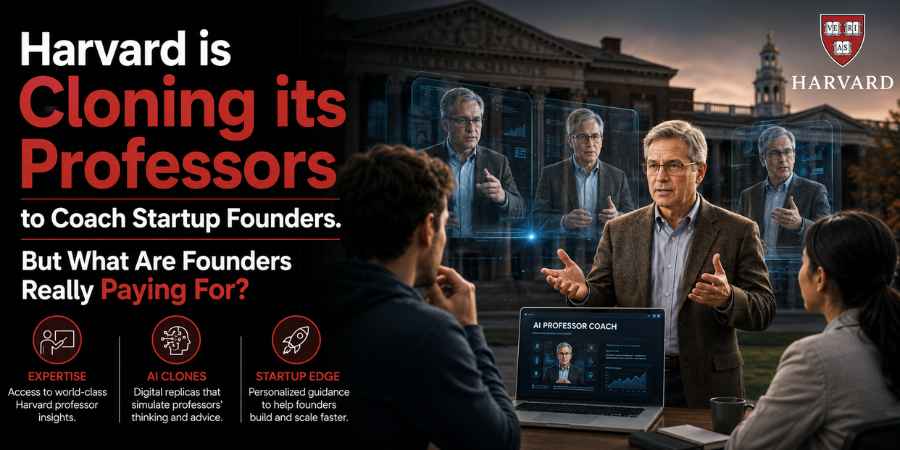
Harvard Business School has found a rather unusual way to give startup founders more access to its expertise: AI versions of its professors.
Its HBS Foundry startup bootcamp costs $699, runs for eight weeks and gives founders AI-powered practice sessions for investor pitches, sales conversations and board meetings. The AI avatars were created with HeyGen, while real instructors continue to lead live sessions. The program has also been tested with more than 100 universities across all 50 U.S. states.
The idea sounds futuristic. The reason it works is much more ordinary.
Founders need practice, and professors do not have unlimited hours.
What is HBS Foundry?
HBS Foundry is Harvard Business School’s AI-powered entrepreneurship platform that helps founders develop ideas, validate markets and prepare funding-ready pitches.
The eight-week Startup Bootcamp takes participants through problem definition, market mapping, validation, traction strategy and pitch development. Harvard says the program is open to all industries and does not require a pitch deck, technical background or previous startup experience.
The platform combines:
- AI mentorship modeled on HBS faculty
- Market and competitive analysis
- Customer discovery
- Pitch practice
- Peer interaction
- Live sessions with real experts
Harvard also says founders retain their intellectual property and that their materials are not sold or used to train AI models.
How do Harvard’s AI professors coach founders?
Founders use AI avatars modeled on Harvard faculty to rehearse situations such as investor pitches, customer meetings and board discussions.
One of the digital professors represents Jeff Bussgang, a Harvard senior lecturer and Flybridge Capital co-founder. The experience is designed for repeated practice rather than a single piece of advice.
A founder can make a pitch, receive feedback, change the argument and try again. There is no need to wait for another meeting with a mentor.
That is also why the avatars do not have to be perfect replicas of the real professors.
They need to provide a useful simulation.
When New York Times reporter Sarah Kessler tested Bussgang’s AI counterpart with an “Uber for bananas” pitch, the avatar remained sceptical. The real Bussgang reportedly found the experience somewhat creepy, while noting that his students liked it.
Why would founders pay $699 for an AI professor?
The $699 fee buys structured startup training and repeated access to AI-assisted practice, rather than direct one-to-one access to a Harvard professor.
That makes the price easier to understand.
A human mentor has limited availability. An AI avatar can handle the same practice exercise repeatedly.
Dragana Savic, who had already raised more than $1 million for her biotech company INIA Biosciences, told Inc that the program helped her work through situations before facing them in real life.
That is a practical use of AI.
The founder still has to make the decisions. The AI simply gives the founder more opportunities to test those decisions.
Is Harvard replacing real professors with AI?
No. HBS Foundry uses AI alongside human instruction, not as a complete replacement for professors or mentors.
The program includes weekly live sessions with instructors, while the AI avatars provide feedback during practice sessions.
Harvard’s own description makes the division clear: Foundry offers personalized AI mentorship modeled on faculty plus live sessions with real experts.
That combination is probably the sensible part of the model.
AI handles repetition.
Humans handle the conversations where judgment, relationships and experience matter most.
What does the Harvard AI professor experiment reveal about education?
It shows how AI can make expert-informed practice available at a scale that human instructors alone cannot provide.
A professor cannot listen to the same startup pitch 30 times.
An AI system can.
That does not make the AI equivalent to the professor. It makes the AI useful for a different part of the learning process.
The same model could eventually apply to other forms of professional training:
- A medical student could rehearse difficult patient conversations.
- A sales representative could practise handling objections.
- A manager could simulate a difficult employee conversation.
- A law student could practise questioning a witness.
- An entrepreneur could rehearse an investor meeting.
The common requirement is simple: practice improves performance, but practice requires access.
AI can make that access much easier.
What happens after the HBS Foundry bootcamp?
Top Foundry participants can progress to the Foundry Catalyst program and eventually compete for up to $100,000 in funding.
Harvard describes the Startup Bootcamp as the first stage of a broader path from idea to funding. Selected founders can move into Catalyst, followed by a pitch event at Harvard Business School.
That makes Foundry more than an AI demonstration.
Harvard is building an ecosystem around the technology.
The AI platform helps founders develop their ideas. Human experts and peers provide additional guidance. Stronger companies can move toward funding.
There is a clear progression from practice to validation to pitching.
Can an AI professor replace a human startup mentor?
An AI professor can replace some mentoring tasks, but it cannot fully replace the judgment and relationships that experienced human mentors provide.
An AI can challenge a founder’s pricing, question a market assumption or identify weaknesses in a pitch.
A human investor can bring something different.
They may know the market personally. They may understand why a particular investor will reject the company. They may recognise a problem with the founder’s strategy that is not visible in the pitch itself.
That is why Harvard’s model is more interesting as a hybrid than as a replacement.
The AI gives founders more repetitions.
The human provides context.
Why is Harvard’s AI professor experiment important?
The significance of HBS Foundry is not that Harvard has created digital professors. It is that a highly selective institution is testing how its expertise can be delivered beyond the limits of faculty time.
Harvard’s own Foundry data points to the scale of the network behind the platform. For HBS alumni entrepreneurship between 2014 and 2025, it cites 1,906 founders, 1,757 companies and $84.6 billion in capital investment, based on PitchBook data. Those figures describe the broader HBS alumni entrepreneurship record, not capital raised by Foundry itself.
The experiment is still young. The AI avatars will not suddenly turn inexperienced founders into successful entrepreneurs.
What they can do is remove one practical limitation: the shortage of time available for practice and feedback.
And that may be the most useful role for AI in professional education.
Not replacing the expert.
Making the expert’s knowledge easier to practise with.