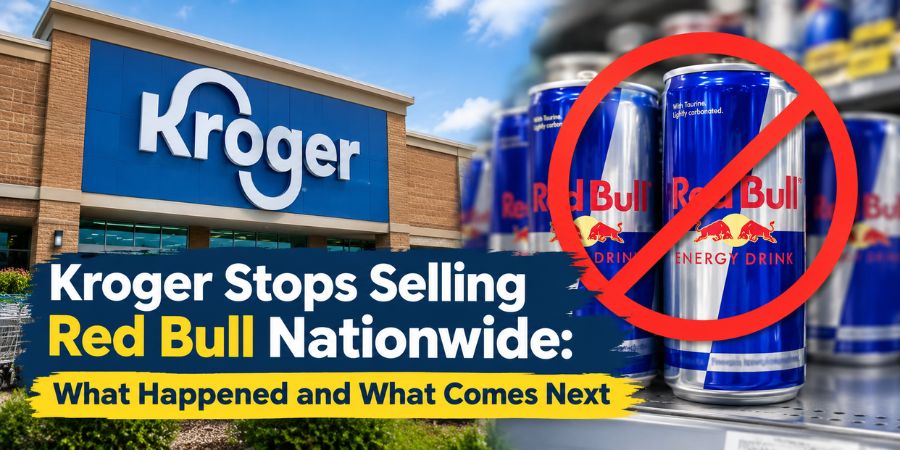
Kroger has stopped selling Red Bull at its U.S. stores and fuel centers, removing one of the country’s best-known energy drink brands from more than 2,700 locations. The retailer sold its remaining Red Bull inventory in August and removed the brand’s coolers and displays by August 31, 2026.
Kroger has not publicly given a specific reason for the decision. The move comes, however, as new CEO Greg Foran pushes the supermarket chain to lower prices and takes a tougher position on supplier price increases. That timing has led to widespread reports that pricing negotiations with Red Bull are behind the withdrawal, although neither company has publicly confirmed that explanation.
For shoppers, the important point is that Red Bull itself has not been discontinued. The brand remains available through other retailers and sales channels in the United States.
What Happened to Red Bull at Kroger?
Kroger confirmed that it has stopped selling Red Bull nationwide. The last products were sold during August, after which Red Bull-branded coolers and displays were removed from stores and fuel centers by August 31.
The decision covers stores across the Kroger family of banners, rather than a small number of locations experiencing a temporary stock problem. Kroger’s network includes names such as Ralphs, Fred Meyer, QFC, Harris Teeter, King Soopers, Fry’s and Mariano’s.
That makes the change significant for shoppers who regularly bought Red Bull during a grocery trip or at a Kroger fuel center.
|
What changed |
Current status |
|
Red Bull sales at Kroger stores |
Stopped |
|
Red Bull sales at Kroger fuel centers |
Stopped |
|
Remaining inventory |
Sold during August |
|
Branded displays and coolers |
Removed by Aug. 31 |
|
Other energy drinks |
Still sold |
|
Red Bull availability in the U.S. |
Continues through other retailers |
|
Confirmed reason for Kroger’s decision |
Not publicly disclosed |
Kroger’s own online shopping platform continues to list a broad energy-drink category, including products from Monster and Alani Nu, but Red Bull products are not available for purchase.
Why Did Kroger Stop Selling Red Bull?
The short answer is that Kroger has not said publicly.
The strongest explanation circulating in current reporting is a disagreement over pricing between the retailer and Red Bull. That explanation should be treated as reported context rather than a confirmed statement from either company. Kroger has declined to explain why it removed Red Bull, while Red Bull had not publicly provided an explanation in the latest reports.
There is a clear reason the pricing question has attracted attention.
Greg Foran, who became Kroger’s CEO in February 2026, has made lower prices a central part of his strategy. During a September 11 earnings call, Foran said Kroger would push back against suppliers seeking higher prices while consumers were under financial pressure. He also said the retailer would increase its reliance on private-label products if acceptable supplier pricing could not be reached.
That does not establish that Red Bull was removed specifically because it demanded a price increase. It does show why a supplier-retailer pricing disagreement is plausible in the current context.
Is Kroger’s Red Bull Decision Part of a Bigger Pricing Strategy?
The Red Bull withdrawal makes more sense when viewed alongside Kroger’s wider approach to private-label products and supplier negotiations.
Kroger reported about $148 billion in revenue for the previous fiscal year, with its own brands generating approximately $39 billion. Foran has also said Kroger intends to expand its Smart Way value range from roughly 130 products to 1,000.
That strategy gives Kroger another way to compete on price.
National brands bring customer recognition and demand, but they also involve negotiations over wholesale costs, promotions and shelf space. Private-label products give a retailer greater control over pricing and product positioning.
The Red Bull situation therefore provides a useful example of a broader retail issue: a supermarket can decide that maintaining a particular national brand is less attractive when its commercial terms no longer fit the retailer’s pricing strategy.
There is still no public evidence that Kroger is systematically removing every brand that seeks higher prices. Red Bull is one documented case, and the company has not described the commercial terms behind it.
Is Red Bull Discontinued in the United States?
No. Red Bull has not been discontinued in the United States.
The change is specific to Kroger. Red Bull continues to market its energy drinks, including its Original, Sugarfree, Zero and Editions products. Its U.S. product information remains active, and the company continues to provide product and nutritional information for its current range.
This distinction is important because “Kroger stops selling Red Bull” can easily be misunderstood as a manufacturer-level discontinuation.
It is not.
Consumers can still find Red Bull at other grocery chains, convenience stores, retailers and other outlets. The company remains an active participant in the U.S. energy-drink market.
What Energy Drinks Can You Buy at Kroger Instead?
Kroger has not abandoned the energy-drink category.
The retailer continues to sell brands including Monster, Alani Nu, Bloom, Rockstar and NOS, according to current reporting and Kroger’s online listings.
That means the shelf space created by Red Bull’s removal can be used for competing products rather than leaving Kroger without an energy-drink selection.
For consumers switching brands, comparing the can price alone can be misleading. Can sizes and caffeine levels differ substantially.
|
What to compare |
Why it matters |
|
Can size |
A lower-priced larger can may contain more product |
|
Caffeine |
Different brands and sizes provide different amounts |
|
Sugar |
Regular and sugar-free products can have very different formulations |
|
Single-can price |
Useful for occasional purchases |
|
Multipack price |
Better measure for regular buyers |
|
Price per ounce |
Makes different can sizes easier to compare |
For example, Red Bull’s standard 8.4-ounce Energy Drink contains 80 milligrams of caffeine. Its 12-ounce version contains 114 milligrams, while the 16-ounce version contains 151 milligrams.
The comparison is useful for shoppers moving to another brand because a larger can with a higher caffeine content is not directly equivalent to a standard 8.4-ounce Red Bull.
Why Does the Red Bull Removal Matter to Kroger?
For shoppers, the immediate consequence is straightforward: anyone who normally bought Red Bull at a Kroger store now needs another source.
For Kroger, the decision is part of the retailer’s effort to control prices while protecting its grocery business from rising costs and strong competition. For Red Bull, losing access to a supermarket network of this size removes an important retail channel, even though the product remains widely available elsewhere.
The timing also comes alongside another brand-related development. Kroger has recently faced reports of limited Boar’s Head availability at some stores, although that situation differs from Red Bull because Boar’s Head remains available at other Kroger locations.
That distinction is worth keeping in mind. The Red Bull decision is a nationwide removal from Kroger’s stores and fuel centers; the Boar’s Head situation reported in September has been more localized.
Will Red Bull Return to Kroger?
There is no announced return date.
Neither Kroger nor Red Bull has publicly confirmed a new agreement or said when sales could resume. The current evidence therefore supports a simple conclusion: Red Bull is unavailable through Kroger for now, while the commercial relationship between the two companies remains unclear.
A future return is possible, but there is no verified basis for giving shoppers a date or saying that a new agreement is imminent.
For now, consumers who want Red Bull will need to purchase it through another retailer.
What Shoppers Should Know
The most important facts are easy to separate from the speculation:
- Kroger stopped selling Red Bull nationwide in August 2026.
- Remaining inventory was sold before the end of August.
- Red Bull coolers and displays were removed by August 31.
- Kroger has not publicly confirmed the reason for the decision.
- Pricing negotiations are widely reported as the likely explanation, but that has not been confirmed by the companies.
- Kroger continues to sell other energy-drink brands.
- Red Bull itself remains available in the United States.
- There is currently no announced date for Red Bull to return to Kroger.
Conclusion
Kroger’s removal of Red Bull is a retailer decision, not the end of the Red Bull brand in the United States. The confirmed facts are the nationwide withdrawal, the August sell-through of remaining inventory and the removal of branded displays by August 31. The reason remains undisclosed.
The pricing explanation fits with Kroger’s current push for lower prices and tougher supplier negotiations, but it should remain described as reported context until Kroger or Red Bull confirms the details. For shoppers, the practical change is immediate: Red Bull is no longer available at Kroger, while competing energy drinks remain on the shelves and Red Bull continues to be sold elsewhere.