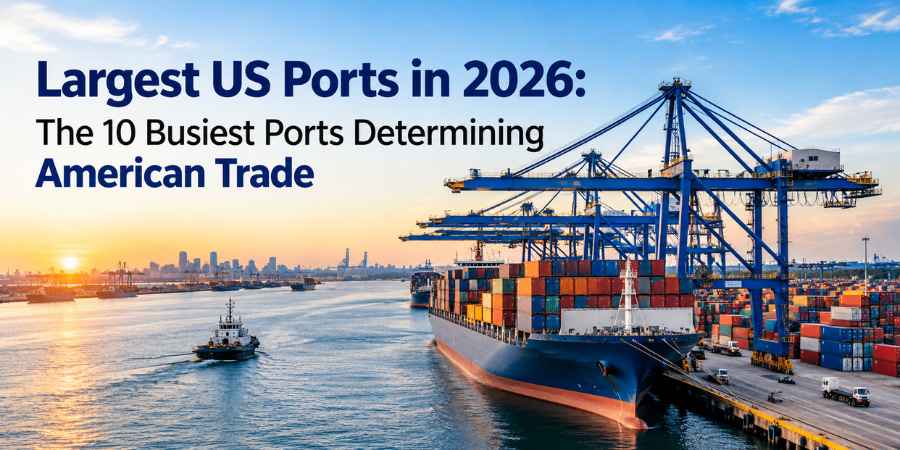
America’s biggest ports rarely make the news when everything is running smoothly. Yet much of the country’s economy depends on them working that way.
Every day, ships carrying consumer goods, machinery, vehicles, industrial equipment and increasingly sophisticated technology arrive at US ports. From there, the cargo moves by rail and truck to factories, warehouses, stores and businesses across the country.
In 2026, that network is under pressure from changing trade policies, shifting supply chains and a new wave of investment in manufacturing, energy and artificial intelligence.
The Port of Los Angeles remains the country’s busiest container gateway. The Port of Long Beach follows closely behind, while New York and New Jersey, Savannah and Houston anchor the country’s major East Coast, Southeast and Gulf Coast trade routes.
The latest figures below use the most recent 2026 data reported by each port. Since ports follow different reporting calendars, these are not a final full-year ranking.
Largest US Ports in 2026
Rank | Port | Latest 2026 volume | Data through |
1 | Port of Los Angeles | 7.04 million TEUs | August |
2 | Port of Long Beach | 6.68 million TEUs | August |
3 | Port of New York & New Jersey | 4.4 million TEUs | June |
4 | Port of Savannah | 4.7+ million TEUs | April* |
5 | Port Houston | 2.60 million TEUs | July |
6 | Port of Virginia | 2.5+ million TEUs | 2026 YTD |
7 | Northwest Seaport Alliance | 1.67 million TEUs | July |
8 | Port of Charleston | 2+ million TEUs | FY2026* |
9 | Port of Oakland | 1.29 million TEUs | July |
10 | JAXPORT | 1.04 million TEUs | July* |
1. Port of Los Angeles
The Port of Los Angeles is still the biggest container port in the United States, and 2026 has been another remarkably busy year.
Through August, Los Angeles handled 7,038,973 TEUs. August alone accounted for nearly 956,000 TEUs, while July came in at more than 960,000.
The port’s summer numbers tell an even bigger story. From June through August, it moved 2.9 million TEUs, the strongest three-month period in its history.
Some of that traffic came from retailers moving holiday merchandise earlier than usual. Other cargo reflected a changing economy, including equipment destined for data centers and infrastructure projects.
Los Angeles is no longer simply a gateway for the consumer products Americans buy. It is increasingly part of the supply chain supporting the country’s next round of industrial and technology investment.
2. Port of Long Beach
The Port of Long Beach is right behind Los Angeles.
Through August 2026, it had handled 6,678,078 TEUs, 1.3% more than during the same period last year. July alone brought 928,508 TEUs through its terminals.
Long Beach and Los Angeles sit side by side on San Pedro Bay, making the area the country’s most important concentration of container traffic.
The scale is impressive, but the port is focused on what happens after the ship arrives. Investments in rail, terminal modernization and zero-emission equipment are intended to keep cargo moving rather than allowing the waterfront to become a bottleneck.
3. Port of New York and New Jersey
The Port of New York and New Jersey is the largest container gateway on the US East Coast.
It handled roughly 4.4 million TEUs in the first half of 2026, with June alone reaching 769,422 TEUs, an 11.9% increase from a year earlier.
Its biggest strength is simple: location.
The port sits close to one of the largest concentrations of consumers and businesses in North America. For importers, that can mean getting goods closer to their final destination without first bringing them through a West Coast port.
That advantage has become increasingly important as companies rethink how much they want to rely on a single trade route.
4. Port of Savannah
Savannah has quietly become one of the most important ports in America’s changing logistics map.
The Port of Savannah handled more than 4.7 million TEUs through April 2026, according to Georgia Ports Authority data. July added another 503,739 TEUs.
The reason for Savannah’s rise is closely connected to what has been happening across the Southeast. Manufacturing facilities, distribution centers and population growth have all increased the need for reliable freight infrastructure.
Georgia is planning billions of dollars in additional port investment, including more container capacity and inland connections.
That last point matters. A modern port is only as useful as the network that carries cargo away from it.
5. Port Houston
Port Houston is the largest container port on the Gulf Coast, and its numbers reflect the continued importance of Texas to the US economy.
Through July 2026, the port handled 2,599,372 TEUs. Loaded container imports were up 5% year to date.
Houston has an advantage that goes beyond container volume. It sits at the heart of a vast industrial region shaped by energy, manufacturing, chemicals and construction.
As more manufacturing and infrastructure investment moves into Texas and the surrounding states, Houston has become an increasingly important alternative to the traditional coastal gateways.
6. Port of Virginia
The Port of Virginia had a particularly strong August.
It handled more than 307,000 TEUs, making it the busiest August in the port’s history and its second-busiest month overall. Volume was 24% higher than in August 2025.
The port has spent years investing in automation, rail and terminal improvements. Those investments are designed around a practical objective: handling more cargo without slowing the movement of ships, trains and trucks.
Its location also gives it access to major markets throughout the Mid-Atlantic and Southeast.
7. Northwest Seaport Alliance
The Northwest Seaport Alliance brings together the marine cargo operations of Seattle and Tacoma.
It handled about 1.67 million TEUs through July 2026, down from the same period last year.
The decline should be viewed in the context of unusually strong cargo activity in 2025. Importers had moved significant volumes earlier as they prepared for changes in trade policy.
The alliance remains an important Pacific gateway, particularly for businesses trading with Asia and serving the Pacific Northwest and inland markets.
8. Port of Charleston
The Port of Charleston has become a central part of the Southeast’s growing logistics network.
SC Ports reported more than 213,000 TEUs in July 2026, the first month of its new fiscal year.
Charleston’s 52-foot harbor gives it the depth needed to accommodate some of the world’s largest container ships. But its future depends just as much on what happens inland.
The port continues to invest in rail and inland connections, helping move cargo beyond South Carolina and into the broader Southeast.
9. Port of Oakland
The Port of Oakland remains Northern California’s principal container gateway.
It handled about 1.29 million TEUs through July 2026. Imports were lower year over year, while full exports were slightly higher.
Oakland has a particularly important role in California agriculture, manufacturing and international trade.
It is also changing how its terminals operate. Electric ship-to-shore cranes began operating at the TraPac terminal in 2026, part of the port’s broader effort to reduce emissions from cargo handling.
10. JAXPORT
JAXPORT, the Port of Jacksonville, is one of Florida’s major international trade gateways.
Its fiscal-year figures put container volume at roughly 1.04 million TEUs from October 2025 through July 2026.
Jacksonville benefits from its position within the Southeast’s highway and rail network and its proximity to Florida’s large consumer market.
The port also handles automobiles and other cargo, giving Jacksonville a broader role in the region’s logistics economy.
How US Ports Are Changing in 2026
The biggest ports are spending heavily to make their operations faster and more resilient.
The priorities are clear:
- More rail capacity to move containers inland faster
- Automation to improve terminal productivity
- Electric equipment to reduce emissions
- Larger terminals and deeper channels for bigger vessels
- Inland ports that extend the reach of coastal gateways
- Better digital systems for tracking and managing cargo
- More diversified trade routes to reduce supply-chain risk
Trade policy has added another layer of complexity.
At Los Angeles, strong summer volumes were partly driven by importers bringing merchandise into the country earlier, ahead of tariff changes and the holiday shopping season.
For ports, the challenge is to be ready for these sudden changes without sacrificing long-term capacity.
Frequently Asked Questions
What is a TEU?
A TEU means twenty-foot equivalent unit. It is the standard measure used to report container traffic.
- One 20-foot container = 1 TEU
- One 40-foot container = 2 TEUs
Because ports handle containers of different sizes, TEUs provide a common way to compare their volumes.
What is the Busiest Port in the US in 2026?
The Port of Los Angeles is the busiest container port in the US in 2026 based on the latest reported figures.
It handled more than 7.03 million TEUs through August 2026, keeping it ahead of Long Beach.
What Are the Top 5 Largest Ports in the US?
The leading US container ports are:
- Port of Los Angeles
- Port of Long Beach
- Port of New York and New Jersey
- Port of Savannah
- Port Houston
They represent the country’s major gateways on the Pacific, Atlantic and Gulf coasts.
What Is the Largest Port on the US East Coast?
The Port of New York and New Jersey is the largest container port on the US East Coast.
It handled approximately 4.4 million TEUs during the first six months of 2026.
What Is the Largest Port on the US Gulf Coast?
Port Houston is the largest container port on the US Gulf Coast.
It handled nearly 2.6 million TEUs through July 2026.
What Is the Largest Port in America?
The Port of Los Angeles is the largest container port in America.
More than 7 million TEUs had moved through its terminals by the end of August 2026.
Key Takeaways
- Los Angeles remains the US leader in container volume.
- Long Beach continues to rank second.
- New York and New Jersey is the leading East Coast gateway.
- Savannah is benefiting from Southeast growth.
- Houston leads container traffic on the Gulf Coast.
- Virginia recorded a record August in 2026.
- Oakland is adding cleaner cargo-handling technology.
- Charleston continues to strengthen its inland connections.
- JAXPORT remains an important gateway to Florida.
- AI, manufacturing and energy projects are creating new sources of port demand.
Conclusion
The biggest US ports are entering the second half of 2026 with a more complicated job than simply moving more containers.
They have to accommodate unpredictable trade flows, larger ships and new types of cargo while keeping goods moving efficiently into the country’s interior.
Los Angeles and Long Beach still dominate the Pacific. New York and New Jersey remain the East Coast heavyweight. Savannah is capitalizing on the Southeast’s growth, while Houston is benefiting from the industrial strength of Texas.
The bigger story is what connects them: America’s supply chain is becoming more diversified, more technology-driven and increasingly shaped by where the next generation of manufacturing and infrastructure is being built.