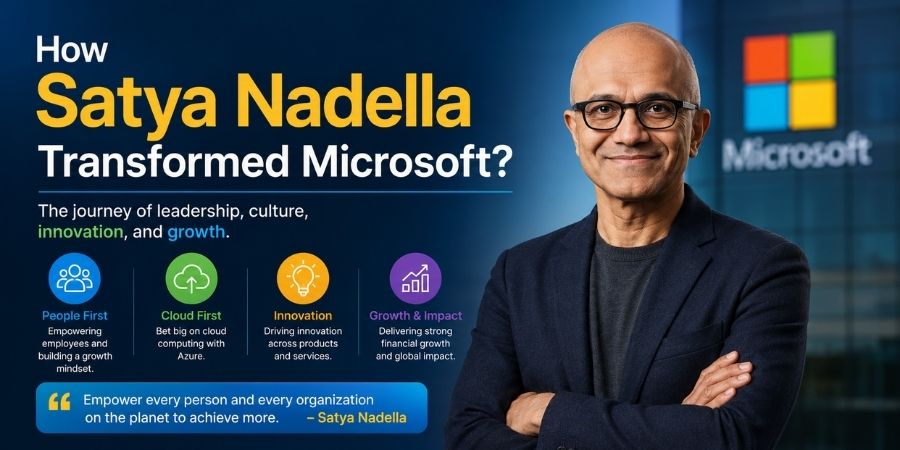
When Satya Nadella became Microsoft CEO in 2014, the company was already one of the world’s biggest technology businesses. But the market around it was changing fast. PCs were losing ground to smartphones, software was moving to the cloud, and companies were beginning to rethink how they bought and used technology.
Nadella did not try to make Microsoft bigger by defending its old strengths. He changed where those strengths were pointed.
The result was a Microsoft built around cloud computing, subscriptions, enterprise software and artificial intelligence. Azure became a core growth engine, Microsoft 365 turned Office into a recurring cloud business, and AI was eventually woven into products across the company.
Microsoft data reveals the magnitude of such change. Turnover stood at $281.7 billion as early as fiscal 2025, while Microsoft Cloud was on $168.9 billion (growing 23% YOY). Azure alone had generated more than $75 billion in revenue (inspiring a growth of 34%).
So, how did Satya Nadella transform Microsoft?
How Did Satya Nadella Transform Microsoft?
Satya Nadella transformed Microsoft by making cloud computing the foundation of the business, moving customers toward recurring subscriptions, changing Microsoft’s culture and making artificial intelligence a central part of its products and infrastructure.
The important part is that these changes were connected.
Azure created the infrastructure. Microsoft 365 brought customers into Microsoft’s cloud ecosystem. Enterprise products such as Dynamics 365 expanded that relationship. AI then became another layer that could run across the same infrastructure and products.
Nadella essentially moved Microsoft’s center of gravity from Windows and packaged software to cloud and AI services.
What Was Microsoft Like Before Satya Nadella?
Before Nadella became CEO, Microsoft was best known for Windows, Office, PCs and traditional enterprise software.
That business was still enormous, but technology was moving in another direction. Cloud platforms were becoming increasingly important, while consumers and businesses were spending more time on smartphones and web-based services.
Microsoft had already started building Azure before Nadella became CEO. The difference under Nadella was the importance given to the cloud across the entire company.
He did not treat Azure as a side business. He made it part of Microsoft’s future.
How Did Satya Nadella Transform Microsoft Azure?
Nadella turned Azure into one of Microsoft’s most important businesses by making cloud infrastructure a central part of the company’s strategy.
This was a natural area for him to lead. Before becoming CEO, Nadella ran Microsoft’s Cloud and Enterprise group.
Once he became CEO, Microsoft continued pouring money into data centers, cloud infrastructure, developer services, databases, security and enterprise workloads.
The payoff has been substantial.
Azure and other cloud services revenue grew 34% in fiscal 2025. Azure alone passed $75 billion in annual revenue for the first time.
Microsoft’s broader cloud business reached $168.9 billion in fiscal 2025, compared with $111.6 billion in fiscal 2023.
That is arguably the clearest evidence of the Microsoft transformation under Satya Nadella.
How Did Satya Nadella Change Microsoft Office?
Nadella changed Microsoft’s Office business by making cloud subscriptions a much bigger part of the company’s productivity strategy.
Office was once closely associated with software installed on a computer and upgraded every few years.
Microsoft 365 changed that relationship.
Word, Excel, PowerPoint, Outlook, Teams and related services became part of an ongoing cloud subscription rather than a product customer simply purchased and replaced periodically.
The financial impact is significant. Microsoft reported $87.8 billion in revenue from Microsoft 365 Commercial products and cloud services in fiscal 2025, up from $66.9 billion in fiscal 2023.
That gave Microsoft something its older model could not provide as effectively: a continuing relationship with customers and a recurring stream of revenue.
Why Was Microsoft’s Cloud Strategy So Important?
Microsoft’s cloud strategy gave the company a way to compete beyond the traditional PC market.
Instead of depending primarily on Windows being installed on a computer, Microsoft could make money when a business ran applications, stored data, developed software or used AI through Azure.
That opened the door to customers using different operating systems and technology stacks.
It also changed Microsoft’s relationship with developers.
Azure became a platform where companies could build and run applications without having to buy and maintain all the underlying hardware themselves.
That shift helped Microsoft compete directly with other major cloud providers while giving its existing enterprise customers a reason to stay within the Microsoft ecosystem.
How Did Satya Nadella Change Microsoft’s Culture?
Nadella changed Microsoft’s culture by pushing the company toward a growth mindset, collaboration and continuous learning.
This part of his transformation is harder to measure than Azure revenue, but it was just as important.
Nadella often contrasted being a “know-it-all” with being a “learn-it-all.” The idea was that Microsoft’s previous success could not become an excuse for assuming the company already had all the answers.
Microsoft has continued to describe growth mindset as a core part of its culture. Nadella has connected it with curiosity, humility, empathy and learning.
The cultural change also supported the business strategy.
A company trying to move from traditional software to cloud services, and later into AI, cannot operate as though yesterday’s products will always define tomorrow’s market.
Did Satya Nadella Make Microsoft More Open?
Yes. Microsoft became significantly more comfortable working across platforms, supporting open-source technologies and partnering with companies that could strengthen its ecosystem.
This was an important departure from the more defensive technology culture associated with Microsoft’s earlier years.
Linux became a serious part of Azure. Microsoft’s developer tools expanded beyond Windows. Office became available across competing platforms.
The goal was no longer simply to make customers use Windows.
It was to make Microsoft useful wherever those customers worked.
That change mattered enormously for Azure because enterprise technology environments are rarely built around one vendor.
How Did Satya Nadella Transform Microsoft Through AI?
Nadella made artificial intelligence the next major layer of Microsoft’s cloud strategy.
The company had already spent years building Azure’s computing infrastructure. Generative AI created a new reason for customers to use that infrastructure.
Microsoft invested heavily in AI data centers, computing capacity and model infrastructure. It also integrated AI into products through Copilot and other services.
In fiscal 2025, Microsoft said it was expanding its AI infrastructure while Azure surpassed $75 billion in annual revenue. The company also reported that its Microsoft Cloud gross margin was being affected by the cost of scaling AI infrastructure.
Microsoft’s AI strategy is not simply about adding a chatbot to Word or Teams. The company is spending enormous amounts on the infrastructure required to run AI at global scale.
What Role Did OpenAI Play in Microsoft’s Transformation?
OpenAI helped Microsoft accelerate its move into generative AI, while Azure provided the infrastructure needed to commercialize those capabilities.
The partnership became especially important after ChatGPT brought generative AI into the mainstream.
Microsoft could combine several advantages:
- Azure’s computing infrastructure
- Microsoft’s enterprise customer base
- Microsoft 365’s enormous user base
- OpenAI’s AI models
- Microsoft’s developer ecosystem
That combination helped Microsoft bring generative AI into products such as Copilot while expanding AI services through Azure.
It also meant Microsoft did not have to build every part of the generative AI stack internally.
What is Microsoft Copilot?
Microsoft Copilot is Microsoft’s family of AI assistants and AI-powered experiences built into products and services across its ecosystem.
Copilot is important because it represents the point where Microsoft’s cloud and AI strategies meet the everyday software people already use.
Instead of asking customers to adopt an entirely new application, Microsoft can put AI inside products such as Microsoft 365.
The company’s AI business has grown rapidly. In January 2025, Microsoft said its AI business had passed an annual revenue run rate of $13 billion, up 175% year over year.
That gives some indication of how quickly AI moved from a research opportunity to a significant commercial business for Microsoft.
What Was Satya Nadella’s Biggest Business Decision?
Nadella’s biggest decision was to make cloud computing central to Microsoft’s future rather than treating it as another product category.
The rest of the transformation followed from that decision.
- Azure supported Microsoft’s enterprise strategy.
- Microsoft 365 moved Office into the cloud.
- Dynamics 365 expanded cloud-based business applications.
- AI workloads created another enormous source of demand for Azure.
- Copilot brought AI into Microsoft’s existing software.
The pieces reinforce one another.
This is why the Satya Nadella Microsoft transformation is more significant than the success of any individual product.
How Much Has Microsoft Grown Under Satya Nadella?
Microsoft’s financial performance has expanded dramatically during Nadella’s tenure.
In fiscal 2025, Microsoft reported:
- $281.7 billion in total revenue
- $101.8 billion in net income
- $168.9 billion in Microsoft Cloud revenue
- $87.8 billion from Microsoft 365 Commercial products and cloud services
- $98.4 billion from server products and cloud services
Azure surpassed $75 billion in annual revenue, growing 34%.
These numbers do not mean every part of Microsoft grew at the same pace. Windows, for example, has become a smaller part of the overall story. Microsoft’s 2025 annual report shows Windows and Devices revenue at $17.3 billion, compared with $98.4 billion from server products and cloud services.
That contrast captures the transformation better than almost any slogan could.
What is Satya Nadella’s Leadership Style?
Satya Nadella’s leadership style is built around long-term technology bets, empathy, learning and organizational change.
He has not led Microsoft by trying to preserve everything that made it successful in the past.
Instead, his approach has been to ask where technology is heading and reposition Microsoft early enough to benefit.
First came cloud.
Then came the subscription model.
Then AI.
That pattern explains much of Satya Nadella’s leadership: recognize the next shift, invest behind it and bring the existing Microsoft ecosystem along with it.
Read our full guide on Satya Nadella’s 5 leadership style.
What is Next for Microsoft Under Satya Nadella?
Microsoft’s next phase is increasingly focused on AI agents, cloud infrastructure and AI-powered enterprise software.
The company has already moved beyond the first wave of generative AI products.
Microsoft is now investing in systems that can perform tasks, work across applications and operate as agents.
The scale of the infrastructure investment is also increasing. In Microsoft’s fiscal 2026 fourth-quarter results, the company reported $331.9 billion in annual revenue, Microsoft Cloud revenue above $214 billion and Azure revenue above $100 billion.
That is a striking progression from the Microsoft that Nadella inherited.
The company is no longer asking how to protect its position in the PC era.
It is competing to provide the infrastructure and software for the AI era.
How Did Satya Nadella Transform Microsoft?
He changed what Microsoft was built around.
Windows and Office once defined the company.
Under Nadella, cloud computing became the foundation. Microsoft 365 turned productivity software into a recurring service. Azure became a major global cloud platform. The company’s culture shifted toward learning and collaboration. Then AI was added across the stack.
The financial results reflect that change. Microsoft Cloud grew from $111.6 billion in fiscal 2023 to $168.9 billion in fiscal 2025, while Azure crossed $75 billion in annual revenue.
And the transformation did not stop there. In fiscal 2026, Microsoft reported that Azure had passed $100 billion in annual revenue and Microsoft Cloud had exceeded $214 billion.
Nadella’s biggest achievement, then, was not simply growing Microsoft.
He gave the company a new center of gravity, and then built the next generation of Microsoft around it.
Key Takeaways
- Satya Nadella transformed Microsoft by making cloud computing the company’s strategic foundation.
- Azure became one of Microsoft’s biggest businesses.
- Microsoft 365 helped shift Office toward recurring cloud subscriptions.
- Nadella changed Microsoft’s culture through the growth-mindset philosophy.
- Microsoft became more open to Linux, open source and cross-platform development.
- The OpenAI partnership accelerated Microsoft’s generative AI strategy.
- Copilot brought AI directly into Microsoft’s existing products.
- Microsoft Cloud generated $168.9 billion in fiscal 2025.
- Azure surpassed $75 billion in annual revenue in fiscal 2025.
- Microsoft’s AI business surpassed $37 billion in annual recurring revenue in fiscal 2026 Q3.
Conclusion
The simplest way to understand how Satya Nadella transformed Microsoft is to look at what became the company’s center of gravity.
It used to be Windows and PC software.
Then it became the cloud.
Now it is increasingly cloud plus AI.
Nadella did not transform Microsoft by throwing away what already worked. He connected Microsoft’s existing strengths to the technologies that were becoming more important.
That is what turned Azure into a major cloud platform, Microsoft 365 into a recurring service, and Microsoft’s existing software ecosystem into a distribution network for AI.
The transformation is still underway. But the direction is clear: Microsoft is no longer defined by the PC. It is increasingly defined by the cloud and the AI infrastructure built on top of it.