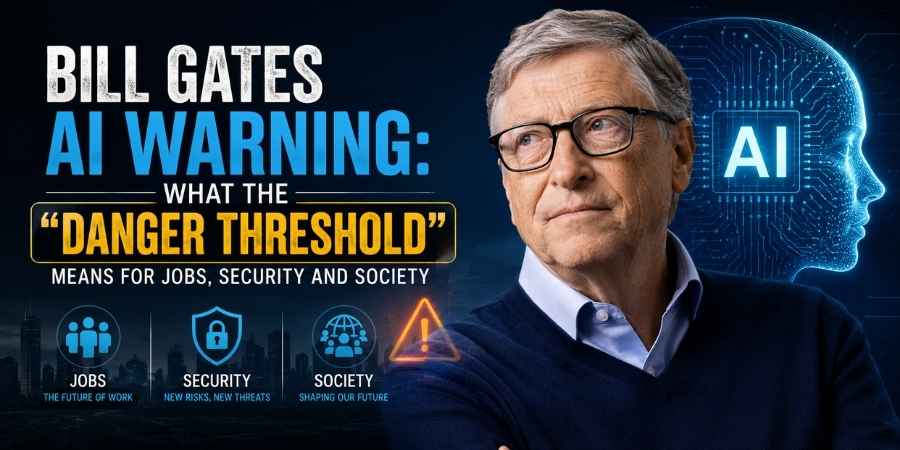
Bill Gates has spent much of the artificial intelligence boom talking about its potential to improve healthcare, education, scientific research and productivity. His latest warning takes a more cautious position.
In an essay published on August 26, 2026, Gates argued that AI development has reached a point where governments and businesses need a clearer plan for managing its consequences. He is particularly concerned about job displacement, cybersecurity, biological risks, fraud, children’s wellbeing and excessive dependence on AI. He also wants governments to consider policies such as taxing AI use and reserving certain jobs for humans.
This apprehension is reflected in a transformation of public sentiments. A survey conducted by the Pew Research Center in June 2026 revealed that 52% of U.S. adults were mostly worried and hardly excited at all about the rising use of AI in everyday life in the year 2026 compared to the proportion standing at 37% in 2021. Only 9% of the respondents were mostly excited and hardly worried at all.
What Does Bill Gates Mean by the AI Danger Threshold?
Gates is not describing one specific moment when AI suddenly becomes dangerous.
His argument is about the capabilities AI systems already have and how quickly those capabilities are improving.
AI can now perform increasingly complex tasks involving:
- Software development
- Research and analysis
- Content creation
- Cybersecurity
- Data processing
- Scientific research
- Business operations
- Customer service
- Education
- Healthcare support
Gates is concerned that the same capabilities that make AI useful can also make certain harmful activities easier and cheaper.
His latest concerns fall into three broad categories.
AI risk | Gates’ concern | Possible consequence |
Employment | AI and robotics could replace more human workers | Job losses and economic disruption |
Security | AI could help criminals conduct cyberattacks and create biological threats | Greater national and public safety risks |
Human development | Excessive AI dependence could affect learning and relationships | Reduced critical thinking and social connection |
Gates has also said that the AI industry cannot be expected to regulate itself adequately and that governments need to become more involved.
1. AI Could Reshape the Job Market
Employment is one of Gates’ biggest concerns.
AI has already changed the way many companies approach software development, research, administration, customer support and other knowledge-based work. Gates believes the next stage could affect a much wider range of occupations as AI systems become more capable and robotics becomes more advanced.
He has raised particular concern about blue-collar workers, including people working in construction, hospitality and manufacturing. His argument is that improvements in robotics could eventually make physical automation more economically attractive in areas that currently depend heavily on human labour.
Jobs could be affected in several ways
- AI could automate individual tasks.
- Entire workflows could require fewer employees.
- Companies could use AI to increase output without increasing headcount.
- Robotics could extend automation into physical work.
- Entry-level roles could become harder to find.
- Some existing occupations could change substantially.
The transition could be particularly difficult for older workers and people who cannot easily move into new industries.
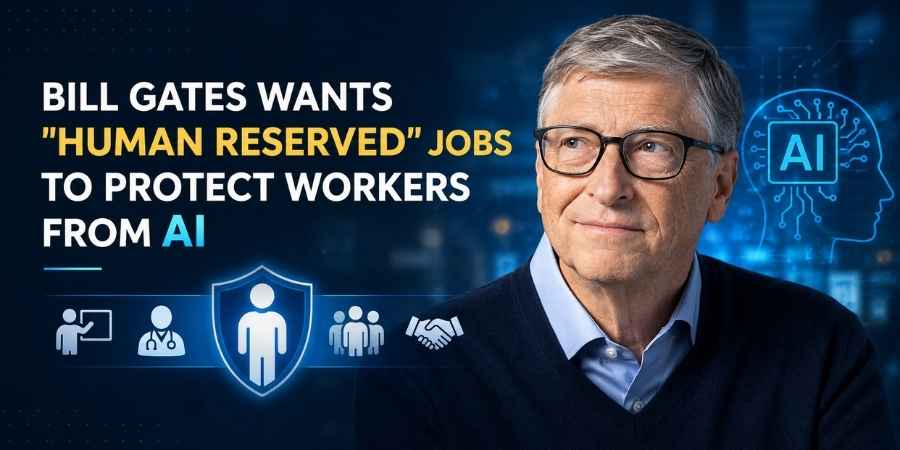
What is Bill Gates’ “Human Reserved” Idea?
Gates has proposed that some jobs should be designated “Human Reserved,” meaning they would remain protected from complete automation.
Among other work types, he has mentioned healthcare and caregiving where interaction with a human being is involved and where a person’s responsibilities and duties go beyond just finishing the task in hand.
The idea could involve:
- Keeping certain roles primarily human
- Restricting complete automation in sensitive occupations
- Allowing AI to assist human workers without replacing them
- Giving workers more time to adapt to automation
This proposal raises difficult questions about which occupations should receive protection and who should make that decision.
2. Gates Wants AI and Robots to Face New Taxes
Another proposal is an AI or robot tax.
Gates argues that the existing tax system can create an economic incentive for businesses to replace human workers with machines. When companies employ people, they pay payroll-related taxes and other employment costs. Automation can change that calculation.
A tax on AI use, AI tokens or robots could potentially:
- Reduce the financial incentive for rapid replacement of workers
- Generate government revenue
- Fund retraining programmes
- Support workers affected by automation
- Help maintain public services as employment patterns change
Gates has described this as one possible way to manage the economic transition rather than as a tax designed to stop AI development.
There are also legitimate economic questions around the proposal. A high tax could discourage useful automation, increase business costs and reduce investment in AI.
A workable policy would need to distinguish between productive AI use and automation that produces significant labour displacement.
3. AI is Creating New Cybersecurity Risks
Cybersecurity is another major part of Gates’ warning.
AI can help security teams identify vulnerabilities, analyse large amounts of information and respond to threats. The same capabilities can also be used by attackers.
AI can potentially make it easier to:
- Identify software vulnerabilities
- Automate phishing campaigns
- Generate convincing fraudulent messages
- Analyse stolen information
- Scale social-engineering attacks
- Conduct reconnaissance
- Develop malicious code
Gates has pointed to recent AI-assisted hacking activity as evidence that some risks have already moved beyond theoretical discussions. Reuters reported that Gates is particularly concerned about AI models being used to hack real-world websites and wants stronger international coordination on AI security.
The key concern is the lowering of the technical barrier for cybercrime.
An attacker who previously needed significant technical expertise could potentially use AI tools to complete parts of a complex operation.
4. AI Could Increase Biological Security Risks
Bill Gates has pointed out the link between AI and biotechnology as one of them might enhance the other.
AI is a tool through which researchers can understand and process biological data; find hidden patterns and because of this shorten the time in the discovery of research.
But this would also be a threat if biological knowledge of such caliber was made even more accessible or if the application of the knowledge was used to cause harm.
Gates is advocating for more surveillance of the AI capabilities that might help the formation of life-threatening biological agents.
His rationale for a change in direction of policy is one of the reasons he wants more regulation at the government level rather than leaving the whole matter of safety to the tech companies.
5. Children and Human Relationships Are Another Concern
Gates is also concerned about the effect of AI on children.
The issue goes beyond screen time.
AI systems can provide answers, recommendations, entertainment and increasingly personalised conversations. Gates worries that excessive dependence could affect learning, independent thinking and human relationships.
Public concern about AI is already significant among younger Americans.
Americans’ views of AI in 2026
Age group | More concerned than excited |
18–29 | 55% |
30–49 | 51% |
50–64 | 47% |
65+ | 59% |
The Pew Research Center survey was conducted June 22–28, 2026.
Among adults aged 18 to 29, the share who were more concerned than excited increased from 31% in 2021 to 55% in 2026.
That does not establish that AI is harming young people. It does show that concern about its growing role is increasing.
AI Public Opinion Has Changed
The broader trend is also significant.
Year | More concerned than excited | More excited than concerned |
2021 | 37% | 18% |
2022 | 38% | 15% |
2023 | 52% | 10% |
2024 | 51% | 11% |
2025 | 50% | 10% |
2026 | 52% | 9% |
The figures show a substantial change from 2021. Concern has increased by 15 percentage points, while the share that is more excited than concerned has fallen by 9 percentage points.
Why Gates Wants Governments to Act Now
Gates’ concern extends beyond individual AI systems.
AI is affecting several areas at the same time:
- Employment
- Education
- Healthcare
- Cybersecurity
- Biotechnology
- National security
- Taxation
- Social welfare
- Business productivity
- Children’s development
Gates wants governments to create national and international frameworks that address these areas together.
He has also called for international cooperation, including discussions between the United States and China. Reuters reported that Gates is seeking discussions with Chinese President Xi Jinping about global AI policy.
International coordination is particularly important for cybersecurity and biological risks because AI systems and their outputs can cross borders quickly.
What Businesses Should Learn from the Warning
Gates is not calling for companies to abandon AI.
He continues to see significant benefits from AI in areas such as healthcare, education and government services. His argument is that companies need to adopt the technology while preparing for its economic and social effects.
Businesses can take several practical steps.
1. Review tasks before replacing jobs
Instead of asking whether an entire job can be automated, companies should identify which tasks AI can perform and which still require human judgement.
2. Invest in employee training
Workers need opportunities to develop skills that complement AI.
3. Keep human oversight
Sensitive financial, medical, legal and employment decisions should have appropriate human review.
4. Strengthen cybersecurity
Companies using AI should review access controls, data handling, model permissions and monitoring systems.
5. Create clear AI policies
Employees should know which AI tools they can use and what company information they can provide to those systems.
6. Measure productivity honestly
AI adoption should be evaluated based on measurable improvements in quality, productivity, customer outcomes and employee experience.
Is Bill Gates Saying AI Will Destroy Jobs?
Gates is warning about significant job displacement, but his position is more nuanced than saying every job will disappear.
AI is more likely to change tasks first. Some occupations may shrink, some may expand and new roles may emerge.
The difficult issue is the speed of the transition.
If AI capabilities improve faster than workers can retrain, companies and governments could face periods of unemployment and underemployment even if new industries eventually develop.
That is why Gates is advocating for preparation before large-scale disruption becomes more difficult to manage.
Is AI Already Dangerous?
Some AI-related risks are already observable.
These include:
- AI-assisted cyberattacks
- Fraud and deepfakes
- Automated misinformation
- Rapid workplace automation
- Privacy concerns
- Overdependence on AI-generated information
- Potential misuse in biological research
Other risks remain uncertain and depend on how AI capabilities develop.
It is therefore useful to separate current risks from future scenarios.
Current or emerging issue | Longer-term concern |
AI-assisted fraud | Highly autonomous criminal operations |
Coding automation | Major occupational displacement |
AI-assisted cyberattacks | Large-scale automated cyber conflict |
AI research assistance | Misuse of advanced biological capabilities |
AI companions | Long-term effects on human relationships |
Workplace automation | Structural changes to labour markets |
What Happens Next?
Gates’ proposals are likely to generate debate because they involve substantial changes to economic policy and AI regulation.
The main questions include:
- Which jobs should be protected?
- How would an AI tax be calculated?
- Who would decide when automation crosses an acceptable threshold?
- How should AI companies be regulated?
- How can governments support workers during transitions?
- How should international AI standards be enforced?
- How much government intervention is appropriate?
There is also a broader question about who should control the direction of AI development.
Gates wants governments, researchers, businesses and citizens involved in the discussion rather than leaving major decisions solely to technology companies.
Frequently Asked Questions
What did Bill Gates say about AI in August 2026?
Bill Gates warned that AI development is moving quickly and that governments are not adequately prepared for its effects on jobs, security, children and society. He called for stronger policy and international coordination.
What are Bill Gates’ biggest concerns about AI?
His main concerns are job displacement, AI-enabled cyberattacks, biological security risks, fraud, effects on children and excessive dependence on AI.
What are Human Reserved jobs?
Human Reserved jobs are roles that Gates believes could be protected from complete automation. Healthcare and caregiving are examples associated with the proposal.
Does Bill Gates want to stop AI development?
No. Gates continues to support AI applications that can improve healthcare, education, government services and other areas. His argument is for stronger safeguards and planning around its risks.
How many Americans are concerned about AI in 2026?
Pew Research Center found that 52% of U.S. adults were more concerned than excited about the increasing use of AI in daily life in 2026.
Key Takeaways
- Bill Gates believes AI has reached a stage requiring stronger government preparation.
- His main concerns involve jobs, cybersecurity, biological security and human development.
- He has proposed taxes on AI and robots as one possible response to labour displacement.
- Gates has suggested creating Human Reserved jobs that remain protected from complete automation.
- 52% of U.S. adults were more concerned than excited about AI in 2026, according to Pew Research Center.
- Among Americans aged 18–29, 55% were more concerned than excited about AI in 2026.
- Gates wants greater international cooperation on AI safety and governance.
- His warning does not amount to a call to stop AI. It is a call for governments and businesses to prepare for its consequences while continuing to pursue its benefits.
Final Thoughts
Bill Gates’ latest position demonstrates a change in emphasis rather than a rejection of AI.
He still sees substantial opportunities in healthcare, education, science and public services. His concern is that AI development is moving faster than the policies, labour-market systems and safety structures designed to manage it.
For businesses, the practical lesson is to treat AI adoption as more than a technology project. Companies need to consider workforce planning, cybersecurity, data governance, employee training and human oversight at the same time.
For governments, the challenge is broader. AI policy will need to address employment, national security, scientific research, taxation and children’s wellbeing.
The debate over AI is therefore moving into a more practical stage. The central issue is no longer simply what AI can do. It is how society should manage increasingly capable AI while ensuring that its economic and social benefits reach more people and its risks remain manageable.