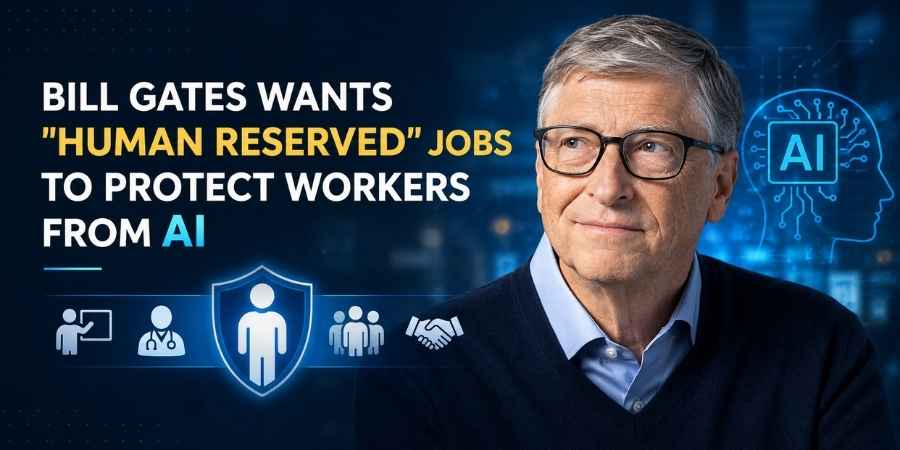
Bill Gates has a new idea for the AI jobs crisis, and it comes with a name that sticks: Human Reserved. In a lengthy essay published on Gates Notes on August 26, 2026, the Microsoft co-founder argued that some jobs should stay off-limits to automation, no matter how capable AI becomes.
The essay covers familiar ground too. Gates praised AI’s promise in science and healthcare. He also backed Pacing The Frontier, an open letter from AI workers calling for a slower rollout of frontier models, while doubting that a slowdown could hold. But the Human Reserved concept, paired with a proposed robot tax, is what sets this piece apart.
What Does Human Reserved Mean?
Human Reserved describes a job category that AI cannot touch, protected by policy rather than by technical limits. Gates draws a clear line between what AI can do and what it should do. A machine could likely deliver a terminal diagnosis to a patient. Gates argues it should never get the chance. Some roles carry emotional weight that only a person can carry properly, and Human Reserved status would keep those roles staffed by humans on purpose.
Why Does Gates Want a Robot Tax?
Gates pointed to a quirk in how businesses pay for labor versus machines. Hire a worker, and payroll taxes kick in immediately. Buy a robot instead, and a company can often deduct the full cost right away. That gap pushes employers toward automation, even when a human would do the job just as well.
A robot tax would narrow that gap. Gates suggested the revenue could fund retraining programs and a stronger safety net for displaced workers, giving people time to shift careers instead of losing income overnight.
Who Would Human Reserved Jobs Protect?
Gates used a specific example to make his point. A 55-year-old construction worker cannot simply retrain for a job at an elder care facility and expect to find it satisfying. Displacement hits hardest in industries where switching careers late in life offers few realistic options. Human Reserved status would shield roles where large numbers of workers have no easy path to a new profession.
The list would not stay fixed. Gates described Human Reserved as a category that shifts over time. Policymakers could carve out protections now, then phase in AI gradually across decades, always keeping a commitment to preserve certain jobs for people.
Quick Facts
Idea | What It Does |
Robot Tax | Adds a cost to automation, similar to payroll tax on human workers |
Human Reserved | Legally protects specific jobs from being replaced by AI |
Funding Source | Robot tax revenue would support retraining and safety-net programs |
Timeline | Gates proposes a gradual phase-in, not an immediate mandate |
Why Have These Ideas Stayed Quiet Until Now?
Both proposals would cut into the profits of major AI labs, which may explain why the industry has stayed mostly silent on them. A robot tax raises the cost of deployment. Human Reserved rules limit the market these companies can sell into. Neither idea helps a lab’s bottom line, so neither has gotten much airtime from the companies building the technology.
Gates left plenty unresolved. He did not say who would decide which jobs earn Human Reserved status, or how governments would enforce the designation across industries and borders. Those questions will likely shape whether the idea moves from an essay into actual policy.
What Happens Next?
Gates joins a growing group of tech leaders speaking publicly about AI’s labor risks, but his specific proposals give lawmakers a concrete starting point. Human Reserved status offers a legal mechanism, not just a warning. A robot tax offers a funding source, not just a talking point. Whether either idea gains traction depends on policymakers willing to test them against resistance from the labs that stand to lose the most.
For now, Human Reserved remains a proposal, not a law. But it names something workers have felt for a while: certain jobs deserve protection precisely because they involve being human.