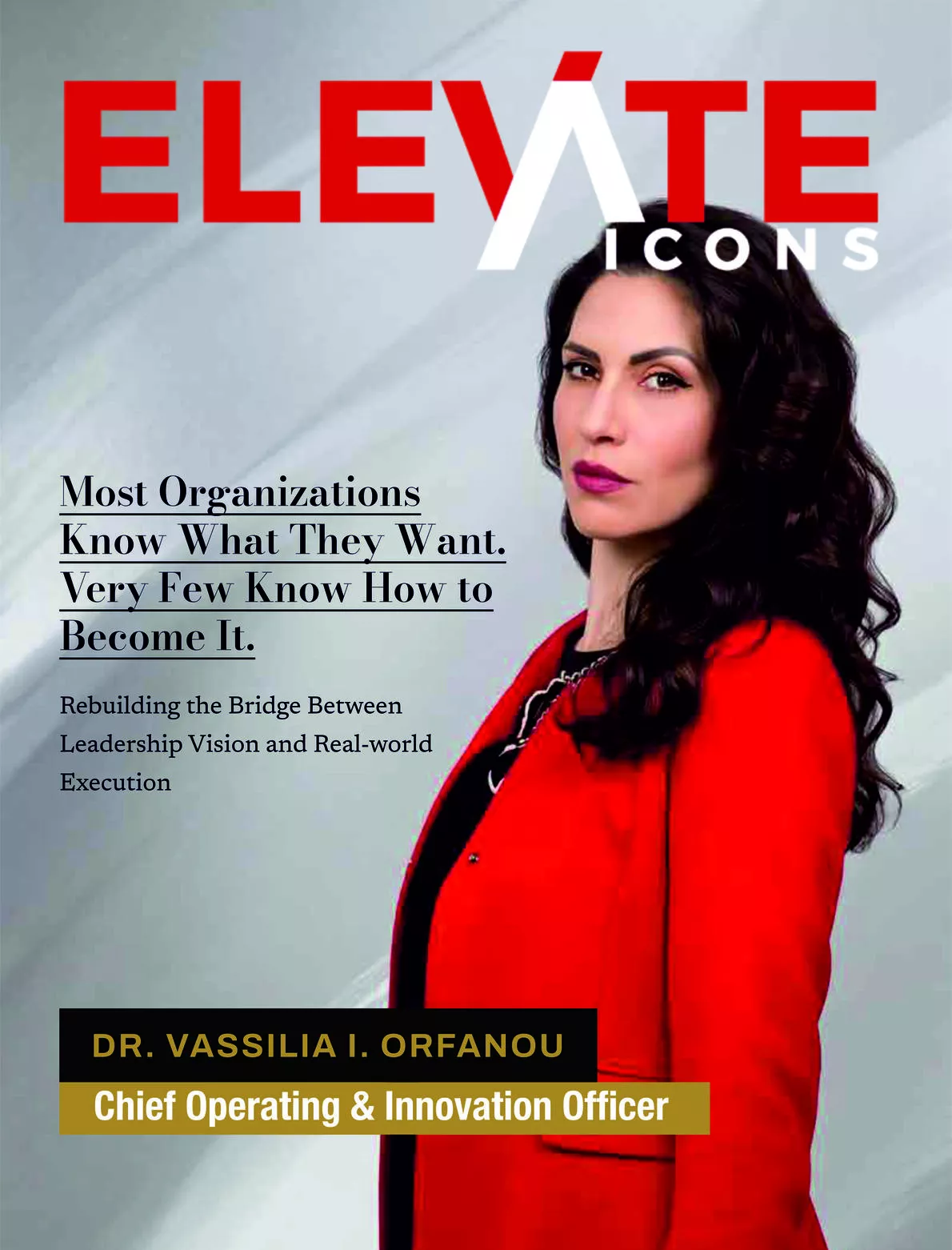
Rebuilding the Bridge Between Leadership Vision and Real-world Execution.
Every organization has a plan. Most have several, sitting in shared drives, presented in boardrooms, approved by people who genuinely believed in them at the time. But there is a moment, familiar to anyone who has sat inside a large organization long enough, when that plan meets the actual company, and something shifts.
The clarity that existed in the room where decisions were made begins to scatter the moment it travels downward. Teams interpret it differently. Middle layers filter it. And by the time it reaches the people doing the daily work, the original intention has taken on so many shapes that nobody can quite trace it back to where it actually started.
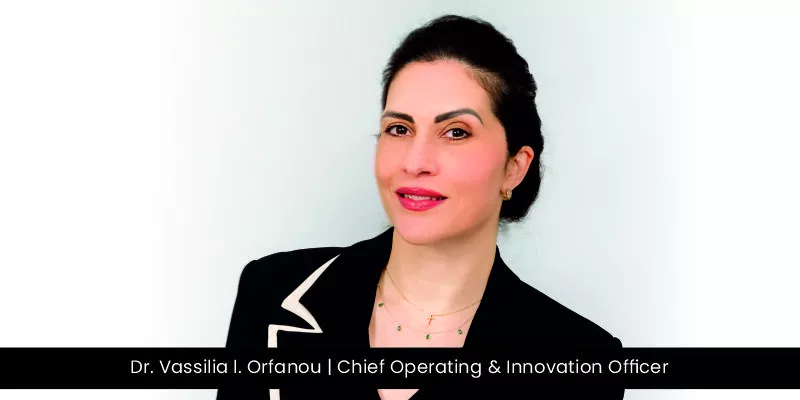
That gap, between what leadership means and what the organization does, is exactly where Dr. Vassilia I. Orfanou has chosen to work, and she will be the first to tell you that closing it takes far more than a good strategy.
Her belief, formed over years of working across strategic marketing, public policy, and business transformation, is that these three disciplines were never meant to operate in separate rooms.
“Behind every organization that truly delivers on its promise, she says, is a clear message, a strong positioning, and a business model that holds all three together, and when any one of them is missing or misaligned, even the most carefully built strategy begins to fail from within.”
As Chief Operating Officer at Luxembourg’s Diplomatic and Communications Institute (LUDCI.eu), she works at precisely that point of failure, entering organizations where the C-level vision is either fragmented, unclear, or simply losing itself in translation, and rebuilding the alignment between leadership, communication, and execution until the organization stops saying the right things and finally, genuinely, starts becoming them.
Shaped by Transformation
A career rarely follows a straight line, but for those who thrive in complexity, it follows pressure. Dr. Orfanou’s 22-year journey has been precisely that: a deliberate move through high-stakes environments, where repositioning and restructuring were not abstract goals but urgent necessities.
From finance and media in New York to leading strategic communications and large-scale EU programs across Europe, she has consistently stepped into roles where organizations needed repositioning, restructuring, or growth acceleration.
Sectors such as banking, defense, technology, engineering, and public institutions are particularly compelling to her because they operate under pressure, whether it be regulatory, reputational, or operational.
In these environments, strategic communications and business model clarity are not optional. They are critical assets. She has built her career in helping organizations navigate that complexity and turn it into an opportunity.
The First 72 Hours
When an organization hits a wall, whether from stalled growth, regulatory pressure, or internal misalignment, the instinct is often to reach for a structural fix. Dr. Orfanou’s approach goes deeper, and it starts with a deceptively simple question.
She begins by diagnosing three core dimensions simultaneously: the business model, the narrative around it, and the people who both lead and implement it. Transformation, in her view, is never just structural, linear, or strategic. “It is human.” So, one of the first questions she asks is very simple: “Do we have the right leaders in the right roles, and are the experts actually empowered, skilled, and aligned to deliver?”
Often, the issue is not only operational, but also how the organization is positioned, how it communicates its value, and how its strategy exhibits market reality. Capabilities may also be misaligned with ambition, which creates friction during the execution phase.
She assesses four things immediately:
- Is the value proposition clear and competitive?
- Is the communication strategy reinforcing or diluting it?
- Is the business model scalable and financially sound?
- Do the current structures, skills, and leadership layers support execution?
From there, she moves quickly into action, aligning messaging, redefining priorities, and, where needed, restructuring the organizational structure to ensure clarity in decision-making and accountability.
Equally important is investing in people, which often means reskilling and retraining teams so that they can operate within a new model, especially in areas such as digital, AI, and strategic communications.
Finally, she creates momentum through quick and visible results. “When people see progress and understand their role within it, transformation becomes real and sustainable.”
Built From Zero
Advisory work has its place, but there is a distinct difference between those who recommend and those who actually build. Dr. Orfanou belongs firmly in the latter category.
For a data infrastructure project, she built the entire marketing and communications function from scratch, but it went far beyond that. The work was not just about creating an awareness through a press campaign. It involved defining the organization’s identity, positioning, and market relevance.
This included building the full communications ecosystem, restructuring how value was presented to stakeholders, and aligning it with revenue-generating activities. Within two years, the initiative reached €45M in press value and significantly scaled the P&L.
It was a clear demonstration of how strategic communications, when aligned with business objectives, can directly drive growth.
The €11M Moment
Across a portfolio of over €850M in value delivered and 300+ cross-border projects, patterns of impact tend to blur together. But some moments cut through.
What Dr. Orfanou values most is the ability to consistently deliver impact across sectors by combining marketing strategy, financial discipline, and business model restructuring. A standout moment was securing and delivering an €11M structural funding project under the auspices of an EU institution.
It required not only a strong technical and financial proposal but also positioning the initiative strategically within a competitive and highly regulated environment. “It is that combination of strategy, communication, and execution that defines success.”
AI is Not Just a Technology Shift
Organizations rushing into AI integration or digital HR changes often underestimate what they are actually changing. For Dr. Orfanou, technology is rarely the hardest part.
AI transformation, in her framing, is not just a technology shift; it is also a business model and communication shift. She focuses on integrating AI into how organizations operate, but also into how they position themselves, engage audiences, and create value.
This means redefining workflows, upskilling teams, and ensuring that both internal and external communication reflect the new reality. “If the transformation is not understood, it will not be adopted.”
38 Projects. One Framework.
Delivering a single complex project on time and on budget is hard enough. Doing it simultaneously across dozens, with millions on the line, requires a fundamentally different operating discipline.
Dr. Orfanou combines rigorous project management with absolute clarity on outcomes and a disciplined, hands-on execution approach. Every initiative she leads starts with a clearly defined structure, a detailed roadmap, financial planning, and a concise set of KPIs that go beyond operations to include marketing performance, stakeholder engagement, and measurable business impact.
While leading multiple EU-funded programs, she simultaneously managed up to 38 projects with a combined budget of over €35M. Each was broken down into milestones with strict timelines, clear ownership, and continuous performance tracking, allowing all outputs to be delivered on time, while maintaining full financial control.
During a €11M structural funding project developed in cooperation with a Big 4 Consortium leader and a series of EU partners, she established a centralized communication and reporting framework that reduced delays, eliminated duplication, and kept all parties focused on shared deliverables and deadlines.
She applies the same discipline in any business environment. For instance, for a different software integration project, while building the tech and communications function from the ground up, she introduced KPI-driven planning across content, media, and digital channels, ensuring that every campaign contributed not only to visibility but also to measurable growth in engagement, partnerships, and revenue streams.
“It is never only about delivering projects. It is about managing them as integrated business drivers with full accountability on time, budget, and impact.”
Trust is Not a Soft Skill
Boardrooms, C-suites, and frontline teams often operate as if they are in different organizations entirely. Bridging that gap is one of the least glamorous and most consequential parts of any transformation.
For Dr. Orfanou, alignment starts with consistent and strategic integrated marketing and communications. She ensures leadership, stakeholders, and teams are all connected through a shared narrative, one that clearly explains the direction, the value, and the expected outcomes.
At the same time, communication is tailored: strategic for the boardroom, practical for execution teams. “When communication is clear and consistent, trust follows.”
Three Questions That Cut Through Noise
Complexity is often mistaken for sophistication. In practice, it tends to be a symptom of unclear thinking. Dr. Orfanou’s method for making tough decisions is deliberately stripped down.
She connects every decision to business impact and communication clarity. Her position is direct: people do not need more information; they need direction. So, she simplifies complexity into three elements: what matters, what changes, and what happens next. She then ensures that the message is consistently reinforced across all channels, both internally and externally.
Bold Ideas Require a Business Case
Creativity without accountability is clearly noise. In high-performance environments, the two are not opposites; they are requirements.
Dr. Orfanou anchors creativity in strategy and measurable outcomes. In marketing and communications, bold ideas are essential, but they must serve a purpose.
She creates environments where teams can innovate, while working within a framework that connects creativity to performance, brand positioning, and revenue impact.
€200K to €6M in just Eight Months
Brand strategy repositioning is one of the most overused phrases in business, and one of the hardest things to execute. The numbers, when they exist, speak for themselves.
For a PR agency, Dr. Orfanou took up the restructuring of the EU Affairs and bid division, both operationally and strategically. The offering was repositioned, the communication strategy refined, and the whole was aligned with market demand.
The result was exponential growth from €200K to €6M in contracts within eight months. It showed how clear positioning and disciplined execution can transform business outcomes.
What Diverse Sectors Teach You
Most professionals develop deep expertise in one or two industries. Working across hospitality, defense, technology, manufacturing, and public administration is a different kind of education, and not always a comfortable one.
Working across such diverse sectors has shown Dr. Orfanou that innovation is rarely about tools alone. It is about how organizations think, communicate, and ultimately structure themselves to evolve. Each sector brought a different lesson.
In hospitality, experience and storytelling drive value and brand differentiation. In defense and technology, precision, trust, and regulatory alignment are critical, and innovation must operate within strict frameworks. In engineering, efficiency and process optimization define competitiveness.
In public administration, impact depends on policy alignment, stakeholder trust, and long-term sustainability.
What connects all of them, in her view, is this: the organizations that truly succeed are those that align three core elements – their culture, their communication, and their business strategy. “When one of these is disconnected, innovation becomes fragmented and short-lived.”
She has also observed that sustainable innovation requires investing in people just as much as in systems. Reskilling teams, fostering cross-functional collaboration, and creating a culture that is open to change are essential.
Without that, even the most advanced strategies or technologies fail to scale. Sustainable innovation happens when organizations create clarity in direction, consistency in communication, and structures that support both accountability and adaptability.
“When these elements move together, innovation is not just implemented. It becomes part of the organization’s DNA.”
What Comes Next
In a moment when AI, communications, and business models are converging at unprecedented speed, the question of what leadership actually means is genuinely open. Dr. Orfanou’s answer is not a cautious one.
What excites her most is the chance to empower organizations to do more than just adapt, to boldly redefine themselves. This, she holds, is the moment to lead, innovate, and imagine what is truly possible.