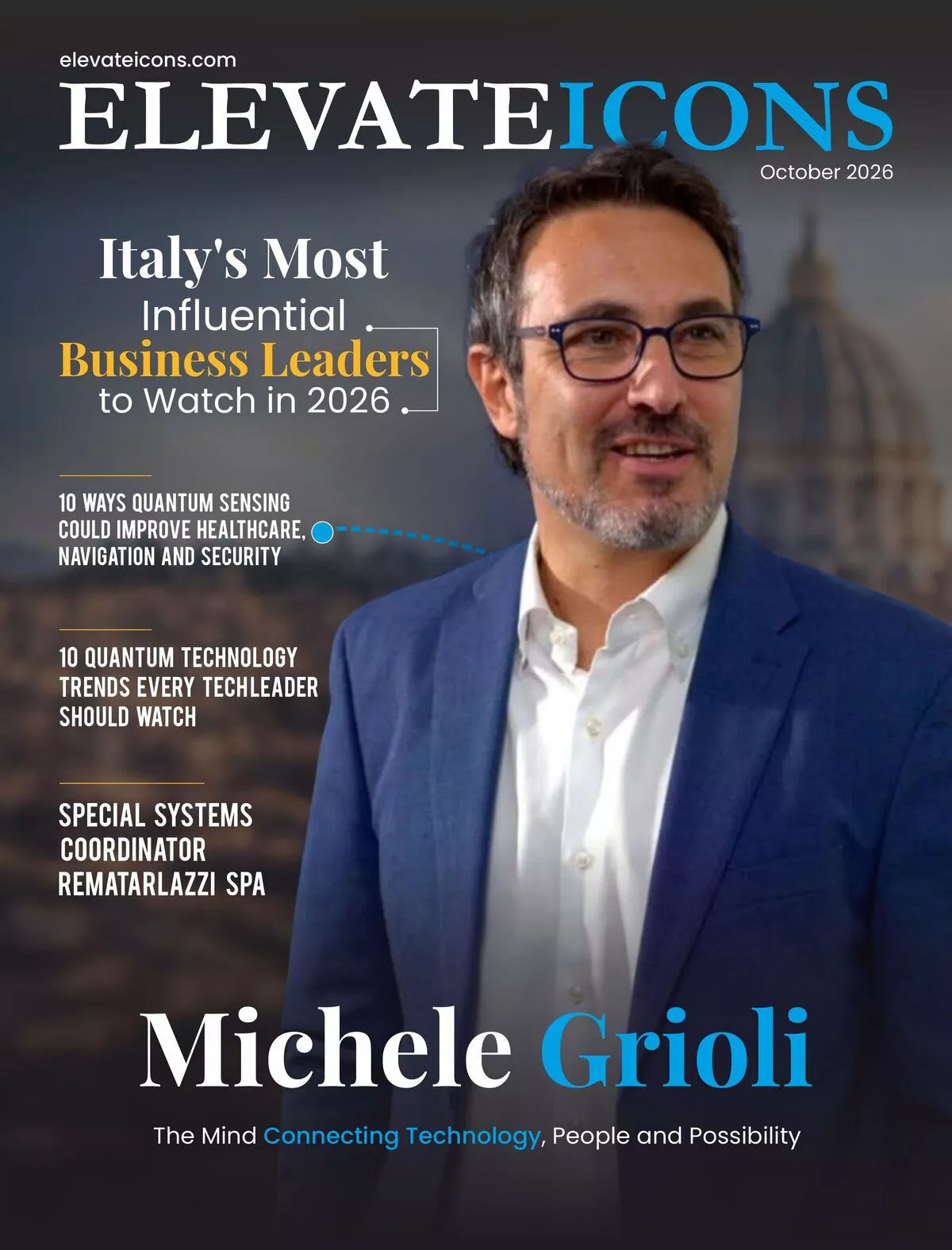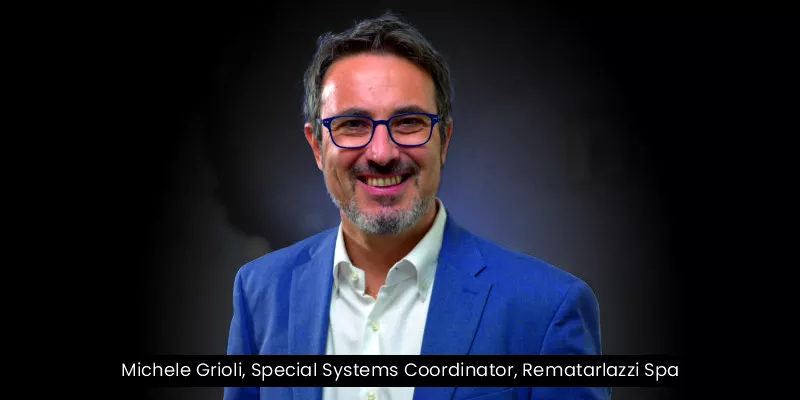
The Special Systems leader bringing together technical expertise, human insight, and a lifelong belief in technology that improves the way people live.
How many different systems can a building depend on before managing them becomes a challenge in itself? Security, Building Automation, Networking, HVAC and energy management each require specialised knowledge, yet they increasingly have to work alongside one another. For the electrical industry, this creates a simple but important question: who understands enough about each side to bring them together in a practical way?
Michele Grioli’s career provides an interesting answer to that question because his experience has developed across several parts of the industry, rather than along a single path.
After completing his technical studies in industrial telecommunications and electronics, Michele began studying economics at university. He completed his first year before an electronics company offered him an opportunity to develop products related to Building Automation for the hotel industry. The opportunity changed the direction of his career and gave him his first real experience of how technology moves from an idea into something people can use.
For seven years, he followed the entire product life cycle, from the initial concept to its launch on the market. During this time, he worked on access control systems and CPUs for thermal management and energy savings. It was a period that gave him a strong understanding of product development while keeping him close to the practical needs of buildings.
After those 7 years, another change followed when the sales management team introduced him to the world of economics and the Italian market. Michele moved from product design into an Area Manager role, where he managed the sales network and the development of new installations. Working closely with professionals in the sector allowed him to gain an in-depth understanding of the electrical market.
His experience then continued with an Italian multinational company specialising in home automation and security, adding another perspective to his growing knowledge of the industry. From there, he joined an interregional company in Central Italy operating in the distribution of electrical materials.
After almost 4 years, Michele was entrusted with coordinating a Business Unit called Special Systems, a new concept within the electrical distribution landscape. It was a role that brought together many of the experiences he had gathered throughout his career.
Today, as Special Systems Coordinator at Rematarlazzi S.p.A., he coordinates an operational structure spread across five regions of Central Italy, specialising in Security, Building Automation, Networking, and HVAC. His journey from technical studies and product development to sales, market knowledge and electrical distribution has given him a broad understanding of an industry where different systems increasingly need to work together.
When Technology Has a Purpose
Technology can solve extraordinary problems, but the question of why it should exist in the first place is often more interesting. For some people, technology begins with a product, a market, or a business opportunity. For Michele, its starting point has always been much closer to people and the quality of their lives.
He has always had a strong aptitude for mathematics, logic, and robotics, with a clear dream since he was young: to use technology to improve people’s lives, from advanced prosthetics to the interpretation of human thought.
He has always believed that life should not simply be prolonged, but expanded. There is an almost obsessive pursuit of living as long as possible, but what if the focus shifted instead towards living better and remaining at the peak of physical and intellectual abilities for as long as possible?
Around 40 years ago, this way of thinking led him towards applied electronics. He became passionate about the field and about the possibilities it could create, while also being aware that practical innovation must always go hand in hand with economics, finance, and commerce. That understanding would become important throughout his career. His work would take him through technical development, sales, project management and regional coordination, giving him a view of the industry from several different sides.
When a Good Product Needs a Good Story
Technical knowledge can take a product a long way, but eventually every solution has to meet a customer, a market, and a real need. Moving through different roles taught Michele that the success of a product depends as much on how people understand it as on how well it works.
When he looks back at his career, there is one guiding principle in which he firmly believes: if you do not communicate well, the product does not exist.
He could create the best solution or system in the world, but if he cannot present it to the market in a clear and understandable way, it is as though nothing has been achieved.
This belief has always been accompanied by strong discipline and by a phrase from Albert Einstein that has deeply inspired him: “Everyone knows that something is impossible to achieve until someone who doesn’t know that invents it.”
Ultimately, he can say that discipline, curiosity, or hunger, and communication are the three pillars that have characterised his entire career. Those three qualities become even more significant when the work extends across different regions, markets and teams, where understanding the technology is only one part of the responsibility.
Leading Across Different Markets
Coordinating people across five Italian regions means dealing with different local markets, customer requirements, suppliers and working environments. The challenge lies in bringing all those differences together while giving people enough space to contribute their own strengths.
For Michele, bringing together the needs of suppliers, the work of colleagues, and the complexity of different local markets is a stimulating challenge.
Throughout his career, he has learned that the strength of a company lies precisely in its diversity. One of the fundamental characteristics of a leader, in his view, is the ability to communicate a subject appropriately and make oneself understood across different markets and business environments.
True leadership is completed by bringing out the skills of colleagues and recognising each person’s uniqueness, so that success and achievement are, first and foremost, the result of their own contribution. That belief in diversity also shapes the way he looks at technology itself. Working between technology and business has taught him to question the excitement that often surrounds every new development.
Knowing When Technology Really Matters
Every new technology arrives carrying a promise. Sometimes that promise answers a genuine need; at other times, enthusiasm around a new idea can move faster than its actual usefulness. For someone working closely with customers and the market, knowing the difference becomes an important part of making the right decision.
Over time, Michele has seen all new technologies emerge with the noble intention of delivering genuine added value to customers. Unfortunately, history has taught him that when technology is driven solely by business and power interests, its evolution can become reckless and dangerous.
If technological growth is sustained only by-passing trends or temporary enthusiasm, he believes it is destined to fade quickly.
His own beliefs are based on a precise principle: truly successful technologies are those capable of “listening” to the customer and understanding their real needs, because only in this way can a healthy and sustainable business be built.
He also sees the present moment as particularly difficult to measure through traditional ideas of technological value. In the current historical moment, it is difficult to place limits or assign fixed values to either old or new technologies. The speed at which demand is evolving cannot easily be measured using traditional benchmarks.
For a business to remain successful, it must take this variable into account and adapt itself to change as well. That constant change is already visible in the way different building systems are beginning to communicate with one another, creating a new set of expectations around connectivity and interoperability.
When Everything Needs to Connect
The idea of a connected building has changed considerably. A security system, an automation platform, a network, or a device can no longer be considered entirely on its own when the wider project depends on information moving between them.
Consider the world of IoT, the Internet of Things. Today, data sharing and interoperability between devices are fundamental pillars for the future of virtually any project.
For Michele, this creates a priority and invaluable criterion when choosing products: new technologies must not only be reliable and functional; they must also be interoperable.
This shift towards connected systems also explains why Special Systems is becoming increasingly important. As more parts of everyday life become connected, the conversation moves from individual products towards the people and expertise required to make those systems useful.
Why People Still Matter Most
Connectivity has created a stronger desire for control. People want to understand what is happening around them, manage their environments, improve efficiency and feel more secure. That desire now reaches almost every part of daily life, from homes and offices to schools, companies, vehicles and connected devices.
Today, the Special Systems sector is acquiring fundamental strategic importance thanks to connectivity and the integration of increasingly advanced systems.
The natural human desire to remain connected to the world has generated a strong need for control, which now extends to virtually every environment: homes, offices, schools, companies, vehicles, and any device that can be connected to a network.
This evolution encompasses everything from energy efficiency and security to comfort.
Behind this growing drive for control, Michele believes companies that want to conduct business seriously must invest decisively in people.
Having expertise within an organisation means having resources and services that can provide genuine value to those approaching new technologies.
Artificial intelligence is frequently discussed today and is certainly a technology capable of providing enormous assistance. However, without human guidance and control, can it truly be considered vital?
For Michele, the answer returns to something that has remained constant throughout his career: the central role of people remains the true driving force behind everything. That belief has also been shaped by years spent close to customers, technical teams and projects, where experience often comes from places far removed from a meeting room.
What the Field Teaches
There are lessons that can be learned from books, and then there are lessons that only become clear after years of dealing directly with people, projects, decisions and mistakes. Michele’s professional journey has been firmly rooted in the latter.
His professional journey has been profoundly shaped by hands-on experience, construction sites, and the value of “getting your hands dirty.”
His choices, decisions, and daily actions do not come from theory; they are the result of experiences lived directly in the field.
Driving thousands of kilometres, shaking hands, looking people in the eye, and listening to their real needs are all experiences that have strengthened the way he makes decisions.
Yet there is another lesson that has stayed with him, one that comes from the moments when things do not go according to plan. What has truly made the difference throughout his career has been his ability to manage mistakes and deal with rejection, because success is born precisely from the “no’s” he has received.
Learning to accept a “no” is not a limitation. It is one of the most important training grounds for correcting the course, growing, and leading others with greater awareness. The same willingness to trust others has shaped his approach to building teams and partnerships, where responsibility becomes meaningful only when people are given the confidence to carry it.
The Courage to Trust People
Technical excellence depends on knowledge, but strong teams depend on something more personal: trust. For Michele, delegation sits at the centre of that relationship because it gives people the space to contribute, make decisions and take ownership of their work.
Perhaps he is repeating himself, but building winning teams and effective leaders requires the courage to put people at the centre of choices and to know how to delegate.
Delegation is not simply about handing over tasks and responsibilities. It creates a genuine partnership with a colleague: a relationship based on mutual trust that brings out the best in each person’s contribution and, almost naturally, ensures excellence for the customer who chooses the company.
His belief in people also connects with a broader view of Italian business. For Michele, the country’s greatest opportunity in technology may already be part of its history.
What Italy Can Give the Future
Italy is often spoken about through its artistic and cultural heritage, yet its contribution to science, technology and innovation tells another important story. Michele sees that history as a reminder of what Italian talent can achieve when curiosity and creativity are given the right conditions.
He would like to add a reflection that celebrates Italian culture and history.
Italy is often described as the homeland of poets and navigators, but its technological culture and great minds have also charted fundamental paths and illuminated the way on a global scale.
There is only a need to think of historical giants such as Leonardo da Vinci and Galileo Galilei, and then consider pioneers of the modern world such as Olivetti in computing, Guglielmo Marconi in telecommunications, and Enrico Fermi in physics and energy.
Throughout history, Italy has been an extraordinary breeding ground for brilliant minds and excellence in virtually every field, excellence that has often been admired and imitated around the world.
He recognises that, historically, Italy has faced limitations in terms of space and raw materials. However, he is convinced that if Italian companies began investing more strongly in education and young creative talent, they could once again provide new energy and extraordinary prestige to the future of technology.
For Michele, that future also carries a personal responsibility. Being recognised among “Italy’s Most Influential Business Leaders to Watch in 2026,” has given greater visibility to a career that has always been guided by the same underlying principles.
Words of Wisdom ‒ Starting with What Can Be Done Today
Recognition can make a career more visible, but for Michele, professional influence carries a quieter responsibility. He sees it as an opportunity to make a concrete contribution, one decision and one person at a time.
When he looks at his career, he does not think in terms of great responsibilities in a presumptuous sense. Rather, he sees it as a constant search for a purpose through which he can make a concrete contribution.
He strongly identifies with the words of Admiral William H. McRaven, who famously reminded people that “if you want to change the world, start by making your bed in the morning.” Within the simplicity of that message lie the pillars of his vision: discipline, curiosity, and communication.
His advice, especially to those entering this sector today, is to always start with concrete actions and measurable, achievable objectives; to remain hungry and develop the strength to manage mistakes; and then to study, learn, and communicate ideas effectively.
If someone truly understands a subject, he believes that person should also be able to teach it. Because it is only by combining the practicality of doing with the power of storytelling that genuine change can be created.