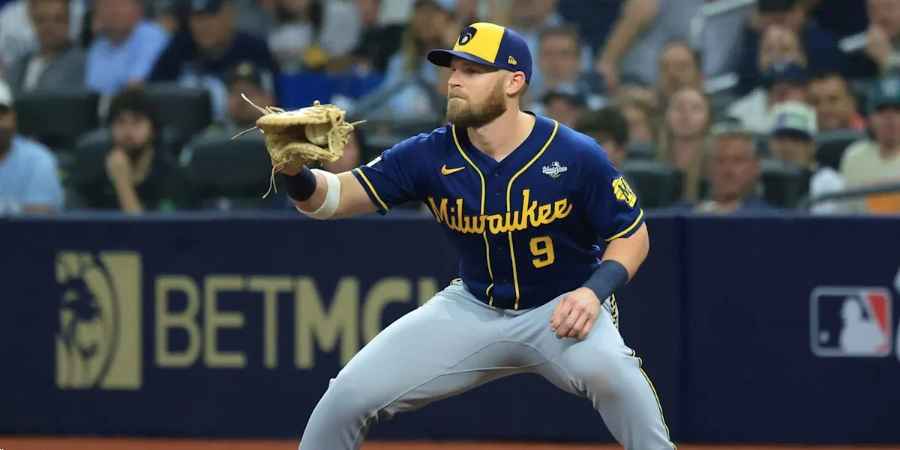
The Boston Red Sox are reportedly bringing in the former Milwaukee Brewers slugger after a career-defining season that saw him earn NLCS MVP honours and win his first World Series title.
A free-agent contract of four years and $58 million is a long-term commitment that a club makes only when it believes a player’s recent production is real and repeatable. That is the bet the Boston Red Sox have reportedly made on Jake Bauers. The first baseman and outfielder has agreed to a four-year, $58 million deal that adds an experienced left-handed hitter to the roster ahead of the 2027 MLB season. ESPN’s Jeff Passan first reported the agreement on November 13, 2026, and MLB.com’s Mark Feinsand confirmed it through a source. The Red Sox had not officially announced the signing at the time of reporting.
The deal follows one of the most productive seasons of his career in Milwaukee. At 31, Bauers has moved from years of inconsistent major-league performance to a key role on a championship team. His contract with Boston shows how sharply his value has shifted over the past two seasons.
Jake Bauers Contract: Why Did the Red Sox Sign Him?
The Red Sox signed Jake Bauers because his 2026 season gave them a hitter with elite plate discipline and improved contact quality. Across 144 regular-season games for Milwaukee, he recorded a .266 batting average, 26 home runs and 86 RBIs. He also posted a .389 on-base percentage and a .484 slugging percentage, which combine for an .873 OPS. Each of these figures was a career high or close to it.
The change in his approach at the plate matters more than the home-run total. Bauers produced a 16.3% walk rate, which ranked in the 98th percentile among qualifying hitters. He recognised pitches outside the strike zone and refused to chase them, and that helped him reach base consistently even though his strikeout rate stayed high at 27%.
Statcast data supports the improvement. His 51.9% hard-hit rate and 92.1 mph average exit velocity showed a level of contact quality that had not defined his earlier career. Better exit velocity, barrel rate and hard-hit percentage together suggest that the gains came from how he hit the ball and not from luck.
In my assessment, the walk rate is the most important number in his profile. Power can disappear when a hitter ages or slumps, but a patient approach usually holds up better because it depends on pitch recognition and not on bat speed alone. A hitter who walks at that rate keeps his on-base value even when the home runs dry up for a stretch. That is the strongest argument for a four-year commitment.
Boston is also buying a left-handed bat. Fenway Park’s short right-field line has long been seen as a friendly target for left-handed pull hitters, so the ballpark may suit his swing, although one season of data cannot prove that.
How Did Jake Bauers Go from a Minor-League Contract to a $58 Million MLB Deal?
Bauers went from a January 2025 minor-league contract with Milwaukee to a $58 million deal because one strong season finally matched the potential scouts had recognised for years. Before Milwaukee, he spent time with the Tampa Bay Rays, Cleveland Guardians, Seattle Mariners and New York Yankees. None of those stops produced a lasting breakthrough.
His 2025 season with the Brewers was useful but unremarkable. He appeared in 85 major-league games and recorded a .235 average, a .353 on-base percentage and seven home runs. Nothing in those numbers pointed to what came next.
The 2026 season changed the picture. The table below compares the two years.
|
Measure |
2025 |
2026 |
|
Games played |
85 |
144 |
|
Batting average |
.235 |
.266 |
|
On-base percentage |
.353 |
.389 |
|
Home runs |
7 |
26 |
The home-run rate stands out. Bauers hit one home run every 12 games or so in 2025 and roughly one every 5.5 games in 2026, which is more than double the pace. His on-base percentage also rose by 36 points.
He delivered in October as well. Bauers earned National League Championship Series MVP honours after the Brewers swept the Los Angeles Dodgers, and his home run against Blake Snell in Game 3 became one of the defining moments of the series. Milwaukee then defeated Tampa Bay in the World Series and secured the first championship in franchise history.
The path from minor-league signing to multimillion-dollar free agent shows how quickly a player’s market value can change when consistent production arrives. It also shows the value of a patient, low-cost bet on a player with an unfinished skill set.
What Does the Jake Bauers Signing Mean for the Milwaukee Brewers?
The signing removes a central piece of Milwaukee’s championship lineup, but it also gives the Brewers a draft asset to replace him. The Brewers extended a $23.15 million qualifying offer, which would have kept Bauers in Milwaukee on a one-year contract for 2027. He declined it and chose the longer commitment from Boston.
Under MLB’s qualifying-offer rules, Milwaukee is eligible for draft-pick compensation because Bauers declined the offer and reportedly signed a contract worth more than $50 million. The compensation is expected to be a Competitive Balance Round A selection, subject to the applicable rules.
The money tells an interesting story. The reported contract averages $14.5 million per year, which is lower than the $23.15 million he could have earned in 2027 by accepting the qualifying offer. Bauers chose total security over a higher one-year salary. He gave up about $8.65 million in 2027 income to secure $58 million in guaranteed money through the end of the deal.
For a player who spent years on short contracts and minor-league deals, that choice is easy to understand. A one-year offer would have required him to repeat his best season to earn another large contract. The four-year deal removes that pressure.
For Milwaukee, losing a player who contributed so much to a title run is a real setback. The Competitive Balance pick gives the front office another chance to add talent at a lower cost.
Can Jake Bauers Maintain His 2026 Performance in Boston?
Nobody can say for certain whether Bauers will repeat his 2026 production, and that uncertainty is the main risk in this contract. His 2026 season was far better than anything in his earlier major-league record. Before it, he had struggled to establish himself as a consistently productive hitter. A single breakthrough year, even one supported by strong Statcast data, does not guarantee a lasting change.
Defence is the second concern. MLB’s analysis placed him in the fifth percentile for Outs Above Average, with a rating of minus eight. He played mostly first base and also made appearances in both corner outfield positions. That flexibility gives Boston options, but his glove will shape how much he can play in the field.
My view is that Boston should treat Bauers as a bat-first player and build his role around his on-base skills. If his defensive numbers stay near the bottom of the league, a heavier share of designated-hitter or platoon-style usage could protect the value he brings at the plate. The final role will depend on how the rest of the roster develops.
The case for optimism rests on the profile of the improvement. Bauers did not simply hit more home runs. He walked more, hit the ball harder and kept his strikeout rate manageable relative to his production. Those are the kinds of changes that tend to last longer than a short hot streak.
For Bauers, the contract offers something his career has not always provided: a substantial multi-year commitment after a season in which he proved himself as a major contributor. For Boston, it is an investment in a player whose offensive development has accelerated quickly. Whether 2026 becomes the foundation for sustained success or stays an exceptional season will be one of the key questions around the Red Sox heading into 2027.