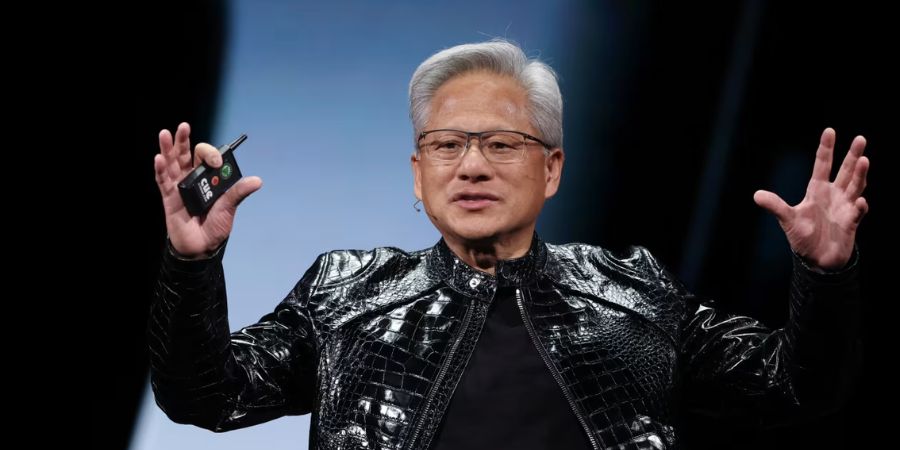
NVIDIA CEO Jensen Huang has spent the last 18 months delivering the same message on every major stage he steps onto, and it keeps getting sharper.
In a June 2026 AP interview, Huang stressed that society needs to change with the advent of AI, arguing that a fuller embrace of the technology would improve people’s lives. Earlier, at GTC Taipei 2026, he went further, declaring that “useful AI has arrived” and laying out his vision for the “age of agents”: agentic AI systems that do not just answer questions but observe, reason, plan, and act across distributed infrastructure.
His broader position, repeated across multiple 2026 appearances: AI will transform every industry, power every company, and be built by every country.
Who is Jensen Huang and Why Do His Words Move Markets?
Huang co-founded NVIDIA in 1993. For most of the company’s life, it was known for gaming chips. That changed.
NVIDIA now controls an estimated 82% of the AI training chip market. Every major AI model, from GPT to Gemini to Claude, was trained on NVIDIA hardware. When Huang speaks about AI’s trajectory, he is not speculating from the sidelines. He is describing infrastructure he helped build and demand he watches in real time.
That is why his statements land differently than those of most tech executives.
What Huang Said and What He Means
At GTC Taipei 2026, Huang backed his claims with GitHub data: code commits nearly tripled between 2023 and early 2026, even though the number of professional developers had not grown. In his framing, roughly 30 to 40 million software developers are now generating vastly more output thanks to AI copilots.
His argument about jobs has also been widely circulated. At the Milken Institute Global Conference in 2025, a line he has repeated in nearly every major interview since, Huang said: “You are not going to lose your job to an AI, but you are going to lose your job to somebody who uses AI.”
The implication for business leaders is direct. The competitive gap between AI-enabled companies and AI-passive ones is already opening. Waiting is a strategy with a cost.
The Numbers Behind the Prediction
|
Metric |
Figure |
|
Global enterprise AI spending, 2026 |
$407 billion |
|
Enterprises with AI in production, Q1 2026 |
72% |
|
Generative AI usage in organizations |
72%, up from 33% in 2024 |
|
Median enterprise ROI on AI investments |
2.4x |
|
AI agent market growth (CAGR through 2030) |
44–46% |
Enterprise AI adoption has crossed a tipping point. 83% of companies with 5,000 or more employees have deployed AI, compared to 42% of firms with 50 to 499 employees.
The gap between large and small business adoption is itself a competitive risk that CEOs at mid-sized companies should not ignore.
Which Industries are Being Rewritten First?
Technology leads adoption at 88%, financial services follows at 79%, and education trails at 34%, per McKinsey. Telecommunications posted the highest agentic AI adoption rate at 48%, just ahead of retail and CPG at 47%.
Industry-by-industry breakdown:
|
Sector |
Primary AI Use Cases |
Adoption Rate |
|
Technology |
Code generation, testing, DevOps |
88% |
|
Financial Services |
Fraud detection, risk analysis, compliance |
79% |
|
Healthcare |
Diagnostics, drug discovery, patient triage |
75% |
|
Retail |
Demand forecasting, personalisation |
47% |
|
Telecom |
Agentic customer support, network optimisation |
48% |
|
Manufacturing |
Predictive maintenance, quality control |
Growing 48% YoY |
|
Education |
Personalised tutoring, content generation |
34% |
Healthcare mirrors this pattern, 75% of US health systems now run at least one AI application. Financial services firms are spending the most per employee: an average of $3,200 in AI spend per employee, 2.6 times the cross-industry norm.
What CEOs Should Do Next
The question most business leaders ask after seeing Huang’s statements is a fair one: where do we start?
Below is a practical sequence:
1. Stop treating AI as an IT project: AI strategy is a topic for the C-suite, not the IT department. Organizations which have quantified their ROI, consider AI a business initiative related to revenue, cost or customer experience, rather than a technology experiment.
2. Find your highest-impact use case first: Ask three questions:
- Where does manual work slow us down most?
- Where do we lose customers due to response speed or personalisation gaps?
- Where are our highest labour costs concentrated?
Start there. One well-scoped pilot generates more learning than ten broad ones.
3. Invest in your data infrastructure before your AI tools: The quality of AI output is strongly linked to the quality of the data. MIT’s Project NANDA has found that 95% of enterprise generative AI pilots fail to result in P&L measurable change and the biggest reason, they say, is that the data are poor or siloed, rather than the AI tools.
4. Train your people, before they leave for companies that do: AI fluency is now showing up in job postings across product, marketing, operations, finance, legal, and HR roles. Companies that build internal AI capability retain talent. Those that do not watch that talent move toward employers who do.
5. Measure ROI on a short cycle: Track productivity output, cost per transaction, customer satisfaction scores, and revenue per employee, before and after AI implementation. The top quartile of AI-investing enterprises reports 5.1x ROI or higher. The difference between average and top-quartile performance usually comes down to measurement discipline.
6. Build governance before you need it: The EU AI Act, fully effective in 2026, affects an estimated 42% of enterprise AI deployments that involve high-risk use cases, including hiring, credit scoring, and healthcare diagnosis. Compliance built reactively costs significantly more than compliance built into the initial design.
What Happens to Companies That Wait
The share of companies allocating at least half their IT budget to AI is expected to rise from 3% to 19%, per EY. Companies that are not investing now will find themselves competing against peers with structurally lower costs, faster development cycles, and more personalised customer experiences, built on AI infrastructure that compounds over time.
The risk is not a single disruption. It is a gradual widening of a competitive gap that becomes very difficult to close.
Other Voices Reinforcing the Same Message
Huang is not alone in this view.
Satya Nadella has described AI as the most significant technology shift since the PC. Sundar Pichai has repeatedly stated that Google is rebuilding its core products around AI-first architectures. Sam Altman has argued that AI will compress decades of scientific progress into years.
What is notable about Huang’s Jensen Huang AI prediction specifically is that it comes from someone whose business depends on measuring AI adoption empirically, not philosophically. He watches chip demand. He tracks model training runs. His view is grounded in infrastructure data, not sentiment.
Conclusion
Gartner forecasts that 40% of enterprise applications will embed task-specific AI agents by end of 2026, up from under 5% in 2025.
The shift from AI tools to AI agents is significant. Tools require human prompting. Agents execute multi-step workflows with minimal human review, handling scheduling, analysis, outreach, reporting, and decision-support simultaneously.
Companies building agent-ready infrastructure today are not just keeping pace. They are positioning for the next competitive advantage cycle.
Key Takeaways for CEOs
- 72% of enterprises already have AI in production, the question is no longer whether to start, but how far behind you are.
- Huang’s statements are grounded in infrastructure data, NVIDIA’s chip demand is a real-time indicator of enterprise AI investment.
- The biggest risk in most AI pilots is data quality, not the AI model.
- AI governance and compliance should be built in from day one, not retrofitted.
- Top-quartile AI investors report 5.1x ROI, the gap between leaders and laggards is already measurable.
FAQs
What did Jensen Huang say about AI in 2026?
Huang stated that AI will transform every industry, power every company, and be built by every nation. At GTC Taipei 2026, he declared that “useful AI has arrived” and outlined his vision for agentic AI systems capable of autonomous multi-step reasoning and execution.
Why does Jensen Huang believe AI will rewrite every industry?
Huang frames AI as foundational infrastructure, comparable to electricity or the internet, rather than a software category. His view is informed by NVIDIA’s position supplying the chips that power global AI training, giving him visibility into enterprise investment trends in real time.
Which industries are adopting AI fastest?
Technology (88%), financial services (79%), and healthcare (75%) lead adoption. Telecommunications has the highest agentic AI deployment rate at 48%.
How should CEOs prepare for AI adoption?
Start with a clearly scoped, high-impact use case. Invest in data infrastructure before AI tooling. Build internal AI fluency through structured training. Measure ROI on a short cycle and build governance frameworks before regulatory pressure forces reactive compliance.
Is AI replacing jobs or creating new ones?
Huang’s position, supported by labour market data, is that AI amplifies human output rather than replacing workers wholesale. The risk is not replacement by AI, but displacement by colleagues and competitors who use AI more effectively.