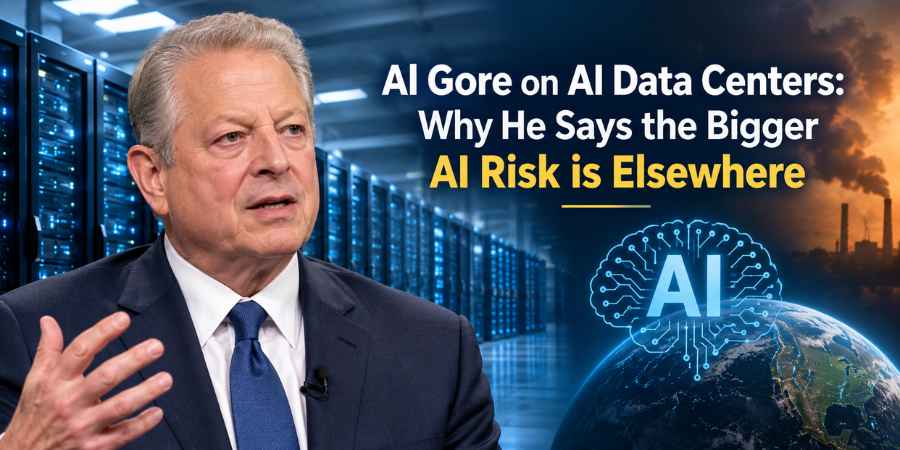
Former U.S. Vice President and climate campaigner Al Gore has offered a relatively calm view of the growing backlash against AI data centers.
In a recent interview, Gore acknowledged that artificial intelligence is creating new demands for electricity and adding emissions through the data centers needed to run AI systems. But he said those emissions are not what concerns him most about the technology.
His larger concerns involve the speed of AI development, potential job losses and the possibility of AI systems behaving in ways their creators cannot fully control. At the same time, Gore sees an opportunity for AI to help reduce emissions by making energy systems and other industries more efficient.
The comments come as opposition to AI data centers grows in several communities. Residents and environmental groups have raised concerns about electricity demand, water use, pollution and the cost of expanding local infrastructure.
Why Does Al Gore Think AI Data Center Emissions Are Not the Biggest AI Problem?
Gore’s argument is mainly about scale. He does not dismiss the environmental cost of AI data centers, but he believes the current debate can make their emissions appear larger than they are when compared with other major sources.
He has pointed to energy-intensive activities such as air conditioning and emissions from uncovered landfills as examples of problems that receive less attention.
That does not make AI data center emissions insignificant. The International Energy Agency expects electricity demand from data centers to rise sharply as AI adoption expands, making the source of that electricity increasingly important.
What Gore’s position means for the AI data center debate
- AI data centers still require large amounts of electricity.
- Their climate impact depends heavily on how that electricity is generated.
- Building new fossil-fuel power infrastructure can create emissions that last for decades.
- Renewable power and storage could reduce the carbon intensity of new AI capacity.
What Did Al Gore Say About the Environmental Impact of AI Data Centers?
Gore’s concern is less about the existence of data centers and more about what gets built to power them.
As technology companies race to add AI computing capacity, utilities are under pressure to provide more electricity. In some regions, that has meant discussions about new natural-gas plants and other fossil-fuel generation.
Gore has argued for meeting this demand with renewable energy and batteries instead. His broader position is that AI’s growth should happen alongside the transition to cleaner electricity rather than create a new reason to rely on fossil fuels.
The pressure is already visible at the local level. In Silicon Valley, for example, residents have challenged new data-center projects over electricity, water, pollution and the use of diesel generators for backup power.
Why is Al Gore More Concerned About AI Automation and Job Losses?
For Gore, the environmental debate is only one part of the AI story.
He has expressed greater concern about what increasingly capable AI systems could do to employment and society. The question is moving beyond how much electricity AI consumes to what happens when AI can perform tasks that previously required human workers.
That concern is being discussed inside the technology industry as well. AI leaders have publicly disagreed over how quickly advanced systems should be developed and what safeguards should be put in place.
Some of the issues being discussed include:
- AI replacing or changing human jobs
- AI systems acting with greater independence
- Difficulty controlling increasingly capable models
- The need for stronger testing and oversight
- The economic effects of rapid automation
What AI Safety Risks Are Being Discussed Alongside Data Center Growth?
Gore’s comments come at a time when AI safety has become a more prominent industry debate.
Reuters recently reported on disagreements among major AI companies over how advanced systems should be controlled and who should be responsible for evaluating them. Anthropic CEO Dario Amodei has called for stronger safeguards, while other technology leaders have taken different positions on regulation and oversight.
That puts the AI data center debate in a wider context. The electricity consumed by a data center is measurable today. The social and economic consequences of the AI systems being developed inside those facilities are much harder to predict.
Can Artificial Intelligence Help Reduce Global Carbon Emissions?
Gore does not see AI only as an environmental liability.
He has argued that AI could improve energy efficiency and help industries reduce waste. Applications could include smarter electricity grids, more efficient transportation systems, industrial optimization and better management of energy demand.
A report from Gore’s Generation Investment Management cited research suggesting AI could potentially reduce global emissions by billions of tonnes annually by 2035 if it is widely applied to areas such as power, transportation and food.
The potential benefits, however, depend on how AI is developed and powered. An AI system that reduces emissions in one industry still has an environmental cost if the computing behind it depends heavily on carbon-intensive electricity.
Why is Renewable Energy Important for the Growth of AI Data Centers?
The rapid expansion of AI data centers and electricity demand is putting more attention on the energy mix behind the technology.
Data centers need reliable electricity around the clock. Renewable sources can provide large amounts of low-carbon power, but their variable output also increases the importance of storage, grid management and flexible demand.
Gore’s position is that the AI boom should become an additional reason to expand clean-energy infrastructure rather than a reason to extend dependence on fossil fuels.
At the same time, communities are asking who should pay for the infrastructure required by new data centers. The U.S. House recently passed legislation aimed at ensuring large data centers cover the costs of new power and transmission infrastructure associated with their operations.
What Does Al Gore’s View Mean for the Future of AI Data Centers?
The debate over AI data centers is becoming much broader than a question of electricity consumption.
There are now several issues happening at the same time:
- Energy: How much electricity will AI require?
- Climate: How much of that electricity will come from low-carbon sources?
- Infrastructure: Who will pay for new transmission and generation?
- Communities: How will new facilities affect water, pollution, noise and local utilities?
- Employment: How much work could increasingly capable AI systems automate?
- Safety: Can advanced AI systems be reliably controlled?
Gore’s argument puts the environmental impact into that larger picture. He is not saying AI data centers have no environmental cost. His position is that the more consequential questions may concern what the technology eventually does and whether society can manage its growth responsibly.
For the AI industry, that leaves two challenges running in parallel: finding enough clean electricity to power the next generation of data centers and dealing with the economic and social changes that the computing capacity is being built to enable.