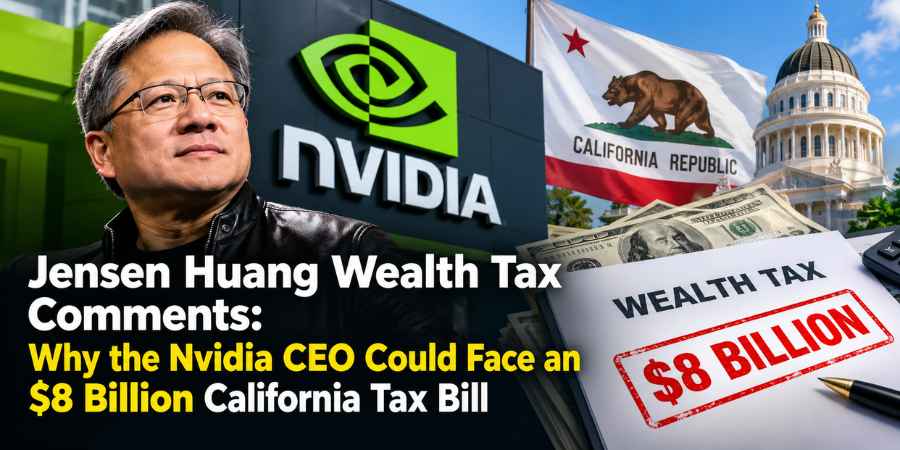
Jensen Huang has put an unusually personal face on California’s debate over taxing billionaire wealth.
In a September 2026 interview with CBS News, the Nvidia CEO said he would accept a potential tax bill of about $8 billion if California’s proposed Proposition 40 takes effect. Huang described the ability to pay that amount as “a privilege” and “a responsibility,” adding that he was more worried about becoming poor than paying taxes.
The figure has generated headlines, but the mechanics behind it are more complicated than a simple 5% calculation. Proposition 40 would create a one-time tax on certain covered assets held by qualifying individuals and trusts. The tax would be tied to wealth, rather than the income a person earns during a particular year.
That difference explains why Huang could face a multibillion-dollar liability even though the tax would be imposed only once.
What Did Jensen Huang Say About the Wealth Tax?
Jensen Huang said he would be willing to pay an estimated $8 billion in California taxes over five years if voters approve Proposition 40. He said the ability to afford such a payment was itself a privilege and said he would be happy to pay more taxes.
Huang also made a joke about his financial position, saying he was not afraid of paying taxes but was “just afraid of being poor.” CBS reported that Huang described himself as “the ultimate American dream” and connected his rise to the educational and professional opportunities he received in the United States.
The remarks are consistent with comments Huang made earlier in 2026. In January, he said he was “perfectly fine” with California’s proposed billionaire tax. At the time, Fortune reported that a 5% levy based on his then-estimated fortune would have produced a bill approaching $8 billion.
His September comments came as the November 3 California vote approaches, putting a current number on what the proposal could mean for one of the state’s most prominent technology executives.
How Would California’s Billionaire Wealth Tax Work?
Proposition 40 would impose a one-time tax of up to 5% on covered assets worth more than $1 billion for qualifying taxpayers and trusts. It is scheduled for a statewide vote on November 3, 2026.
The proposal is different from California’s regular income tax.
Income tax applies to money earned during a period. A wealth tax instead looks at the value of assets a person owns. California’s Legislative Analyst’s Office defines wealth as the value of what someone owns, minus debts, while noting that the measure uses its own rules to determine which assets are covered.
Under Proposition 40, covered assets include:
- Businesses
- Securities
- Art
- Collectibles
- Intellectual property
Real estate and some pensions and retirement accounts would generally be excluded.
The tax would be due in 2027. Taxpayers could elect to spread payments over five years, although the official analysis says additional charges would apply when payments are deferred.
Proposition 40 at a Glance
|
Provision |
Proposed rule |
|
Type of tax |
One-time wealth tax |
|
Maximum rate |
Up to 5% |
|
Threshold |
More than $1 billion in covered assets |
|
Key residency date |
January 1, 2026 |
|
Tax year/payment |
Due in 2027 |
|
Installment option |
Five years, with additional charges |
|
Health care allocation |
90% of revenue |
|
Other allocation |
10% for food assistance or education-related programs |
|
Election |
November 3, 2026 |
The measure’s official summary says 90% of the revenue would go toward health care, while the remaining 10% would be directed toward food assistance or education-related programs.
Why Could Jensen Huang Owe About $8 Billion?
The widely reported $8 billion figure is an estimate, not a final tax assessment.
Forbes estimated Huang’s real-time net worth at $187.4 billion as of September 16, 2026, placing him eighth on its global billionaire ranking at that point. Forbes also says Huang owns approximately 4% of Nvidia, meaning changes in Nvidia’s share price can materially change his estimated fortune.
A simple 5% calculation illustrates the scale:
$160 billion × 5% = $8 billion
But that calculation should not be treated as the precise amount Huang would owe.
The proposed tax does not simply take an individual’s latest media-reported net worth and multiply it by 5%. It has specific rules governing covered assets, exclusions and valuation. Huang’s public net-worth estimates also move with Nvidia’s stock price.
That is why headlines referring to an “$8 billion tax bill” are best understood as an estimate based on Huang’s reported wealth, rather than a bill already calculated by California tax authorities.
Why Does the January 1, 2026 Date Matter?
The residency date is one of the least discussed parts of Proposition 40 and one of the most important.
The measure applies to qualifying taxpayers who were California residents on January 1, 2026. That means the proposal does not simply ask who happens to live in California when the tax becomes payable in 2027. The January 1 date is built into the measure’s eligibility rules.
That feature also explains why the debate around billionaire relocations has become closely connected to Proposition 40.
If a billionaire leaves California after the relevant date, that does not automatically erase the measure’s potential application. The proposal was structured around the January 1, 2026 residency status, rather than allowing the tax question to be settled simply by moving before the payment deadline.
For Huang, that matters because his public comments indicate that he continues to regard California and Silicon Valley as central to his life and work.
What Would California Actually Collect?
California’s official estimate is considerably more cautious than some of the headline figures circulating in the political debate.
The Legislative Analyst’s Office says the state would probably collect tens of billions of dollars from the one-time wealth tax, with the money arriving over several years. The exact amount is difficult to predict because billionaire wealth is heavily connected to assets such as stocks, whose values can change rapidly.
The state also anticipates a possible reduction in ordinary income-tax revenue.
The official analysis estimates that ongoing state income-tax collections from billionaires could fall by less than $1 billion per year, partly because some wealthy residents could change their financial behavior or leave California.
That creates an important distinction between the proposal’s one-time revenue and its possible long-term effect on annual tax collections.
|
Question |
Official analysis |
|
One-time wealth-tax revenue |
Tens of billions of dollars |
|
Collection period |
Spread over several years |
|
Possible ongoing income-tax reduction |
Less than $1 billion annually |
|
Main uncertainty |
Asset values and taxpayer responses |
|
Administrative costs |
Tens of millions of dollars annually for several years |
The state would also incur costs to calculate liabilities, administer the tax and collect payments. The Legislative Analyst’s Office estimates those costs could reach tens of millions of dollars per year for several years.
Why is Huang’s Position Unusual in the Current Debate?
Huang’s comments stand out because the proposed tax has become a major point of disagreement among California’s billionaire technology community.
Reuters reported in September that California has roughly 250 billionaires with combined wealth exceeding $2 trillion, according to Forbes estimates, making the state an unusually concentrated test case for a wealth tax. The same report described disagreements over potential revenue, capital movement and the broader economic effects of the proposal.
Other technology billionaires have publicly opposed the measure or taken steps to change their California residency. Google’s Sergey Brin, for example, has spent heavily on efforts opposing Proposition 40, according to recent reporting.
Huang’s response has been different. Rather than focusing publicly on the size of his potential liability, he has repeatedly framed California’s taxes as part of the cost of living and operating in the state.
That does not settle the wider policy debate. It does, however, make Huang an important example of how the proposal could affect an individual whose fortune is overwhelmingly connected to a publicly traded technology company.
What Happens to the Money If Proposition 40 Passes?
The proposed allocation is unusually specific.
Under the official voter guide:
- 90% of the tax revenue would be used for health care.
- 10% would go toward food assistance or education-related programs.
- The revenue could not simply replace existing funding for those purposes.
- The new revenue would be exempt from several constitutional spending requirements.
The measure qualified for the November 2026 ballot through California’s initiative process. The Secretary of State announced in June that the initiative had exceeded the required signature threshold and qualified for the November 3 election.
Proposition 40 is therefore no longer merely a proposed tax circulating for signatures. It is a certified ballot measure that California voters are scheduled to consider.
What Makes the $8 Billion Figure Difficult to Pin Down?
Three factors make the headline number less straightforward than it appears.
- First, Huang’s wealth changes. Most of his fortune is connected to Nvidia shares, so a change in Nvidia’s stock price can move his estimated net worth by billions of dollars. Forbes’ September estimate illustrates how large that underlying figure has become.
- Second, the measure has asset-specific rules. Proposition 40 covers businesses, securities, art, collectibles and intellectual property but excludes certain categories of property and retirement assets.
- Third, the payment schedule affects the final amount. The tax would be due in 2027, but taxpayers can spread payments across five years under the proposal, with additional charges for doing so.
For those reasons, “$8 billion” works as a useful estimate of the scale of Huang’s potential liability, but it should not be presented as a final assessment.
What Jensen Huang’s Comments Actually Tell Us
The most important part of the Jensen Huang wealth tax story is not simply that an Nvidia billionaire could owe billions. It is that California’s proposal would tax a form of wealth that is very different from an ordinary salary or annual business income.
Huang’s estimated fortune has grown alongside Nvidia’s extraordinary rise in the artificial-intelligence semiconductor market. Because so much of that wealth is tied to Nvidia stock, a tax based on asset value can reach a very large number even when no equivalent amount of cash has been earned as annual income.
Huang has said publicly that he is willing to accept that possibility. His comments provide a clear view of his personal position, but the broader effects of Proposition 40 remain a question for California’s voters and policymakers.
The official state analysis identifies both sides of the fiscal equation: potentially tens of billions of dollars in temporary revenue, alongside the possibility of lower future income-tax collections and significant administrative work.
For now, the $8 billion number should be read as a measure of scale rather than a settled bill. The actual outcome depends on the final rules, the value of Huang’s covered assets and what happens when California voters decide the measure’s fate on November 3, 2026.