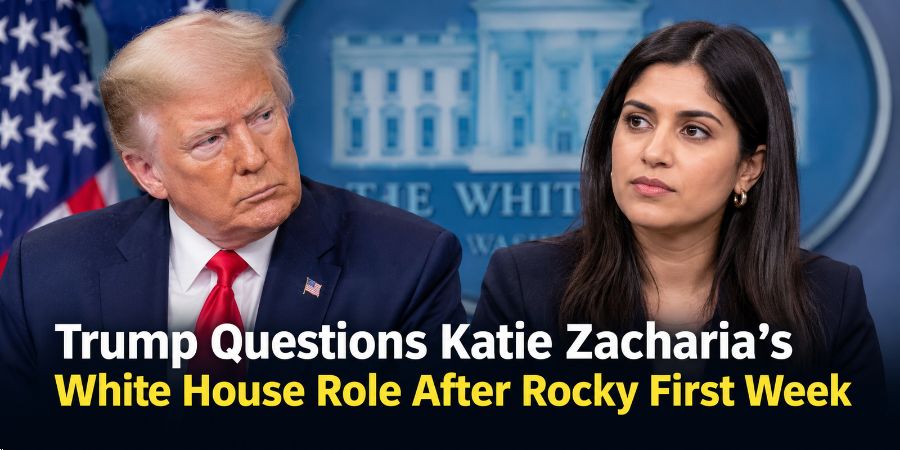
US President Donald Trump has urged Katie Zacharia to reconsider her position as White House press secretary, putting her future in doubt less than a week after her appointment. The controversy follows scrutiny of her legal credentials and a brief first press briefing that drew attention to her readiness for one of the administration’s most visible communications roles.
Trump spoke about Zacharia’s future on Friday, October 16, 2026, as he prepared to leave Washington for a campaign rally in Georgia. He said he had encouraged her to consider whether the job was right for her, describing the media scrutiny she had faced as unfair.
According to Reuters, Fox News subsequently cited a White House official who said Zacharia was transitioning out of the role. Trump, however, did not announce a final decision in his public remarks.
Why Trump is Questioning Katie Zacharia’s Role
The Katie Zacharia White House press secretary appointment came under pressure almost immediately after Trump announced her selection on October 9.
Key developments include:
- October 9: Trump announced Zacharia as the successor to Karoline Leavitt, who had left the White House in August.
- October 13: Zacharia delivered her first press briefing, which lasted approximately 14 minutes and included questions from three media outlets.
- October 14–15: Questions about her professional background and legal qualifications continued to attract attention.
- October 16: Trump said he had advised her to reconsider the position, while subsequent reporting indicated that she might be leaving the role.
The sequence turned what should have been a transition in the administration’s communications team into a public discussion about the appointment itself.
What Triggered the Controversy Over Her Credentials?
The central issue concerns Zacharia’s legal qualifications.
When Trump announced her appointment, he described her as an attorney. Zacharia holds a law degree from Pepperdine University, but scrutiny followed over whether she was licensed to practise law.
In a Fox News interview, Zacharia acknowledged that she had taken the California bar exam and failed it. She said she had not retaken the examination and explained that she had originally expected to move to China after law school.
The distinction is important:
- A law degree demonstrates that someone has completed legal education.
- Bar admission or professional licensing determines whether someone is authorised to practise law in a particular jurisdiction.
- Professional descriptions should accurately reflect a person’s qualifications and licensing status.
The controversy is therefore about how Zacharia’s legal background was described, rather than whether she attended law school. The Associated Press had previously reported that questions about her credentials were growing as she began her new role.
Who is Katie Zacharia?
Zacharia entered the White House role with experience in conservative media and political communications.
Her professional background includes:
- Trump Media & Technology Group: She worked as a senior communications adviser to the company.
- Conservative television: She appeared as a commentator on Fox News and Newsmax.
- Department of Homeland Security: She briefly served as a spokesperson earlier in 2026.
- Pepperdine University: She earned her undergraduate and law degrees from the institution.
The political and media contacts that she has within the circles surrounding Trump have also contributed to her being a well-known personality to the president. Nonetheless, being a press secretary not only implies political familiarity. The position involves explaining policies, answering tough questions, coordinating information from the government departments, and reacting to changes on time.
Why the White House Press Secretary Role Matters
The press secretary acts as the main spokesperson for the president and the administration, involving a trade-off between political communication, accuracy and being able to think and respond under pressure.
The role involves several responsibilities:
- Explaining presidential decisions and administration policies.
- Responding to questions from journalists during briefings.
- Coordinating with officials to verify information.
- Addressing breaking developments and controversies.
- Communicating the administration’s position while maintaining consistency with the facts.
Zacharia’s first briefing was short, but one appearance alone cannot establish whether someone is capable of performing the job over time. The larger challenge emerged when questions about her credentials became a separate story that the administration had to address.
For the White House, this creates a communications problem: instead of focusing exclusively on policy, officials must also respond to scrutiny surrounding the person communicating that policy.
What Happens Next for Katie Zacharia?
Trump’s comments have placed Zacharia’s future in doubt, while reporting that she was transitioning out of the position suggests a possible departure. The White House had not announced a definitive decision in the reporting cited above.
The next developments to watch are:
- An official personnel announcement: This would establish whether Zacharia has formally left the role.
- A successor or interim appointment: The administration may need to clarify who will handle briefings and media enquiries.
- The administration’s response: Officials may address questions about how the appointment was made and what happens to the communications team next.
Until the White House confirms her status, reports of a departure should be attributed to the outlets and officials who reported them.
What this Episode Reveals About Political Appointments
The controversy offers a broader lesson about high-profile government appointments. Political connections and familiarity with a president can help someone secure a position, but the demands of the role become clear once the person is under public scrutiny.
For a press secretary, credibility is particularly important because the job involves explaining decisions that affect the public. Preparation, accurate descriptions of professional qualifications and the ability to respond to unscripted questions can all influence how effectively the role is performed.
The immediate question is whether Zacharia will remain in the position. The wider issue is how an administration manages a communications appointment when scrutiny of the spokesperson begins to overshadow the message the office is meant to deliver.