Few deep thinkers have molded the modern world as much as John Locke. His ideas about liberty, government, and the human mind sit underneath a lot of what we now take for granted, from constitutions to classroom philosophy.
Below are 25 of his most inspiring quotes on freedom, wisdom, and life, organized so you can actually find what you’re looking for, plus answers to the questions people habitually have about him and his work.
Who is John Locke?
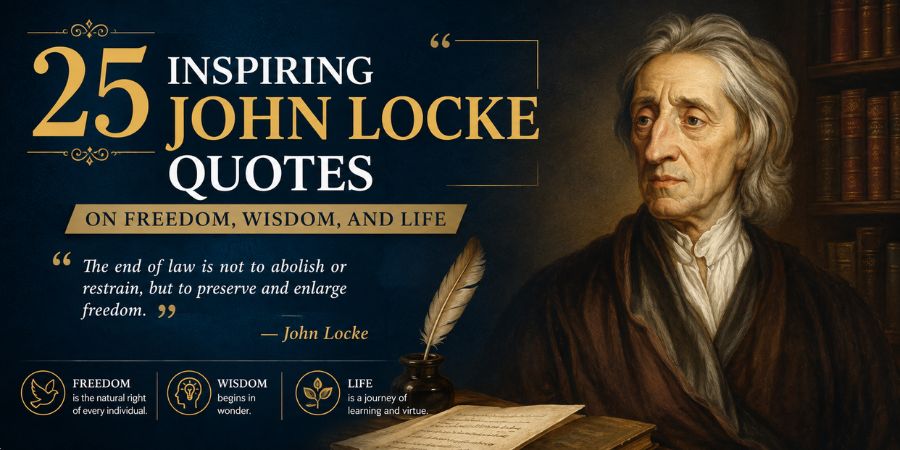
John Locke (1632–1704) was an English philosopher and physician widely regarded as the father of liberalism and one of the most influential Enlightenment thinkers. He argued that people are born with natural rights to life, liberty, and property, and that governments only hold legitimate power when they have the consent of the people they govern.
His two best-known works, Two Treatises of Government and An Essay Concerning Human Understanding, went on to shape the U.S. Declaration of Independence, modern democratic theory, and how we still think about knowledge and the mind today. If you’ve ever heard the phrase “life, liberty, and the pursuit of happiness,” you’ve heard an echo of Locke.
What are John Locke’s most famous quotes on freedom?
Locke’s most famous quotes on freedom center on the idea that liberty only exists under law, not in spite of it, and that no person has the right to control another without consent.
|
# |
Quote |
Source |
|
1 |
“The end of law is not to abolish or restrain, but to preserve and enlarge freedom.” |
Second Treatise of Government (1689) |
|
2 |
“Where there is no law, there is no freedom.” |
Two Treatises of Government (1689) |
|
3 |
“Being all equal and independent, no one ought to harm another in his life, health, liberty, or possessions.” |
Second Treatise of Government (1689) |
|
4 |
“Every man has a property in his own person. This nobody has any right to but himself.” |
Two Treatises of Government (1689) |
|
5 |
“I have no reason to suppose that he, who would take away my liberty, would not, when he had me in his power, take away everything else.” |
Two Treatises of Government (1689) |
|
6 |
“Freedom of men under government is to have a standing rule to live by, common to every one of that society… and not to be subject to the inconstant, uncertain, arbitrary will of another man.” |
Second Treatise of Government (1689) |
|
7 |
“The people cannot delegate to government the power to do anything which would be unlawful for them to do themselves.” |
Two Treatises of Government (1689) |
|
8 |
“Wherever law ends, tyranny begins.” |
Second Treatise of Government (1689) |
|
9 |
“All mankind… being all equal and independent, no one ought to harm another.” |
Second Treatise of Government (1689) |
These lines are still quoted in political speeches and law classrooms because they get at something simple: freedom without any rules quickly turns into freedom for the strongest to dominate everyone else.
What did John Locke say about wisdom and knowledge?
Locke believed wisdom came from active thinking, not passive reading, and that real understanding requires questioning what we’re told rather than just absorbing it.
- “Reading furnishes the mind only with materials of knowledge; it is thinking that makes what we read ours.” ‒ An Essay Concerning Human Understanding (1690)
- “New opinions are always suspected, and usually opposed, without any other reason but because they are not already common.” ‒ An Essay Concerning Human Understanding (1690)
- “It is one thing to show a man that he is in an error, and another to put him in possession of the truth.”
- “Reason must be our last judge and guide in everything.”
- “To love truth for truth’s sake is the principal part of human perfection in this world, and the seed-plot of all other virtues.”
- “With books we stand on the shoulders of giants.”
- “The actions of men are the best interpreters of their thoughts.” ‒ An Essay Concerning Human Understanding (1690)
What did John Locke believe about education and children?
Locke saw education as something that shapes character just as much as it fills the mind, and he had strong opinions about the role parents play in that process.
|
Quote |
Why it’s still quoted |
|
“Education begins the gentleman, but reading, good company, and reflection must finish him.” |
A reminder that formal schooling is only the starting point of learning |
|
“There is frequently more to be learned from the unexpected questions of a child than the discourses of men.” |
Locke valued curiosity over rote instruction |
|
“Parents wonder why the streams are bitter, when they themselves have poisoned the fountain.” |
A sharp line about how parents shape their children’s habits |
|
“The improvement of understanding is for two ends: first, our own increase of knowledge; secondly, to enable us to deliver that knowledge to others.” |
Locke tied personal learning to teaching others |
What are John Locke’s best quotes on life and self-mastery?
Locke’s quotes on life circle back to one core idea again and again: real freedom starts inside a person, not outside them.
- “The most precious of all possessions is power over ourselves.”
- “What worries you, masters you.”
- “A sound mind in a sound body, is a short, but full description of a happy state in this world: he that has these two, has little more to wish for.”
- “Who lies for you will lie against you.”
- “Liberty and truth go hand in hand with justice.”
- “Good and evil, reward and punishment, are the only motives to a rational creature.”
Why are John Locke’s quotes still relevant today?
Because the questions he was wrestling with, how much power a government should have, what makes knowledge trustworthy, how children should be raised, are still live questions today.
His writing gave language to ideas that later formed the U.S. Constitution, modern human rights frameworks, and even how psychologists talk about the mind as something shaped by experience rather than fixed at birth.
That’s a big part of why his quotes on freedom and inspiring quotes on life keep circulating centuries after he wrote them.
Quick-reference: John Locke quotes by theme
|
Theme |
Example Quote |
|
Freedom |
“Where there is no law, there is no freedom.” |
|
Wisdom |
“Reading furnishes the mind only with materials of knowledge; it is thinking that makes what we read ours.” |
|
Education |
“There is frequently more to be learned from the unexpected questions of a child than the discourses of men.” |
|
Life & self-mastery |
“What worries you, masters you.” |
|
Government |
“Wherever law ends, tyranny begins.” |
Conclusion
John Locke’s writing has held up for more than 300 years because it doesn’t just argue for freedom, it explains what freedom actually requires: law, reason, self-control, and honest thinking.
Whether you’re looking for inspiring quotes on life, sharper thinking on liberty, or just a better sense of who John Locke was and why he still gets quoted constantly, his own words tend to say it better than any summary can.