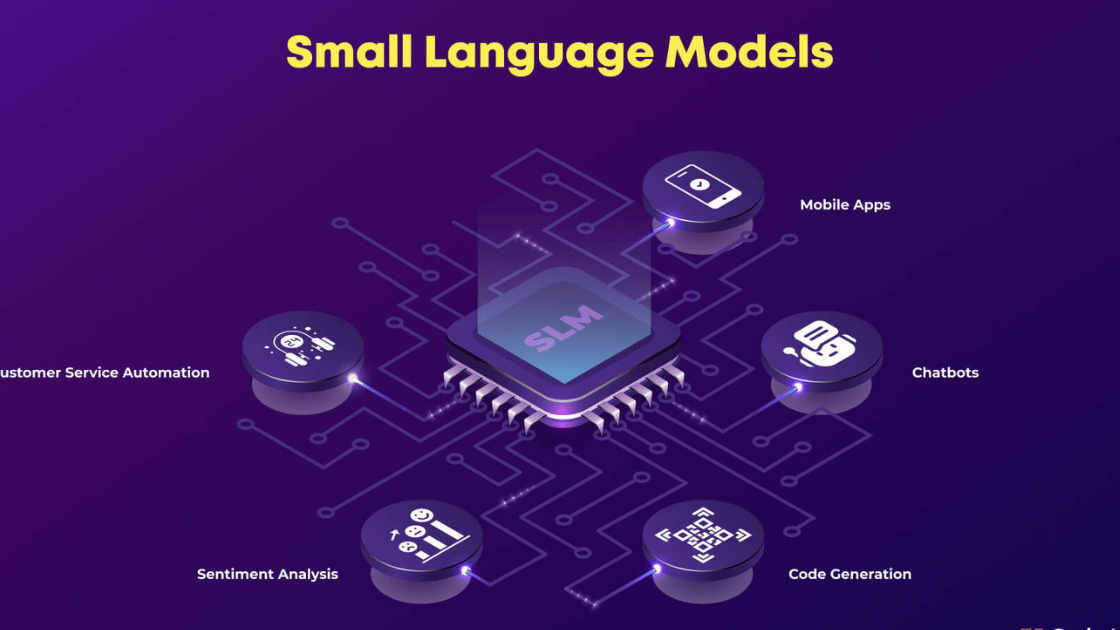
Artificial intelligence is evolving rapidly, but in 2025, one of the most important trends isn’t about building bigger AI models—it’s about making them smarter and more efficient. While Large Language Models (LLMs) like ChatGPT and other advanced AI systems dominate headlines, Small Language Models (SLMs) are quietly transforming how businesses deploy artificial intelligence. These compact AI models deliver faster responses, lower operating costs, stronger privacy, and greater flexibility, making them an attractive solution for organizations seeking practical AI adoption.
As enterprises focus on efficiency, scalability, and data security, Small Language Models are emerging as one of the biggest drivers of AI innovation across industries such as healthcare, finance, retail, manufacturing, and customer service.
What Are Small Language Models?
Small Language Models (SLMs) are lightweight AI models designed to perform specific language-related tasks while using significantly fewer computing resources than large language models. Although they contain fewer parameters, modern SLMs are highly optimized for speed, accuracy, and domain-specific applications.
Unlike general-purpose AI models trained to answer almost any question, Small Language Models are often developed for specialized business tasks such as customer support, legal document analysis, healthcare assistance, software development, financial reporting, or internal knowledge management.
This focused approach allows organizations to deploy AI more efficiently without investing in expensive infrastructure.
To understand how advanced AI models are improving decision-making, read our article on AI Reasoning Breakthroughs: How 2025’s Frontier Models Are Mimicking Human Logic.
Why Small Language Models Are Gaining Popularity
The rapid adoption of Small Language Models is driven by three major advantages: speed, affordability, and control.
Faster Performance
Because Small Language Models require fewer computational resources, they generate responses much faster than larger AI models. This makes them ideal for applications such as chatbots, voice assistants, real-time translation, customer service automation, and intelligent search systems.
Lower Operating Costs
Running large AI models requires significant cloud computing infrastructure, increasing operational expenses. Small Language Models consume less memory, require less processing power, and reduce cloud computing costs, making AI accessible for startups, small businesses, and enterprises alike.
Better Data Privacy
Many organizations prefer deploying Small Language Models on private servers or edge devices rather than sending sensitive information to public cloud platforms. This approach enhances data security while helping businesses comply with industry regulations.
Industry Applications of Small Language Models
The flexibility of Small Language Models allows businesses to develop highly specialized AI solutions across multiple industries.
Healthcare
Healthcare providers use SLMs to summarize patient records, automate clinical documentation, answer medical queries, and improve workflow efficiency while protecting patient privacy.
Financial Services
Banks and financial institutions deploy Small Language Models for fraud detection, compliance monitoring, customer support, and financial document analysis without exposing confidential information to external AI services.
Retail and E-Commerce
Retail companies use specialized AI models to personalize product recommendations, automate customer support, manage inventory inquiries, and improve shopping experiences.
Enterprise Operations
Businesses integrate Small Language Models into internal knowledge bases, HR systems, IT support, software development workflows, and document management platforms to improve employee productivity.
These focused implementations often deliver higher accuracy because the models are trained specifically for industry-specific tasks.
Why Smaller Doesn’t Mean Less Powerful
One of the biggest misconceptions about artificial intelligence is that larger models always produce better results. In reality, Small Language Models often outperform larger systems for specialized tasks because they are optimized for specific domains.
Organizations can fine-tune SLMs using proprietary datasets, allowing AI to understand company terminology, customer interactions, business policies, and technical documentation with greater precision.
This specialization results in:
- Faster deployment.
- Higher accuracy.
- Easier customization.
- Lower maintenance costs.
- Improved explainability.
- Better compliance with privacy requirements.
Rather than replacing large language models, Small Language Models complement them by handling routine business tasks more efficiently.
Powering Edge AI and Smart Devices
One of the biggest advantages of Small Language Models is their ability to operate directly on local devices. Smartphones, laptops, wearable technology, smart appliances, industrial equipment, and autonomous vehicles increasingly rely on compact AI models that function without requiring constant cloud connectivity.
Running AI locally improves response times, reduces latency, enhances privacy, and minimizes internet dependency. As edge computing continues expanding, Small Language Models will become essential for delivering intelligent experiences across billions of connected devices.
According to the IBM AI Learning Center, smaller and specialized AI models are becoming increasingly valuable for organizations seeking efficient, scalable, and cost-effective artificial intelligence solutions while maintaining strong data governance.
The Future of Small Language Models
As artificial intelligence continues advancing, Small Language Models will play a crucial role in enterprise AI strategies. Businesses will increasingly combine large foundation models with smaller specialized AI systems to create efficient, secure, and highly customized solutions.
Future SLMs are expected to power intelligent assistants, enterprise software, robotics, healthcare devices, industrial automation, and personalized digital experiences while consuming fewer computing resources.
Rather than competing directly with large AI models, Small Language Models represent a practical evolution toward efficient, affordable, and responsible artificial intelligence.
Conclusion
Small Language Models are proving that bigger isn’t always better in artificial intelligence. By delivering faster performance, lower infrastructure costs, stronger privacy, and highly specialized capabilities, SLMs are becoming essential tools for businesses embracing AI in 2025. As organizations continue investing in intelligent automation and digital transformation, Small Language Models will play a central role in making artificial intelligence more accessible, scalable, and practical across every industry.