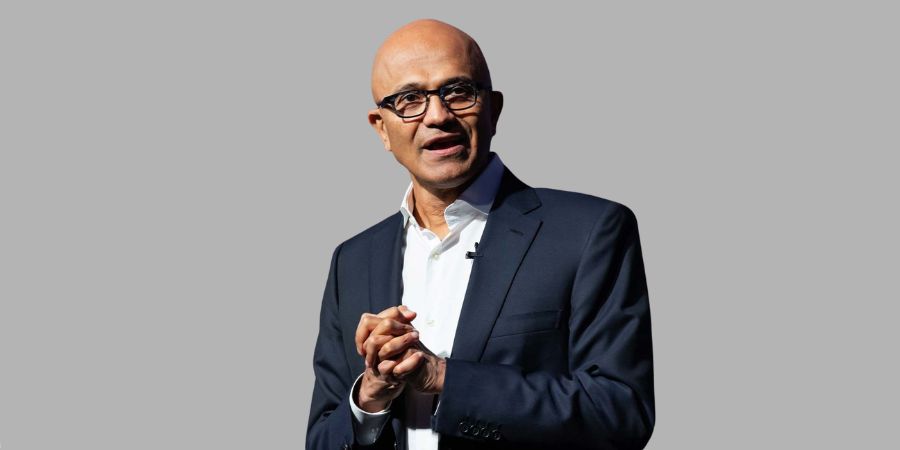
When Satya Nadella became Microsoft’s CEO in 2014, he inherited one of the most powerful technology companies in the world. But power was not the problem. Microsoft had plenty of it.
The harder problem was what to do with a company that had become very successful at defending what it already knew.
Nadella approached that problem differently. Rather than trying to be the loudest person in the room, he focused on changing how Microsoft learned, collaborated and responded to customers. The result was a cultural shift built around empathy, curiosity, a growth mindset and a willingness to change direction.
That is what makes Satya Nadella’s leadership style worth studying. It is about creating an organisation that can keep learning after it has already become successful.
Below are 5 leadership lessons from Nadella’s approach:
What is Satya Nadella’s Leadership Style?
Satya Nadella’s leadership style is centred on empathy, growth mindset, continuous learning, customer focus and collaborative leadership. Rather than presenting himself as the person with all the answers, Nadella has pushed Microsoft toward becoming a “learn-it-all” organisation, one that listens, experiments, adapts and learns from customers and employees.
His approach can be summarised in 5 ideas:
- Lead with empathy.
- Build a growth mindset.
- Make learning more important than being right.
- Put customers at the centre of innovation.
- Change the organisation before demanding better results from it.
What we find particularly interesting is that none of these sounds revolutionary on its own. The difficult part is actually practising them when you are running a company as large as Microsoft.
1. Empathy
Nadella sees empathy as a leadership and innovation skill because understanding what people actually need helps leaders make better decisions, build better products and create stronger relationships.
This is probably the most misunderstood part of Satya Nadella’s leadership style.
Empathy is sometimes treated as something soft. Something nice to have if the business is already doing well.
Nadella sees it differently.
For him, empathy is connected directly to innovation.
Microsoft’s own account of Hit Refresh describes empathy as central to Nadella’s thinking, while Nadella has repeatedly connected empathy with understanding customers’ unmet and unarticulated needs.
Think about the difference.
A company can ask customers:
“What feature would you like us to build?”
That is listening.
But empathy asks a deeper question:
“What are you actually trying to accomplish, and what is making that difficult?”
That distinction matters.
Nadella has argued that innovation comes from understanding needs customers may not be able to articulate themselves.
The leadership lesson:
Don’t just listen to what people say.
Try to understand why they are saying it.
A good leader does not need to agree with everyone. But they should make an effort to understand the person sitting across the table.
That applies to customers. It applies to employees.
And, perhaps most importantly, it applies when you disagree.
2. Growth Mindset
Nadella shifted Microsoft’s culture toward a growth mindset, encouraging employees to become “learn-it-alls” rather than “know-it-alls.”
This became one of the defining ideas of his tenure.
When Nadella arrived, he believed Microsoft needed a cultural change. In his account of the transformation, he described an organisation where hierarchy, internal competition and the pressure to prove expertise could get in the way of curiosity and creativity. His alternative was a culture built around listening, learning and developing people’s capabilities.
The phrase “learn-it-all” is more than a nice slogan.
It changes the behaviour you reward.
A know-it-all asks:
“How do I prove that I am right?”
A learn-it-all asks:
“What am I missing?”
That is a very different leadership environment.
Microsoft still describes growth mindset as one of its core cultural attributes today, alongside customer obsession, diversity and inclusion, and “One Microsoft.”
The leadership lesson:
You don’t build a learning organisation by telling people to learn.
You build one by making it safe, and valuable, for people to admit they don’t know something.
That means leaders have to model the behaviour themselves.
If the CEO always needs to have the answer, everyone below the CEO quickly learns that asking questions is dangerous.
Nadella’s approach was almost the opposite.
Curiosity became a leadership behaviour.
And that is particularly relevant now. In Microsoft’s 2025 discussion of its culture, Nadella again described growth mindset as the everyday practice of being a “learn-it-all, not a know-it-all,” connecting it with humility and empathy.
3. Approach to Change
Nadella’s approach shows that organisational transformation often begins with changing the company’s assumptions, culture and priorities, not simply introducing a new strategy.
This is where the Microsoft story gets more interesting.
It is easy to look at Microsoft’s success in cloud computing and AI and reduce the story to strategy:
Microsoft invested in Azure.
Microsoft partnered with OpenAI.
Microsoft expanded its cloud business.
All true.
But strategy does not execute itself.
Nadella had to create an organisation capable of making those moves.
Stanford’s Graduate School of Business notes that Nadella made fundamental strategic shifts at Microsoft, including becoming more open to working with competitors, pursuing major acquisitions and moving the company toward greater collaboration and inclusion.
That is a significant change for a company that had spent years competing aggressively across the technology industry.
The lesson is not that every company should copy Microsoft’s partnerships or acquisitions.
It is this:
Sometimes the biggest obstacle to a new strategy is the culture created by the old strategy.
If employees are rewarded for protecting existing products, they will protect existing products.
If they are rewarded for learning, experimenting and serving customers, they are more likely to explore what comes next.
The leadership lesson:
When results are not improving, don’t immediately assume your people need to work harder.
Ask whether the system is encouraging the behaviour you actually want.
Sometimes the problem is not effort.
It is the environment.
4. Customer Obsession
Nadella encourages Microsoft to focus on customer outcomes and unmet needs rather than becoming overly focused on Microsoft’s own products and internal success.
This sounds obvious.
It is surprisingly difficult.
Large companies can become obsessed with themselves.
They start measuring success through:
- Revenue
- Market share
- Product launches
- Internal targets
- Competitive rankings
- Quarterly performance
Those numbers are important.
But Nadella has repeatedly pushed the idea that Microsoft should also think about the value it creates for customers and the broader ecosystem. In a 2017 interview, he argued that long-term business success should be considered partly through the outcomes created outside Microsoft’s own balance sheet.
That is an important distinction.
A company can have a successful product that customers tolerate.
A truly customer-focused company keeps asking:
“What became possible for the customer because we existed?”
That is a much harder question.
It forces the organisation to look beyond features.
A practical example
Imagine you run a software company. Your team tells you:
“We launched 20 new features this year.”
The customer might respond:
“Great. But my team still spends three hours every Friday doing something manually.”
The first statement measures output. The second exposes the actual problem.
Nadella’s emphasis on empathy and customer understanding pushes leaders toward the second question.
The leadership lesson:
Don’t confuse shipping more with creating more value.
Your customer does not care how many meetings your team had or how complicated the engineering problem was.
They care about what became easier, faster, safer or possible because of your work.
5. Leading by Example
Nadella’s leadership style emphasises that cultural change has to begin with leaders themselves; employees are unlikely to adopt behaviours that senior leadership does not demonstrate.
This may be the simplest lesson.
It is also the one leaders most often ignore.
Stanford’s account of Nadella’s leadership includes a particularly useful idea: when leaders talk about what the organisation values, they have to ask how much of that behaviour is actually visible in the leadership team, starting with the CEO.
Think about the contradictions we see in organisations every day.
A CEO says: “We encourage experimentation.”
But punishes every failed experiment.
A manager says: “I want honest feedback.” But becomes defensive when someone provides it.
A company says: “We value collaboration.”
But promotes people who take credit individually. People notice these contradictions.
Culture is not what is written on the wall.
Culture is what people learn they can safely do.
That is why Nadella’s own behaviour matters to his leadership philosophy.
- If the leader is curious, people have permission to be curious.
- If the leader admits they don’t know, other people can admit it too.
- If the leader listens, listening becomes less of a performance and more of a habit.
The leadership lesson:
Before asking: “Why aren’t my employees behaving differently?”
ask: “What behaviour am I demonstrating as the leader?”
That question can be uncomfortable.
It can also be extremely useful.
What Makes Satya Nadella’s Leadership Style Different?
The defining feature of Satya Nadella’s leadership style is that he treats culture, empathy and learning as business capabilities rather than separate “people” initiatives.
That is perhaps the biggest takeaway.
Nadella did not present empathy as something disconnected from performance.
- He connected it with innovation.
- He did not treat growth mindset as a motivational exercise.
- He connected it with Microsoft’s ability to adapt.
- He did not separate culture from strategy.
- He treated culture as part of the mechanism through which strategy gets executed.
Microsoft’s current culture still explicitly describes growth mindset, curiosity, experimentation, agility and smart risk-taking as part of how teams work.
And the company is now applying that same philosophy to another enormous transition: AI.
In 2025, Microsoft said its “North Star” was bringing together infrastructure, platforms, applications and agents for the AI era, while reaffirming growth mindset as a core part of its culture.
That continuity is important.
The technology changes.
The leadership principle does not.
Keep learning. Keep listening. Keep adapting.
What are the 5 Leadership Lessons from Satya Nadella?
If we had to reduce Satya Nadella’s leadership style to five practical lessons, they would be these:
- Lead with empathy: Understand the person, customer or problem before trying to solve it.
- Be a learn-it-all, not a know-it-all: Curiosity is more valuable than the need to always appear right.
- Change culture alongside strategy: A new strategy rarely works if the old behaviours remain rewarded.
- Measure the value you create for customers: Internal success means little if customers are not better off.
- Model the behaviour you expect: People watch leaders much more closely than they read company values.
There is a reason Nadella’s story continues to attract so much attention.
It is not because he discovered some secret formula for leadership. It is almost the opposite.
His approach is built around ideas that sound remarkably ordinary: listen, learn, understand people, stay curious and be willing to change.
The difficult part is doing those things when you are already successful.
That, perhaps, is the most useful lesson from Satya Nadella’s leadership style.
Success can convince a leader that they already know what works.
Nadella’s approach starts from a different assumption:
What worked yesterday may not be enough for tomorrow.
And if the organisation can keep learning, perhaps it does not need to fear change quite as much.