There is a reason we find the story of Nehemiah so interesting for founders.
He was not a king. He was not a military commander. He was not even a builder by profession. He was a cupbearer serving the Persian king when he heard that Jerusalem was in ruins and its people were living in distress.
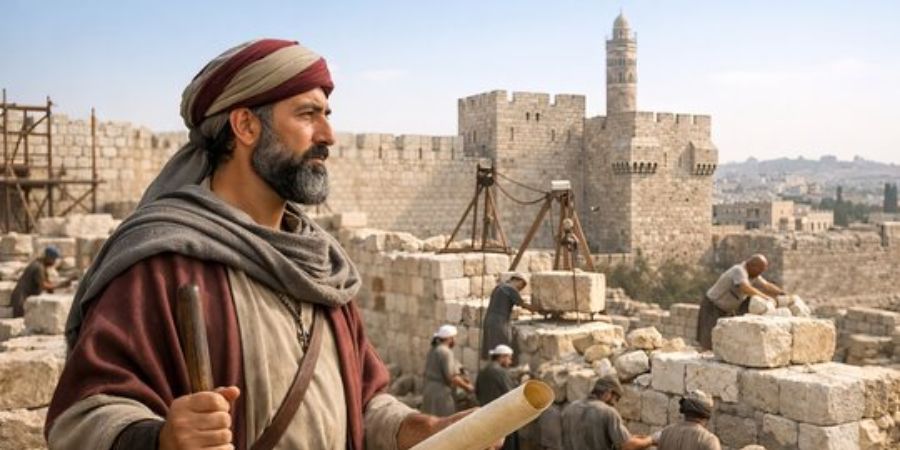
And yet, he eventually led the rebuilding of Jerusalem’s walls in 52 days. More importantly, he did it while dealing with limited resources, internal conflict, external opposition and people who had every reason to believe the project would fail.
That makes the Book of Nehemiah surprisingly relevant to entrepreneurship.
A founder also starts with something that does not yet exist. There is usually uncertainty, limited money, sceptical people, competing priorities and plenty of reasons to postpone the difficult work.
What Nehemiah demonstrates is not a formula for building a company. The context is obviously very different.
But the leadership principles are remarkably transferable.
Here are 10 of them.
What Can Founders Learn from Nehemiah’s Leadership?
Founders can learn from Nehemiah how to build a clear vision, prepare before acting, communicate a compelling purpose, delegate responsibility, handle opposition, protect organisational integrity, stay focused and lead people through difficult change. His story shows that leadership is not simply about having a big idea. It is about turning that idea into organised action while keeping people committed to the mission.
The 10 lessons are:
- Start with a problem worth solving.
- Give yourself time to think before acting.
- Turn vision into a clear plan.
- Make people part of the mission.
- Delegate instead of trying to do everything yourself.
- Expect resistance.
- Don’t allow distractions to steal the mission.
- Protect trust and integrity.
- Address internal problems, not just external threats.
- Finish the work, and build what comes next.
1. Founders Should Start with a Problem Worth Solving
Nehemiah’s leadership began with a problem that deeply mattered to him: Jerusalem’s walls were broken, its gates had been burned and the people were living in distress.
There is something important here. Nehemiah did not wake up one morning and decide:
“I want to be a leader.”
The leadership opportunity came because something was broken. When he heard what had happened, he wept, fasted and prayed.
That difference is important for founders too. The strongest businesses rarely begin with:
“I want to start a company.”
They begin with:
“Why is this problem still happening?”
- Maybe customers are waiting three weeks for something that should take three days.
- Maybe an industry still depends on spreadsheets and email chains.
- Maybe a product works, but the experience around it is terrible.
- Maybe a group of people is being ignored by an existing market.
The founder’s job is not to manufacture an opportunity simply because they want a startup.
It is to notice what is broken and become curious enough to understand it.
The founder lesson:
Before asking “What should I build?”, ask:
“What is broken enough that someone would care if I fixed it?”
That is a much better starting point.
2. Pause Before Taking Action
Nehemiah did not immediately rush from hearing about Jerusalem’s condition to rebuilding it; he first prayed, understood the situation and prepared for the opportunity to act.
This is one of the easiest lessons for founders to ignore. We live in a culture that celebrates speed.
- Build quickly.
- Launch quickly.
- Raise quickly.
- Scale quickly.
But speed without direction is not really speed. Sometimes it is simply movement.
Nehemiah spent time in prayer before approaching King Artaxerxes. When the king eventually asked what he wanted, Nehemiah had a specific request ready, including permission to travel and letters and materials needed for the work.
He had clearly thought about what needed to happen. This is what good preparation looks like. It does not mean waiting until every variable is known. It means knowing enough to make the next intelligent move.
The founder lesson:
Don’t confuse thinking carefully with moving slowly. A founder can be decisive without being impulsive.
3. Turn a Big Vision into a Practical Plan
Nehemiah broke a huge rebuilding project into smaller responsibilities and organised people around specific sections of the wall.
This may be one of the most practical leadership lessons in the entire story.
“Rebuild Jerusalem” is a massive objective.
It is almost useless as an instruction.
So, Nehemiah turned the enormous objective into smaller pieces of work. Chapter 3 describes different families and groups taking responsibility for particular sections of the wall.
That is exactly what founders have to do.
You cannot tell a team: “Let’s build a billion-dollar company.”
That is a destination, not a plan.
You need to turn it into:
- What needs to happen this quarter?
- What needs to happen this month?
- Who owns it?
- What does success look like?
- What has to happen first?
- What is blocking the next step?
A vision gives people somewhere to go.
A plan tells them what to do on Monday morning.
The founder lesson:
Big ambitions become manageable when you break them into specific ownership and measurable work.
4. Get People to Believe in the Mission
Nehemiah did not simply announce the problem; he explained the situation, shared the vision and invited the people to participate in rebuilding.
This is where leadership becomes different from management.
A manager can assign work.
A leader has to make people care about the work.
After inspecting the walls, Nehemiah told the people about the situation and the opportunity to rebuild. Their response was essentially: let’s begin.
That is powerful because people were not merely receiving instructions. They understood why the work mattered.
Founders sometimes make the opposite mistake. They explain the product endlessly but barely explain the mission.
Employees then know what they are building but not why it matters. Customers feel the same thing.
A compelling mission does not mean creating a dramatic slogan. It means being able to answer a simple question:
“Why should anyone care?”
The founder lesson:
People will work hard for a task. They will often work harder for a purpose they believe in.
5. Delegation
Nehemiah understood that he could not rebuild the wall alone, so he distributed responsibility across families, groups and individuals.
This sounds obvious. It isn’t.
Founders are particularly vulnerable to doing everything themselves.
At the beginning, you probably have to. You answer customer emails.
- You sell.
- You hire.
- You write copy.
- You fix the product.
- You look at the numbers.
- You solve operational problems.
And because you were doing everything yesterday, it can feel safer to continue doing everything tomorrow.
That becomes dangerous as the company grows.
Nehemiah’s example shows a different approach: organise people around ownership.
Delegation is not dumping tasks on employees.
It is giving someone enough authority and clarity to own an outcome.
The founder lesson:
If every important decision still has to pass through you, you haven’t really built a team. You’ve built a queue.
6. What Should Founders Do When People Oppose Them?
Nehemiah expected opposition and responded with both faith and practical preparation rather than allowing fear to stop the project.
The opposition was not subtle.
Sanballat and Tobiah mocked the builders. Later, threats became more serious, and Nehemiah organised guards while the people continued working.
There is an important distinction here. Nehemiah did not pretend the threats were imaginary.
He acknowledged the risk.
Then he prepared for it.
Founders need the same mindset.
Criticism is not always a sign that you are doing something wrong.
- Sometimes it is.
- Sometimes it is useful.
- Sometimes it is simply noise.
- And occasionally, it is a genuine threat that deserves a response.
The skill is knowing the difference.
The founder lesson:
Don’t confuse confidence with pretending there are no problems. Good leaders see the problem clearly and keep moving anyway.
7. Stay Focused When Others Try to Distract You
Nehemiah repeatedly refused invitations designed to pull him away from the work because he understood that not every request deserved his attention.
This may be my favourite lesson for founders.
In Nehemiah 6, Sanballat and Geshem repeatedly ask Nehemiah to meet them. Nehemiah refuses because leaving the work would interrupt the project.
The famous idea behind his response is simple:
He had important work to do.
Founders today have a slightly different version of the same problem.
The distractions are:
- Another partnership opportunity
- Another conference
- Another investor meeting
- Another feature request
- Another social media trend
- Another competitor
- Another “urgent” internal request
Everything looks important when you are building a company. It isn’t.
The founder lesson:
A founder needs to know not only what to say yes to, but what deserves a firm no.
Focus is not doing one thing forever. It is refusing to abandon the important thing every time something new appears.
8. Have Integrity
Nehemiah confronted exploitation among his own people and refused to use his position for personal advantage.
This is where the story becomes more uncomfortable, and more useful.
The external enemy is easy to understand.
The internal problem is harder.
In chapter 5, Nehemiah confronts nobles and officials over the exploitation of poorer members of the community. He also describes how he did not use the privileges available to him as governor for personal gain.
This is important enormously for founders.
A company can survive a competitor. It can survive a bad quarter. It can survive a failed product.
What is much harder to repair is lost trust.
Employees notice when a founder behaves differently from what they expect of everyone else. Customers notice. Investors notice. Eventually, the market notices.
The founder lesson:
Your character becomes part of the company’s culture whether you intend it to or not. People copy what leaders tolerate.
9. Fix Internal Problems Before Celebrating External Success
Nehemiah understood that rebuilding the wall was not enough; the community itself also needed justice, order and spiritual renewal.
This is one of the deeper lessons in the story.
The wall was the visible achievement.
But the wall was never the entire mission.
Once the physical work was completed, Nehemiah and others focused on restoring the community’s religious and social life as well. The Book of Nehemiah continues beyond the construction itself into reforms and renewal.
Founders can learn something important here.
A company can hit revenue targets and still be unhealthy.
It can grow quickly and still have:
- Burned-out employees
- Poor communication
- Weak managers
- Broken incentives
- Unhappy customers
- Toxic internal politics
Revenue can tell you that something is working. It cannot tell you everything is working.
The founder lesson:
Don’t only measure what is visible from the outside. Ask what is happening inside the organisation that produced those results.
10. Finish What You Started
Nehemiah demonstrates that leadership is not simply about starting a difficult project; it is about sustaining momentum until the work is completed and then preparing the organisation for what comes next.
The wall was completed in 52 days. That is remarkable.
But the more interesting part is what happened afterward.
The completion of the wall did not mean the leadership assignment was finished. The community still needed structure, renewal and continued leadership.
Founders face the same trap.
There is a lot of excitement around starting.
- The pitch deck.
- The first customer.
- The first hire.
- The first million.
- The funding announcement.
But building a company is mostly what happens after the exciting milestones.
The work becomes repetitive. Problems become less glamorous. You have to keep improving the product.
- Keep serving customers.
- Keep hiring carefully.
- Keep fixing things nobody wants to fix.
- Keep showing up.
The founder lesson:
Starting proves that you can begin. Finishing proves that you can lead.
What Makes Nehemiah’s Leadership Relevant to Founders Today?
The story of Nehemiah is not a startup story.
But Nehemiah faced a broken situation:
- He cared deeply about fixing it.
- He paused before acting.
- He planned.
- He communicated the vision.
- He organised people.
- He delegated responsibility.
- He prepared for opposition.
- He stayed focused.
- He confronted internal problems.
- And he kept going until the work was done.
There is another lesson here that we think founders should pay particular attention to.
Nehemiah did not build the wall by becoming indispensable to every part of the work.
He created a structure in which other people could contribute.
That is a significant difference between being a person who is good at getting things done and being a leader who builds something that can continue getting things done without them.
What are the 10 Leadership Lessons from Nehemiah?
For a founder, the lessons can be reduced to these ten principles:
- Find a problem that genuinely matters.
- Think before you act.
- Turn vision into specific plans.
- Give people a reason to care.
- Delegate real ownership.
- Expect opposition instead of being surprised by it.
- Protect your focus.
- Never trade integrity for short-term results.
- Fix internal problems as seriously as external ones.
- Finish what you start and prepare for what comes next.
Perhaps the biggest lesson is the simplest one.
Nehemiah did not begin with a position of obvious power. He began with a burden, a broken situation and a willingness to do something about it.
The same is true of many founders.
- You don’t need to start with the biggest team.
- You don’t need to have all the answers.
- You don’t even need to look like a traditional leader.
You need to see something that needs to change, understand why it matters, gather people who believe in the work, and then have the discipline to keep building when the excitement wears off.
That is leadership.
And sometimes, the best leadership lessons are found in stories that were never written as business case studies in the first place.