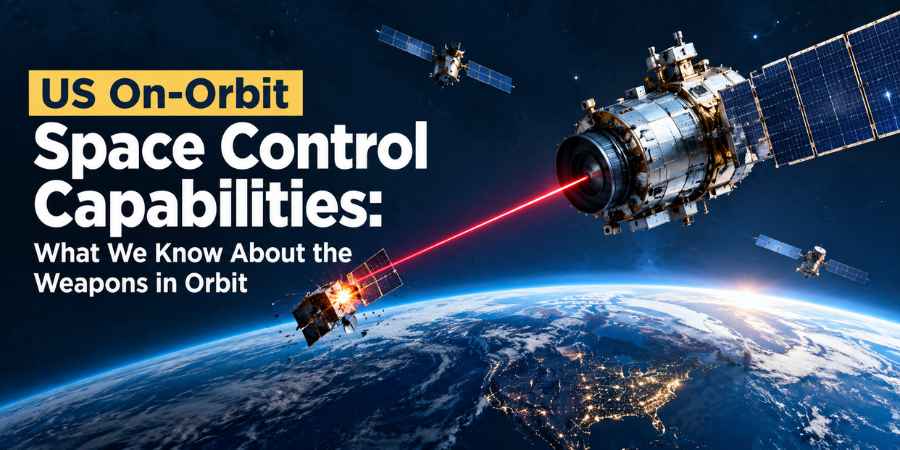
The United States has confirmed that it has deployed “on-orbit space control weapons,” marking the first public acknowledgment that American weapons are already operating in space. U.S. Air Force Secretary Troy Meink made the disclosure at the Air, Space & Cyber Conference on September 14, 2026, but did not identify the systems, their numbers or their specific capabilities.
The announcement puts fresh attention on US on-orbit space control capabilities and the expanding military competition in space involving the United States, China and Russia.
What Are US On-Orbit Space Control Capabilities?
US on-orbit space control capabilities refer to military systems positioned in space that can help protect U.S. forces and respond to hostile activity in orbit.
The Pentagon has not disclosed exactly what weapons are deployed. The Space Force described them as “on-orbit space control weapons,” while Meink said they are intended to defend the joint force.
That leaves an important distinction between what has been confirmed and what is being speculated about.
Confirmed:
- The U.S. says weapons are deployed in orbit.
- They are described as space-control weapons.
- U.S. officials say they can support defense of American forces.
- The Pentagon has not disclosed their exact design or number.
Not confirmed publicly:
- Which satellites or spacecraft carry the weapons.
- How many systems are deployed.
- Their locations and orbits.
- Their specific effects or operating methods.
- Whether particular systems have been tested against targets.
Why Did the US Reveal Its Space Weapons Now?
The disclosure comes as the U.S. military places greater emphasis on protecting satellites and other space infrastructure from China and Russia.
The U.S. Space Force says both countries are developing counterspace capabilities designed to disrupt or degrade American space-based systems. Its latest threat assessment describes China as the principal pacing challenge and says Russia also continues to develop and deploy counterspace systems.
The United States depends heavily on space for communications, navigation, missile warning, intelligence and military operations. GPS alone supports military operations as well as aviation, financial transactions, power grids and other civilian activities.
The disclosure therefore signals that Washington is treating space as an operational military environment rather than simply a communications and surveillance domain.
What Can Space Control Weapons Do?
The exact capabilities of the newly disclosed U.S. weapons remain classified or undisclosed.
More broadly, space-control systems can be designed around several types of military effects, including protecting friendly satellites, disrupting hostile space systems or preventing an adversary from using space-based capabilities effectively.
These capabilities do not necessarily mean missiles destroying satellites.
Modern counterspace operations can involve electronic warfare, cyber operations, directed-energy systems and spacecraft capable of operating close to other objects in orbit. The U.S. Space Force says China and Russia are pursuing capabilities across several of these areas.
That makes the phrase “space weapons” broader than anti-satellite missiles.
Does the US Have Anti-Satellite Weapons?
The latest announcement does not confirm that the newly acknowledged systems are anti-satellite missiles.
The United States has demonstrated anti-satellite capabilities in the past. In 2008, the U.S. military used a modified SM-3 missile to destroy the malfunctioning USA-193 satellite during Operation Burnt Frost.
The current announcement is different because officials are specifically acknowledging weapons already deployed in orbit.
A ground-launched anti-satellite missile can attack an object in space without being permanently stationed there. An on-orbit weapon is itself positioned in space before a conflict or engagement.
How Does China Compare with US Space Capabilities?
China has built a substantial military space and counterspace program, including satellites, electronic warfare capabilities and systems that can potentially interfere with other spacecraft.
The U.S. Space Force says China operates more than 510 intelligence, surveillance and reconnaissance-capable satellites and is expanding its orbital infrastructure. It also says China has demonstrated anti-satellite capabilities and operates ground-based laser and jamming systems.
China destroyed an inactive weather satellite with an anti-satellite missile in 2007, creating a large debris field that remains part of the broader concern surrounding destructive actions in orbit.
Beijing has criticized the U.S. move, arguing that deploying weapons in space could increase instability.
What About Russia’s Space Weapons?
Russia also has a range of counterspace capabilities, according to the U.S. Space Force.
Russia conducted a destructive anti-satellite test in 2021 against a Soviet-era satellite, producing more than 1,500 pieces of trackable debris. The U.S. Space Force also says Russia has deployed suspected orbital anti-satellite prototypes and has developed ground-based systems capable of interfering with satellite sensors.
Russian officials have criticized Washington’s announcement and warned that deploying weapons in orbit could threaten long-term stability in space.
Why Are US On-Orbit Space Control Capabilities Important?
The significance is less about one newly revealed weapon and more about the changing role of space in military planning.
For decades, military satellites largely supported forces operating on Earth. Modern warfare increasingly depends on space-based communications, navigation, intelligence and surveillance.
That creates a vulnerability: if an adversary can disrupt or disable those systems, military operations can be affected without a conventional attack on a ground facility.
The U.S. Space Force says China and Russia are specifically developing capabilities intended to disrupt and degrade American space-enabled operations.
The United States is now publicly acknowledging that it has placed its own space-control weapons in orbit.
What Does the US Space Weapons Announcement Mean?
The announcement does not provide enough information to determine how powerful the new systems are or how they would be used in an actual conflict.
What it does establish is significant:
- The U.S. has publicly acknowledged weapons deployed in orbit.
- The systems are described as supporting space control and defense of U.S. forces.
- Their technical specifications remain undisclosed.
- China and Russia already possess or are developing counterspace capabilities.
- Space is becoming increasingly integrated into military deterrence and defense planning.
The biggest development is therefore the change in what Washington is willing to say publicly. The United States has moved from discussing the need for space-control capabilities to acknowledging that some of those weapons are already in orbit.
Takeaways
- The bigger story is the disclosure, not the weapon itself: The Pentagon has acknowledged that the U.S. already has weapons in orbit, but has deliberately withheld what they are, how many exist and whether they have been tested. That makes the announcement itself the significant development.
- “Space control” is deliberately broad: The term does not automatically mean a satellite-killing missile. Space-control operations can involve electronic warfare, jamming, lasers, cyber capabilities or systems designed to interfere with another spacecraft.
- Deterrence appears to be a major reason for going public: Air Force Secretary Troy Meink said the wording was deliberate and linked the disclosure to deterrence. At the same time, he said revealing technical details would undermine that purpose.
- The U.S. is moving from protecting satellites to preparing to fight over space: American military operations increasingly depend on satellites for communications, navigation, missile warning, sensing and targeting. The Pentagon’s latest language shows that protecting those systems now includes having capabilities that can respond to attacks in orbit.
- The next phase will be about scale: The disclosure comes alongside plans for additional space-based capabilities, including the Space-Based Interceptor program and the Space-Based Air-Moving Target Indication constellation. The U.S. is therefore building a broader space-control architecture rather than relying on a single system.