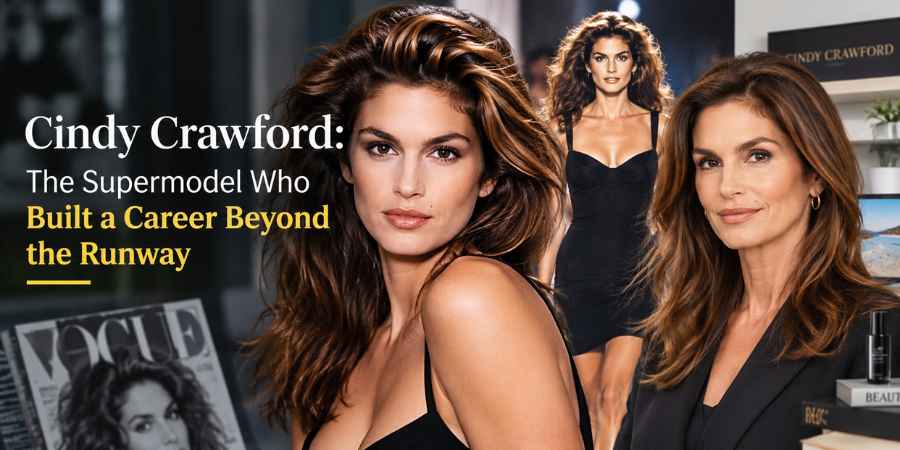
Cindy Crawford is one of the defining supermodels of the 1990s, but her career was never limited to fashion shows and magazine covers. She turned modeling into television work, beauty and home businesses, books, brand partnerships and a lasting place in popular culture.
At 60, Crawford is still working in fashion. In May 2026, she walked the Gucci Cruise 2027 show in New York’s Times Square, where she shared the runway with Paris Hilton and Tom Brady. Days later, she spoke about the experience, including a small wardrobe malfunction that the audience never saw.
That ability to move between generations is part of what makes the Cindy Crawford story different from a standard supermodel biography.
Who is Cindy Crawford?
Cindy Crawford is an American model, television personality, entrepreneur and author who became one of the most recognizable faces of the supermodel era.
She was born on February 20, 1966, in DeKalb, Illinois. Crawford originally studied chemical engineering at Northwestern University after graduating high school as valedictorian, but left college after one term to pursue modeling in New York.
Her career accelerated during the 1980s and early 1990s, when fashion models began becoming celebrities in their own right.
Crawford was part of a group that included Naomi Campbell, Christy Turlington, Linda Evangelista and Tatjana Patitz, helping redefine what a successful model could become outside the traditional fashion industry.
How Did Cindy Crawford Become Famous?
Cindy Crawford became famous through a combination of high-fashion modeling, major magazine covers, advertising campaigns and television exposure.
She was already building a modeling career when the industry began shifting toward the idea of the celebrity supermodel.
One of the most important moments came in 1990, when Crawford appeared alongside Campbell, Turlington, Evangelista and Patitz on the cover of British Vogue. The same group later appeared in George Michael’s “Freedom! ’90” video, turning a fashion story into a pop-culture moment.
Crawford also became a familiar television face as host of MTV’s House of Style. The program gave viewers access to models and fashion in a way that traditional runway shows could not.
It helped establish Crawford as a personality rather than simply a face in a photograph.
Why is Cindy Crawford Considered One of the Original Supermodels?
Crawford became a supermodel because her name itself became commercially valuable.
Before the supermodel era, models were generally the people behind the image. Crawford and her contemporaries increasingly became the image.
She appeared on hundreds of magazine covers, worked with major designers and photographers and became recognizable to people who had little interest in fashion.
Her career included work with brands such as Versace, Calvin Klein, Revlon, Maybelline and Pepsi. Vogue’s retrospective of her career highlights the way her runway work, magazine appearances and advertising helped turn individual fashion moments into part of mainstream culture.
Her trademark beauty mark above her upper lip also became part of her public identity. Crawford has spoken about initially being told to have it removed before embracing it as part of her appearance.
What Was Cindy Crawford’s Famous Pepsi Commercial?
Cindy Crawford’s 1992 Pepsi commercial is one of the most recognizable advertisements of her career.
The original commercial featured Crawford arriving at a roadside convenience store in a white tank top and cut-off jeans before buying a Pepsi.
The simplicity of the advertisement became part of its appeal. Crawford later recalled that the jeans she wore were actually her own, and Vogue noted that the commercial became so closely associated with her that she recreated the concept for Pepsi’s 2018 Super Bowl campaign with her son Presley.
The commercial is still frequently referenced when discussing memorable advertising from the 1990s.
What Did Cindy Crawford Do After Becoming a Supermodel?
Crawford used modeling as a starting point for building businesses and media projects rather than treating it as her only career.
She hosted House of Style, produced fitness videos, wrote books and moved into beauty and home products.
She has described this transition as a deliberate effort to create opportunities beyond traditional modeling. In a British Vogue interview, Crawford explained that models were often expected to have relatively short careers, which encouraged her to think about what would come next.
That approach was unusually important at the time.
Today, models routinely build beauty brands, clothing lines, media businesses and personal brands. Crawford was doing versions of that before the current influencer economy existed.
What is Meaningful Beauty and Is Cindy Crawford Its Founder?
Meaningful Beauty is a skincare brand founded by Cindy Crawford with French cosmetic specialist Dr. Jean-Louis Sebagh.
The idea came from Crawford’s experience with Sebagh and treatments involving antioxidants derived from a rare melon grown in the South of France. Crawford and Sebagh later developed the Meaningful Beauty skincare system around that concept.
The brand’s philosophy is built around what it calls “age maintenance”—taking care of the skin consistently rather than treating aging as something that suddenly needs to be reversed.
Meaningful Beauty says its community has grown to more than five million customers. That figure is a company claim rather than an independently audited measure, so it is best understood as the brand’s own reported customer count.
What is Cindy Crawford’s Approach to Aging and Beauty?
Crawford’s public approach to aging has increasingly focused on consistency rather than trying to maintain the appearance of being a different age.
In recent interviews, she has discussed simple habits, exercise and skincare while acknowledging that her relationship with aging has changed over time.
In September 2026, Real Simple reported that Crawford’s current personal routines include not checking her phone immediately after waking, maintaining a regular approach to skincare and making time for short workouts. She also emphasized realistic fitness rather than treating exercise as an all-or-nothing activity.
That philosophy fits with the broader direction of her business career: beauty as maintenance and confidence rather than a promise to stop aging.
Is Cindy Crawford Still Modeling?
Yes. Crawford continues to take on selected fashion and commercial work.
Her 2026 Gucci Cruise appearance is a recent example. She also remains connected to major fashion brands and has continued to appear in campaigns and editorial features.
Her current work looks different from the nonstop modeling schedule associated with her peak years. She can choose projects that make sense for her at this stage of her career.
That selectiveness is significant because Crawford no longer needs a constant runway schedule to remain commercially relevant.
Who Are Cindy Crawford’s Children?
Cindy Crawford has two children with her husband, businessman Rande Gerber: Presley Gerber and Kaia Gerber.
Both followed their mother into modeling.
Kaia Gerber has developed an independent career as a model and actress, while Presley also modeled for major fashion brands. Crawford has occasionally worked alongside her children, including fashion campaigns and appearances.
In a 2025 interview with PEOPLE, Crawford spoke about being proud of the relationship between her children and recalled how special it was to work together as a family.
Crawford’s influence on the next generation of models is therefore personal as well as professional. Her daughter Kaia has built a recognizable identity of her own rather than simply remaining known as Cindy Crawford’s daughter.
What is Cindy Crawford’s Connection to the 1990s Supermodel Era?
Cindy Crawford represents the point at which fashion models became full-scale cultural celebrities.
The 1990s supermodel group was unusual because the models were recognizable outside fashion magazines. Their names appeared in music videos, television programs, advertising campaigns and entertainment news.
The famous Versace runway show in 1991 remains one of the clearest examples. Crawford walked alongside Naomi Campbell, Christy Turlington and Linda Evangelista to George Michael’s “Freedom! ’90.” Vogue has described the moment as one where fashion, music and pop culture came together.
That model of celebrity changed the fashion business.
A successful model no longer had to remain anonymous behind the designer’s clothes. The personality wearing them could become part of the product’s cultural value.
What Makes Cindy Crawford’s Career Different from Other Supermodels?
Her longevity comes from having built an identity that could exist outside the runway.
Crawford did not rely on one decade of fashion success. She moved into television, fitness, beauty, publishing, interiors and brand partnerships while continuing to model.
She also understood the commercial value of recognizability. Her beauty mark, Pepsi campaign, House of Style appearances and signature off-duty style all became identifiable parts of her public image.
That created something more durable than a conventional modeling résumé.
The fashion industry changed around her, but the name Cindy Crawford remained useful to brands because audiences already knew who she was.
What is Cindy Crawford’s Legacy?
Cindy Crawford’s legacy is larger than her status as a 1990s supermodel.
She helped establish a career model that is now common: build recognition through fashion, then use that recognition to create businesses, media opportunities and long-term partnerships.
Her influence can also be seen in the way today’s models operate. Models are now expected to have personalities, business interests, social audiences and careers that extend beyond runway appearances.
Crawford was navigating that territory decades before social media made personal branding routine.
And she is still working.
At 60, she remains part of fashion’s current conversation while carrying the history of an era when a handful of models became household names. Her career is therefore useful as more than a nostalgia story. It shows how modeling evolved from a job centered on photographs and runways into a platform for building a lasting public identity.