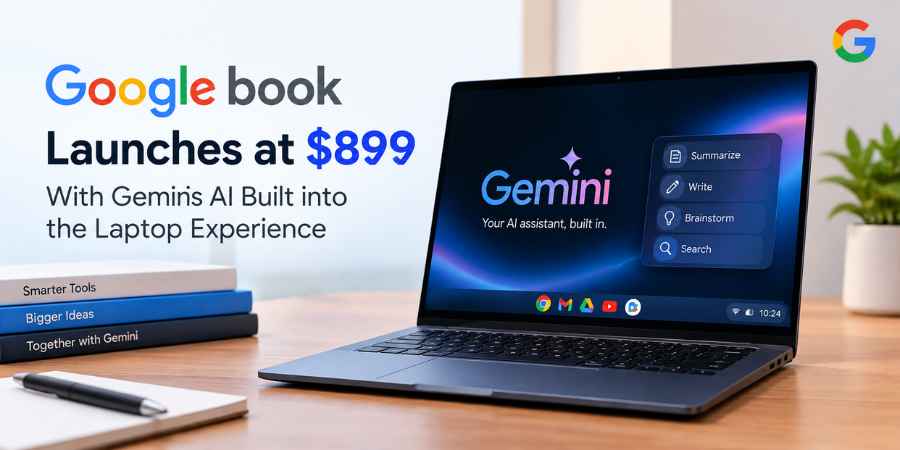
Google is putting Gemini AI at the center of a new laptop category called Googlebook, with the first devices starting at $899 and going on pre-order September 21. Built by Acer, ASUS, Dell, HP and Lenovo, the laptops combine Android’s app ecosystem with desktop elements from ChromeOS and Google’s AI tools.
The launch gives Google a new way to put Gemini in front of users: instead of asking people to open an AI chatbot or install an AI application, Google is building the assistant into the way they use the laptop itself.
The first Googlebooks arrive in U.S. stores on October 4, followed by launches in Canada, the U.K., Ireland, France, Germany and Australia on October 5.
What is Googlebook and How is It Different from a Chromebook?
Googlebook is Google’s new premium laptop category, built around Android, Chrome and Gemini rather than the traditional ChromeOS Chromebook experience.
Google says the platform combines the Android technology stack with desktop foundations from ChromeOS. The company introduced Googlebook in May as its next step after the Chromebook, which Google originally positioned as a cloud-first computer.
The new machines are designed to run native Android apps while also supporting familiar desktop software and workflows.
The starting Acer model includes:
- Intel Core Ultra 5 processor
- 16GB RAM
- 512GB storage
- 14-inch 2.8K OLED touchscreen
- Convertible design
- Google Titan C security
- Up to 16 hours of claimed battery life
Other launch models use Intel Core Ultra 5 or Qualcomm Snapdragon X Elite processors and range from $899 to $1,299.
How Does Gemini Work on the Googlebook?
Google has designed Gemini to work through the laptop interface itself rather than keeping AI in a separate application.
One of the most visible features is Magic Pointer, which lets users use the cursor to select something on the screen and ask Gemini to work with it.
Google gives examples such as selecting content from a webpage, asking Gemini to compare information or using selected images as the starting point for a new creation.
The idea changes the role of the cursor. Instead of simply pointing, clicking and dragging, the pointer becomes another way to call on Gemini.
That sounds like a small interface change, but it reflects Google’s larger strategy: make AI available at the exact point where a person is already working.
What is Rambler on Googlebook?
Rambler is Googlebook’s AI-assisted dictation feature, designed to turn informal speech into cleaner written text.
A user can speak naturally instead of carefully dictating every sentence. Rambler is designed to remove filler and organize the spoken thoughts into more usable text.
For writers, students and people who regularly dictate notes, this may prove more useful in everyday work than some of the flashier AI demonstrations.
It also shows where Google’s laptop strategy is heading. The company is not only adding Gemini as a chatbot; it is trying to make AI part of basic computer actions such as typing, selecting, organizing and creating.
What Other AI Features Does Googlebook Have?
Googlebook also includes vibe-coded widgets, Gemini Live and access to Google’s AI tools across the desktop experience.
The laptops are built with NPUs capable of more than 45 TOPS, allowing supported AI processing to happen on the device. Google also says Gemini can work across a user’s workflow, including information from emails and calendars.
Developers get access to Google’s Antigravity platform and a Linux terminal environment. Google says users can run tools such as Claude Code or Antigravity CLI on the device.
The software is therefore aimed at more than casual AI use. Google is also positioning Googlebook as a machine for development, creative work and more demanding desktop tasks.
How Much Does Googlebook Cost?
The first Googlebook laptops start at $899 and go up to $1,299.
The launch lineup includes:
|
Model |
Starting price |
Processor |
Display |
|
Acer Googlebook 14 |
$899 |
Intel Core Ultra 5 |
14-inch 2.8K OLED |
|
Dell XPS Googlebook |
$999 |
Snapdragon X Elite |
13.4-inch 2.5K LCD |
|
Lenovo Googlebook 15 |
$1,099 |
Intel Core Ultra 5 |
15.3-inch 2.8K OLED |
|
ASUS Googlebook 14 |
$1,299 |
Intel Core Ultra 5 |
14-inch 2.8K OLED |
|
HP Googlebook 14 |
$1,299 |
Snapdragon X Elite |
14-inch 2.8K OLED |
All five launch models come with 16GB of memory and 512GB of storage. Claimed battery life varies by model, from up to 13 hours on the Lenovo to up to 19 hours on the HP under Google’s stated test conditions.
What Do You Get With a $899 Googlebook?
The $899 price includes more than the laptop itself.
Google is bundling 12 months of Google AI Pro, which includes 5TB of cloud storage and advanced Gemini tools. Buyers also receive additional subscriptions and services, including three months of YouTube Premium, Adobe Photoshop and other software offers.
Google says Googlebook devices will receive regular updates for up to 10 years.
That software bundle is part of the product’s value proposition. Google is effectively using the laptop purchase to bring users into a wider collection of Google AI and subscription services.
Is Googlebook Replacing Chromebooks?
Googlebook is positioned as a new premium category rather than an immediate end to Chromebooks.
Google has previously said existing Chromebooks would continue to receive support, while some devices could eventually become eligible to transition to the Googlebook experience. TechCrunch reports that Google sees an especially large opportunity in education, where around 50 million Chromebooks are used in schools, according to Google.
That gives the launch a significance beyond the consumer laptop market.
Google already has an established relationship with schools through Chromebooks. If Googlebook becomes the next step for some of those users, Gemini could gain a much larger presence across students’ and educators’ everyday computing.
Why Is Google Betting on Gemini Hardware?
Googlebook gives Google a way to make Gemini part of the operating environment rather than another application competing for attention.
People already use AI on laptops through websites, desktop applications and browser extensions. Google is betting that tighter integration can make AI more useful because users do not have to stop what they are doing and switch to a separate tool.
That approach also gives Google more control over the hardware and software experience.
The question is whether those conveniences are enough to justify buying a new laptop.
TechCrunch’s analysis points out that features such as Magic Pointer and AI widgets may be useful without necessarily providing a compelling reason for someone with a recent laptop to upgrade.
When Will Googlebook Go on Sale?
Googlebook pre-orders opened September 21, 2026.
The first devices will reach U.S. stores on October 4. Availability follows on October 5 in Canada, the U.K., Ireland, France, Germany and Australia.
Google’s initial hardware partners are:
- Acer
- ASUS
- Dell
- HP
- Lenovo
The five manufacturers give Googlebook a broader hardware lineup from launch instead of limiting the platform to a single Google-branded laptop.
What Does Googlebook Mean for the Laptop Market?
Googlebook arrives at a point when laptop makers are increasingly treating AI as part of the computer rather than an optional software feature.
Microsoft has pushed Copilot into Windows PCs, Apple has integrated Apple Intelligence across its devices, and Google is now taking a different route by combining Android, Chrome, Gemini and laptop hardware in one platform.
The more interesting part of Googlebook is therefore not simply its $899 starting price. Google is testing whether AI can become a reason to replace a perfectly functional laptop.
For now, the hardware looks like a conventional premium laptop with modern processors, OLED displays and long battery-life claims. The bigger change is happening in the software: Google wants the cursor, voice input, phone connection, apps and everyday desktop tasks to become entry points for Gemini.
If users adopt that workflow, Googlebook could become more than a successor to the Chromebook. It could become Google’s attempt to redefine what people expect a laptop to do when an AI assistant is built into the operating system from the start.