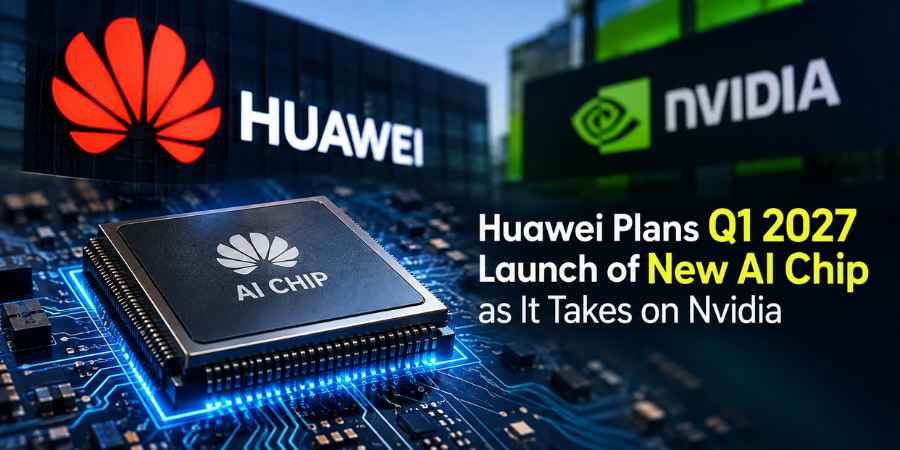
Huawei is bringing forward the launch of its next-generation AI chip as the Chinese technology company pushes deeper into the artificial intelligence hardware market dominated by Nvidia.
The Huawei AI chip, called the Ascend 960DT, is now expected to be ready in the first quarter of 2027, three quarters earlier than the company’s previous schedule. Huawei announced the updated timeline at its Huawei Connect conference in Shanghai on September 17.
The move comes as China continues to build its own AI computing infrastructure amid U.S. restrictions on access to advanced foreign semiconductors.
When Will Huawei Launch the Ascend 960DT?
Huawei plans to have the Ascend 960DT AI chip ready in Q1 2027. The company had previously targeted the third quarter of 2027 for the chip.
Huawei also plans to release the Ascend 960PR in the third quarter of 2027, one quarter earlier than previously planned. The company said it intends to continue releasing new generations of Ascend processors, with the Ascend 970 and 980 expected in 2028 and 2029.
Huawei spokespersons said the 960 series is expected to deliver roughly double the performance of earlier generations.
Why is Huawei Developing New AI Chips?
Huawei is trying to build a larger domestic alternative to Nvidia’s AI computing hardware.
The company is already seeing strong demand in China. Huawei rotating chairman Eric Xu said the company cannot currently produce enough AI computing equipment to meet domestic demand and has therefore kept overseas sales limited. He also said Huawei has no immediate plan for a major international expansion because of those capacity constraints.
Xu said Huawei’s Ascend chips may already have a larger share of China’s AI chip market than Nvidia’s, although Huawei did not provide data to support that claim.
How is Huawei Trying to Compete with Nvidia?
Huawei is taking a different approach to the limits of individual AI chips. Instead of relying only on making a more powerful processor, the company is working on systems that connect large numbers of processors and allow them to operate together.
Its new Peerium Computing Architecture is designed to eventually link as many as 1 million AI processors in a single computing system. Huawei’s UnifiedBus technology connects processors with memory, storage and networking equipment.
Huawei said clusters of around 100,000 chips are already becoming common for training some of the largest AI models. Communication between machines can consume more than 40% of training time in conventional server systems, according to the company.
The new architecture is intended to reduce that bottleneck.
What Does the Huawei AI Chip Push Mean for China?
Huawei’s chip strategy has become part of China’s broader effort to reduce its dependence on foreign semiconductor technology.
U.S. restrictions have limited China’s access to some advanced Nvidia chips and semiconductor manufacturing technology. Huawei has faced U.S. trade restrictions since 2019.
The company has already deployed more than 1,000 systems using its earlier Ascend 910C processors. Huawei also said more than 5,200 developers were active each month on software for its Ascend chips, with more than 40 AI models trained directly on its platform.
Can Huawei Catch Nvidia in AI Chips?
Huawei’s progress gives it a stronger position in China’s domestic AI hardware market, but it still faces major challenges.
Nvidia retains a significant software advantage through CUDA, its widely used platform for developing and running AI applications. Huawei is therefore competing on more than chip performance. Its ability to build large computing systems, attract developers and scale production will also shape how far its AI chip business can go.
For now, the accelerated Huawei AI chip roadmap shows that the company is moving quickly. The Ascend 960DT’s Q1 2027 launch will be an important test of Huawei’s ability to turn its growing domestic demand into a larger AI computing ecosystem.
Key Takeaways
- Huawei is dealing with a supply problem of its own. The company says demand for its AI computing equipment in China currently exceeds what it can produce, which is limiting how quickly it can expand beyond the domestic market.
- Huawei is building around networking as much as chip performance. Its strategy increasingly focuses on connecting large numbers of processors so they can function as a larger computing system. That approach helps address the practical limits of relying on a single accelerator.
- The domestic customer base is already significant. Huawei has shipped more than 1,000 AI-computing systems to more than 370 customers, giving its Ascend platform an installed base that goes beyond a purely experimental alternative to Nvidia.
- Software remains a major part of the competition. Nvidia’s CUDA ecosystem has been built up over many years, so matching hardware performance alone does not automatically give Huawei the same developer reach. Huawei is therefore also trying to expand its own AI software ecosystem.
- China’s AI hardware market is becoming more self-contained. Export restrictions have made access to some advanced Nvidia technology more difficult, while Chinese companies are increasing investment in domestic alternatives. Huawei’s progress is part of that broader shift rather than an isolated product launch.
- Huawei is planning for increasingly large AI models. Company leadership has pointed to Chinese AI developers working toward models with dramatically larger parameter counts, increasing the need for computing systems that can connect many processors efficiently.
- The next battleground may be the whole AI infrastructure stack. The competition is moving beyond individual chips toward processors, memory, networking, interconnects, software and large-scale computing clusters. Huawei’s announcements show how Chinese companies are approaching AI infrastructure as an integrated system.
- Huawei’s international expansion is not the immediate priority. Despite its ambitions, the company’s current production constraints mean that meeting Chinese demand is taking precedence over aggressively selling its AI systems worldwide.
Reference: https://techcrunch.com/2026/09/17/huawei-plans-q1-2027-launch-of-new-ai-chip-as-it-takes-on-nvidia/