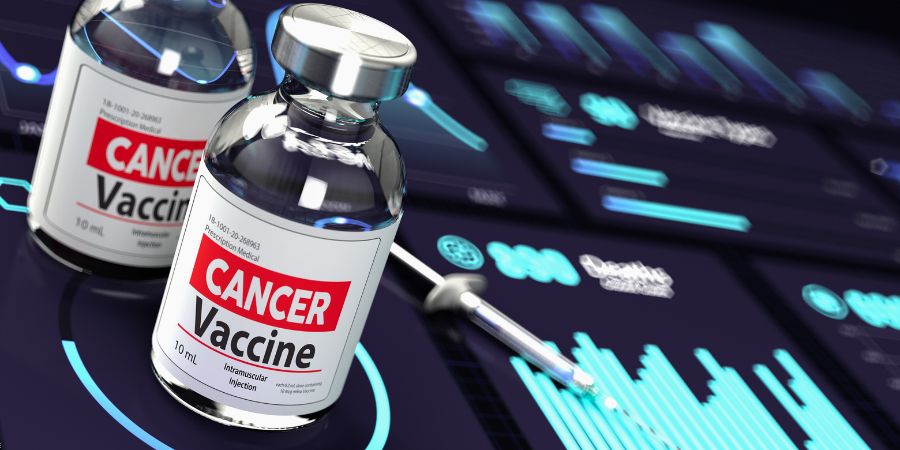
Moderna and Merck announced on August 19, 2026 that their personalised mRNA cancer vaccine, intismeran, combined with Merck’s immunotherapy Keytruda, successfully met the primary endpoints of a Phase 3 clinical trial in melanoma patients.
People who received both treatments lived longer without cancer recurrence and experienced fewer cases of distant cancer spread compared to patients who received Keytruda alone, the current standard of care for post-surgical melanoma.
What is the Moderna and Merck mRNA Cancer Vaccine?
The Moderna mRNA cancer vaccine, called intismeran, is a personalised therapeutic vaccine that uses mRNA technology to teach a patient’s immune system to recognise and attack their specific tumour mutations. It is not a preventive vaccine, it is designed for people already diagnosed with cancer.
Unlike a standard drug, intismeran is built individually for each patient. Scientists analyse the patient’s tumour, identify the mutations driving cancer growth, create mRNA sequences encoding those mutations, and inject them back into the patient. The immune system then learns to recognise those tumour signals, the same way it responds to a virus, and targets cells carrying them.
“What we’re trying to do here is to tell the immune system that it missed the signature of the tumour cell if you have cancer,” Moderna CEO Stephane Bancel told TIME. “This product basically allows us to teach the immune system about the mutation in your cancer that allows the cancer to grow.”
The speed of the mRNA platform is central to why this approach works at scale. Generating personalised genetic sequences takes weeks, fast enough to be clinically meaningful, which was not possible with older vaccine technologies.
What Did the Phase 3 Cancer Vaccine Trial Results Show?
The Phase 3 trial of intismeran plus Keytruda met both primary endpoints, recurrence-free survival (RFS) and distant metastasis-free survival (DMFS), in 1,137 patients with stage 2 to stage 4 melanoma after surgery. The combination outperformed Keytruda alone on both measures. Specific survival rate figures have not yet been released pending full publication.
The study is the largest trial of a personalised mRNA cancer therapy ever conducted.
Earlier Phase 2 data, presented at ASCO, one of oncology’s most significant annual conferences, showed the combination:
- Lowered the risk of recurring melanoma by 49% compared to Keytruda alone.
- Lowered the risk of distant cancer spread or death by 59% compared to Keytruda alone.
Phase 3 results confirmed those findings held across a significantly larger patient population. That distinction matters enormously in clinical medicine. Phase 2 data is directional. Phase 3 data on more than 1,000 patients is what regulators, oncologists, and hospital systems act on.
How Does mRNA Cancer Treatment Work Differently from Traditional Cancer Treatment?
Traditional cancer treatment, chemotherapy, radiation, or surgery, attacks cancer cells physically or chemically. mRNA cancer therapy works by programming the patient’s own immune system to identify and destroy cancer cells from within, using the tumour’s unique genetic fingerprint as a target.
Here is the key difference in practice:
|
Approach |
How It Works |
Patient-Specific? |
|
Chemotherapy |
Kills rapidly dividing cells broadly |
No |
|
Radiation |
Damages cancer cell DNA locally |
No |
|
Keytruda (immunotherapy) |
Unmasks cancer cells hidden from immune system |
No |
|
Intismeran (mRNA vaccine) |
Teaches immune system to target specific tumour mutations |
Yes, built per patient |
|
Combination (intismeran + Keytruda) |
Unmasks and targets, dual mechanism |
Partially |
Keytruda works by removing the disguise cancer cells use to evade immune detection. Cancer cells begin as normal human cells, which is why the immune system often fails to flag them. Keytruda strips away that camouflage. Intismeran then gives the immune system a precise picture of what to look for.
Together, they appear to do something neither does as effectively alone.
Is the mRNA Cancer Vaccine Approved by the FDA?
No. Intismeran is not yet FDA-approved. It remains an experimental therapy available only through clinical trials. Merck’s Keytruda, the immunotherapy used alongside intismeran, was first approved for melanoma treatment in 2014 and received approval specifically for post-surgical melanoma in 2019.
The study design reflects that regulatory reality. Because intismeran is experimental, trial participants needed to receive the approved standard of care.
“It would be unethical for us to tell people to come on a study of something that we don’t know if it works, when people are fighting for their lives,” Bancel said. “That’s why we did the study together with Keytruda, which can improve outcomes, and we tried to show that the combination was better, and we did.”
Regulatory submissions to the FDA are expected to follow the Phase 3 announcement. No specific timeline has been confirmed.
Can the mRNA Cancer Vaccine Work for Other Cancers Beyond Melanoma?
Moderna is already studying intismeran across 9 ongoing clinical trials in lung cancer, kidney cancer, pancreatic cancer, and bladder cancer. Early-stage data in lung cancer is being actively collected. The mRNA mechanism is not tumour-specific, it works by targeting mutations, which all cancers carry.
Bancel is direct about the scientific logic: “From a scientific standpoint there is no scientific sense that it would work in melanoma and not work in another tumour type.”
His longer-term vision is striking:
“Think about if you get a screening X-ray and find stage 1 lung cancer. Then you get intismeran, which is like a vaccine so you have no severe toxicity like with other immunotherapy. Think about getting this product on your way to work, or even potentially at your local pharmacy, that would be an incredible change in care.”
That picture, a personalised cancer vaccine administered as routinely as a flu shot, remains years away from reality. But for the first time, the clinical data is pointing in that direction rather than simply hypothesising it.
What Do the Results Mean for Moderna’s Future?
The Phase 3 intismeran results are the most significant positive clinical news Moderna has reported since its COVID-19 vaccine. The company has been navigating falling COVID vaccine revenues, a 10% workforce reduction in 2025, and lost government pandemic preparedness contracts. The mRNA cancer vaccine results give Moderna a credible post-pandemic pipeline story.
The company laid off between 500 and 800 employees in 2025 after a combination of declining COVID shot sales and the cancellation of government contracts to develop mRNA flu vaccines. In early August 2026, the FDA approved Moderna’s mRNA flu vaccine, the first of its kind, though only after initially refusing to review the submission.
The intismeran Phase 3 announcement, released less than two weeks later, is the clearest signal yet that Moderna’s mRNA technology platform has meaningful oncology applications, not just infectious disease ones.
For Merck, Keytruda is already one of the best-selling cancer drugs in history. Adding intismeran to its approved indication would extend the drug’s utility and commercial life well beyond its existing approvals.
FAQs: mRNA Cancer Vaccine 2026
What is the mRNA cancer vaccine?
The mRNA cancer vaccine from Moderna is called intismeran. It is a personalised therapeutic vaccine that uses mRNA sequences built from a patient’s own tumour mutations to train the immune system to attack cancer cells. It is used in combination with Merck’s immunotherapy Keytruda in current trials.
Is the Moderna cancer vaccine available to patients?
Not yet. Intismeran is currently experimental and only accessible through clinical trials. FDA approval has not been granted. Regulatory submissions are expected following the Phase 3 results announced on August 19, 2026.
How effective is the mRNA cancer vaccine?
Earlier Phase 2 data showed the intismeran and Keytruda combination reduced the risk of melanoma recurrence by 49% and reduced the risk of distant cancer spread or death by 59%, compared to Keytruda alone. Phase 3 results confirmed the combination met both primary survival endpoints in 1,137 patients.
What cancers can the mRNA vaccine treat?
Melanoma is the current focus, with Phase 3 data published in 2026. Moderna has nine ongoing studies covering lung cancer, kidney cancer, pancreatic cancer, and bladder cancer. Results from those trials are expected over the next several years.
How is the Moderna cancer vaccine different from a COVID vaccine?
The COVID mRNA vaccine is preventive, it prepares the immune system before infection. The mRNA cancer vaccine is therapeutic, it is given after a cancer diagnosis to help the immune system fight a tumour already present. Both use mRNA technology, but for entirely different purposes.
When will the mRNA cancer vaccine be approved?
No FDA approval timeline has been confirmed. Moderna and Merck are expected to submit the Phase 3 results to regulatory agencies. Approval, if granted, would likely come in 2027 at the earliest, depending on the speed of regulatory review.
Is the cancer vaccine a cure for melanoma?
The data does not support describing intismeran as a cure. It significantly reduces the risk of recurrence and distant spread in post-surgical melanoma patients. Whether it produces long-term cancer-free outcomes across a broader patient population will require longer follow-up data.
What Comes Next for the mRNA Cancer Vaccine?
The immediate next step is regulatory submission. Moderna and Merck are expected to file the Phase 3 data with the FDA and other global regulators, though no deadline has been announced publicly.
In parallel, the nine ongoing intismeran studies across other cancer types will continue generating data. The lung cancer studies, both stage 1 and stage 3, are the most closely watched, given how common and deadly lung cancer is globally.
Bancel has also indicated Moderna is exploring intismeran as a standalone therapy, potentially in earlier-stage cancers where combining it with Keytruda would not be ethically required because the patients have no existing approved standard of care.
The personalised cancer vaccine concept has been theorised for decades. The mRNA platform, proved at scale during the COVID-19 pandemic, is now providing the delivery mechanism that earlier attempts lacked. Whether the Phase 3 melanoma results translate across tumour types will define whether intismeran becomes a specific melanoma drug or something significantly larger.
The next round of data will answer that.